Click on the poster to register:


Click on the poster to register:
Watching Pete Townshend wailing on his Fender Stratocaster last night at the Verizon Center reminded of what I’d read about Fender’s history. Part of the Fender story regards how the firm got hammered by Japanese competition in the 1970s, but then bounced back by refocusing on quality. So while I was listening to “Won’t Get Fooled Again,” I’m embarrassed to say I was pondering Donald Trump’s misguided statements favoring protectionism.

As president, Trump suggests he’d block imports from China, Mexico, and even Japan. But what Trump does not seem to realize is that import competition makes American companies stronger. To make America great again, we need both import competition and domestic policy reforms, including slashing the corporate tax rate to 15 percent, as Trump is advocating.
Let’s look at a bit of history. American firms Fender and Gibson have long been the dominant electric guitar makers. But both firms were in decline in the 1970s, as quality fell and import competition increased. Leo Fender had sold his guitar company to conglomerate CBS in 1965, and within a few years musicians began noticing substantial drops in product quality. A similar decline happened at Gibson in the 1970s, which was also controlled at the time by an ineffective corporate parent.
Japanese guitar firm Ibanez saw an opportunity. It had expanded into electric guitars in the 1960s with the idea of making cheaper copies of American products. But by the 1970s, the firm realized that it could make higher-quality products than the Americans, but at lower cost. And like Honda and Toyota in automobiles, Ibanez focused on product innovation, while the American firms rested on their laurels. Ibanez’s strategy succeeded, and today it is one of the top guitar firms.
By the 1980s, Gibson was “floundering” and “might well have gone under,” noted an article in Guitar World. And Fender was “all but dead,” according to the company’s official history. But America’s capital markets came to the rescue. Fender was bought out in 1985, and Gibson in 1986, by teams of investors determined to revive the firms’ traditions of quality. Today, Fender and Gibson are back on top of this competitive industry.
By the way, the weakness of Fender and Gibson also prompted American entrepreneurs to enter the fray. Randall Smith started guitar amplifier company Mesa Boogie in his California workshop in the late 1960s. Smith told Guitar World that he saw the decline of Fender and Gibson in the 1970s, and he was determined to “avoid that fate and remain dedicated to the instruments and the musicians that play them.” Smith’s company went on to invent an array of new features for guitar amps that have become standard in the industry.
Hartley Peavey has a similar story. As a teenager in Meridian, Mississippi, Peavey began building guitars and amps for his friends, which led to his founding Peavey Electronics in 1965. He wanted to offer consumers better value for money than the gear on the market at the time. Peavey used innovative manufacturing techniques to keep his costs down and to challenge Fender and Gibson with quality guitars at lower prices. Today, Peavey is one of the largest names in amps and guitars, and it ships many of its products worldwide from factories in Mississippi.
In sum, Trump is singing the right song on corporate taxes, but don’t be fooled by his rhetoric on trade.
For more on guitars, see here.
It’s very hard to be optimistic about Japan. I’ve even referred to the country as a basket case.
But my concern is not that the country has been mired in stagnation for the past 25 years. Instead, I’m much more worried about the future. The main problem is that Japan has the usual misguided entitlement programs that are found in most developed nations,
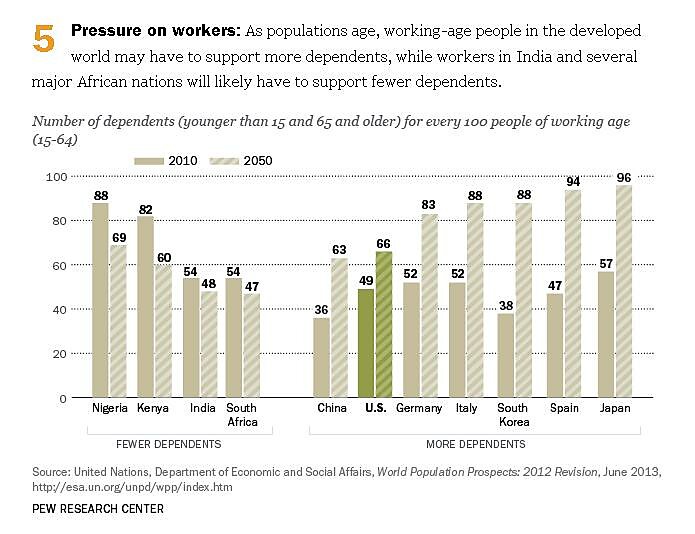
but has far-worse-than-usual demographics. That’s not a good long-term combination.
As I repeatedly point out in my speeches and elsewhere, a modest-sized welfare state can be sustained in a nation with a population pyramid. But even a small welfare state is a challenge for a country with a population cylinder. And it’s a crisis for a jurisdiction such as Japan that will soon have an upside-down pyramid.
To make matters worse, Japanese politicians don’t seem overly interested in genuine entitlement reform. Instead, most of the discussion (egged on by the tax-free bureaucrats at the OECD) seems focused on how to extract more money from the private sector to finance an ever-growing public sector.
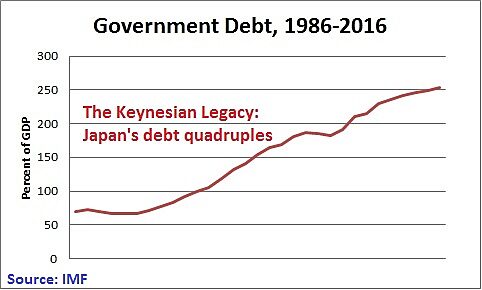
But the icing on the cake of bad policy is that Japanese politicians are addicted to Keynesian economics. For more than two decades, they’ve enacted one “stimulus package” after another. None of these schemes have succeeded. Indeed, the only real effect has been a quadrupling of the debt burden.
The Wall Street Journal shares my pessimism. Here’s some of what was stated in an editorial late last year.
Japan is in recession for the fifth time in seven years, and the…Prime Minister who promised to end his country’s stagnation is failing at the task. …Mr. Abe’s economic plan consisted of three “arrows,” starting with fiscal spending and monetary easing. The result is a national debt set to hit 250% of GDP by the end of the year. The Bank of Japan is buying bonds at a $652 billion annual rate, a more radical quantitative easing than the Federal Reserve’s. …The third arrow, structural economic reform, offered Japan the only hope of sustained economic growth. …But for every step Mr. Abe takes toward reform, one foot remains planted in the political economy of Japan Inc. In April 2014, Mr. Abe acquiesced to a disastrous three percentage-point increase in the value-added tax, to 8%, pushing Japan into its first recession on his watch. More recently, he has pushed politically popular but economically ineffectual spending measures on child care and help for the elderly. …only 25% of the population now believes Abenomics will improve the economy. Reality has a way of catching up with political promises.
You might think that even politicians might learn after repeated failure that big government is not a recipe for prosperity.
But you would be wrong.
Notwithstanding the fact that Keynesian economics hasn’t worked, Japanese politicians are doubling down on the wrong approach.
According to a report from Bloomberg, American Keynesians (when they’re not busing giving bad advice to Greece) are telling Japan to dig a deeper hole.
Paul Krugman urged Japanese Prime Minister Shinzo Abe to…expand fiscal stimulus to revive the economy.
Reuters filed a similar report:
U.S. economist Paul Krugman said on Tuesday he advised Japan’s Prime Minister Shinzo Abe to…boost fiscal spending… Krugman’s advice was the same as that which fellow U.S. economist Joseph Stiglitz gave Abe last week.
Indeed, there apparently was a consensus for bigger government:
Every one of the economists that Prime Minister Shinzo Abe has invited here for a series of meetings with policymakers has recommended that Japan let loose government spending… When Abe asked why consumer spending has remained feeble since the 2014 consumption tax increase, the U.S. academic suggested the answer lies in expectations that fiscal stimulus will end. …Abe’s government…appears to be seeking to rally the G‑7 for aggressive fiscal policy.
So why did the Japanese government create an echo chamber of Keynesianism? Perhaps because politicians want an excuse to buy votes with other people’s money.
With an upper house election looming in July, ruling coalition lawmakers also are eager to dole out massive public spending.
And it appears that Japanese politicians are happy to take advice when it’s based on their spending vice ostensibly being a fiscal virtue. That’s not too shocking, but the Keynesian scheme that’s being prepared is a parody even by Krugmanesque standards.
Japan’s government is considering handing out gift certificates to low-income young people in a supplementary budget for fiscal 2016 as consumer spending remains sluggish on a slow wage recovery, the Sankei Shimbun newspaper reported Thursday. Government officials believe certificates for purchasing daily necessities would lead to spending, unlike cash handouts which could be saved… The additional fiscal program would follow a similar measure for seniors and the ruling coalition would use it to gain voter support before the Upper House election expected in July, the daily said.
Maybe the politicians will succeed in buying votes, but they shouldn’t expect better economic performance. Giving people gift certificates won’t alter incentives to work, save, and invest (the behaviors that actually result in more economic output).Indeed, on the margin, these handouts may lure a few additional people out of the labor force.
The plan is foolish, even from a Keynesian perspective. Since money is fungible, do these people really think gift certificates will encourage more spending that cash handouts?
By the way, another reason to be pessimistic about Japan is that there apparently aren’t any politicians who understand economics. Or, at least, there aren’t any that want good policy. The opposition party isn’t opposed to Keynesian foolishness. Instead, it’s leader is only concerned about who gets the goodies.
Katsuya Okada, the leader of the main opposition Democratic Party of Japan, said in parliamentary debate in January. “Elderly people are not the only ones who are suffering. Among the working generation, only a limited number of people are feeling the fruit of Abenomics.”
The bottom line is that Japan will become another Greece at some point. I’m not smart enough to know whether that will happen in five years or twenty-five years, but barring a radical reversal in government policy, the nation is in deep long-run trouble.
P.S. Though I have to give the Japanese government credit for being so incompetent that it introduced a giveaway program that was so poorly designed that nobody signed up for the handout.
P.P.S. And Japan also wins the prize for what must be the world’s oddest regulation.
South Dakota Gov. Dennis Daugaard signed a scholarship tax credit (STC) bill into law today, making the Mount Rushmore State the 29th state to enact a private school choice law, and the 21st to enact STCs. However, while an important step in the right direction, the number of students who will be able to receive tax-credit scholarships is vanishingly small.
South Dakota’s Partners in Education Tax Credit Program provides tax credits to insurance companies that contribute to nonprofit scholarship organizations that help low-income families pay tuition at the school of their choice. According to the Friedman Foundation, nearly four in ten South Dakota families meet the income eligibility requirements (150 percent of the federal poverty line, or about $67,000 for a family of four in 2015–16), but only a tiny fraction of eligible students will actually receive scholarships because the law only provides a total of $2 million in tax credits. With a scholarship cap equal to 82.5 percent of the state’s per-pupil expenditure at district schools, the maximum scholarship value in 2015–16 will be $4,023. That means that in a state with about 147,000 K‑12 students–nearly 16,000 of whom are enrolled in private schools–only 500 students could receive scholarships worth $4,000.
That’s great for the one-third of one percent of South Dakota students who might get a scholarship, but it’s hardly revolutionary.
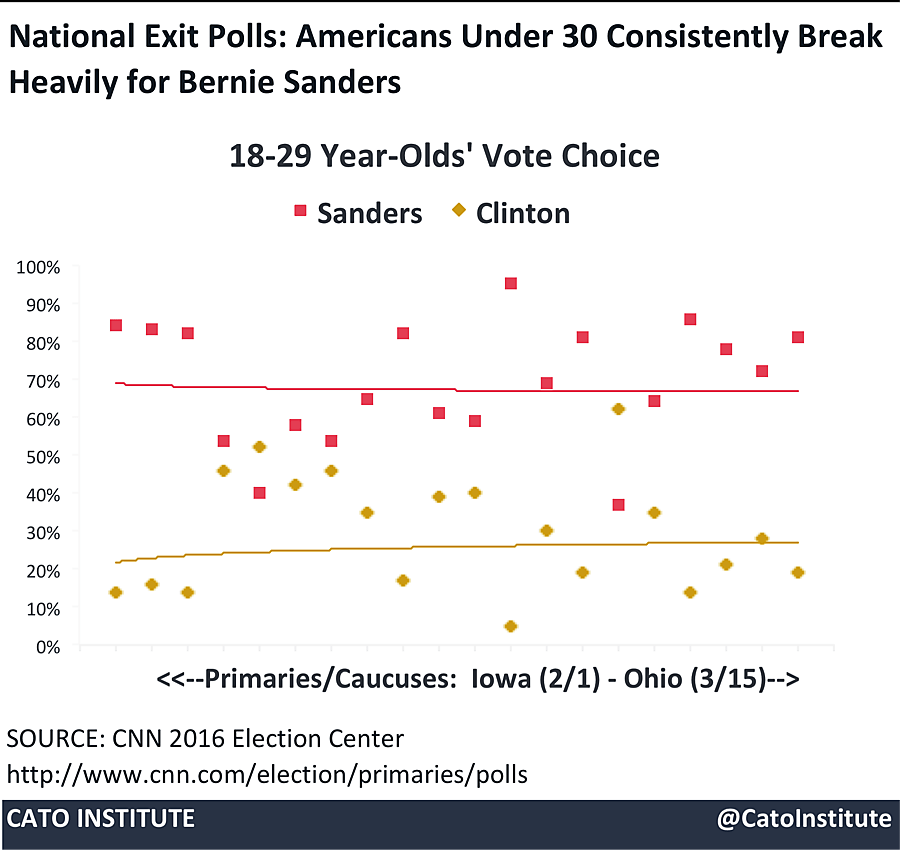
National exit polls show that Democratic presidential candidate Bernie Sanders has captured many of the hearts and minds of the young Democratic electorate. Fully 70–80% of young Democrats, under the age of 30, are casting their ballots for Sanders over Hillary Clinton in state primaries and caucuses.
Many young people are drawn to Sanders’ vision of Democratic socialism. First, they don’t associate socialism with Soviet-style command and control economies with long bread lines and political repression. Instead, millennials associate the basic concept of socialism with Scandinavia. They like the idea of these countries’ large social welfare programs where government plays an active role in providing for people’s needs. Indeed, young people are the only cohort in which a majority—52%—support a “bigger government providing more services” compared to 38% of Americans overall.
Are young people the first generation to support activist government in their youth? Not in the least.
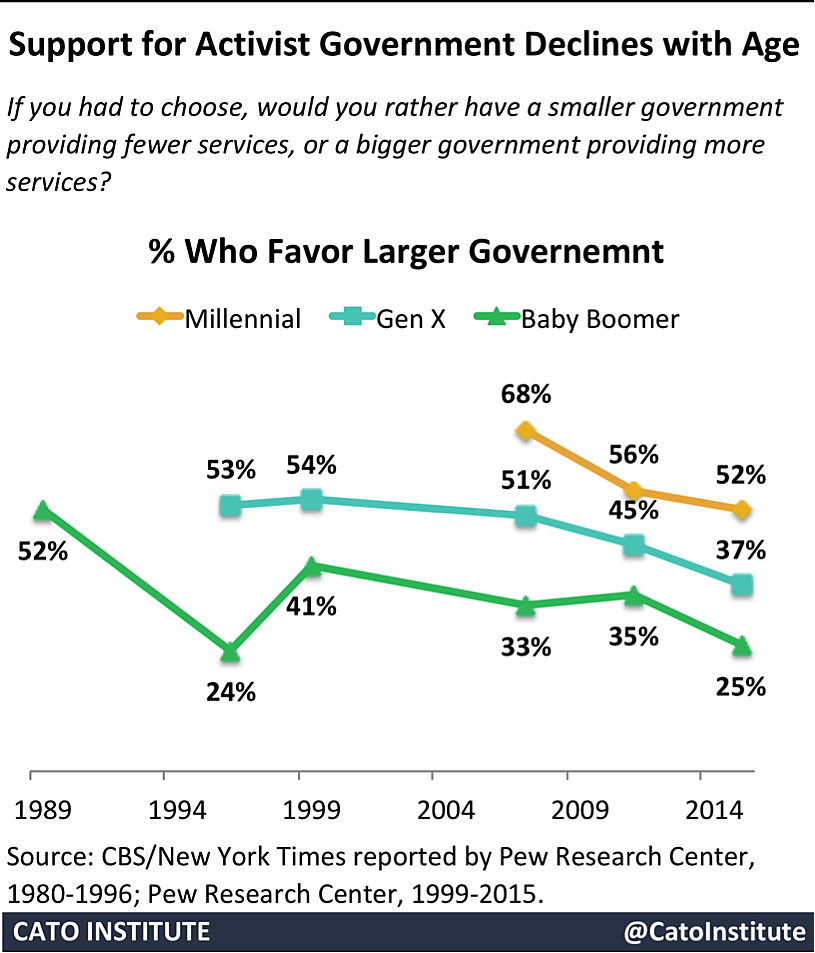
When Gen Xers were in their 20s during the 1990s they too preferred “bigger government providing more services” at about the same level as millennials today (~53%). Baby Boomers in their 30s during the 1980s also preferred bigger government (52%). However, about the time as both Baby Boomers and Gen Xers began entering their 40s, both groups began to prefer smaller government with fewer services. Today, 37% of Gen Xers and 25% of Baby Boomers continue to favor larger government.
It appears that as Americans get older, get promoted at their jobs, make more money, and start paying higher taxes, they become less thrilled with the idea of activist government.
It should be noted that back in 2007, when millennials were nearly 10 years younger than today, the Pew Research Center found fully 68% in support of a larger government offering more services. Is this an outlier? No poll conducted of previous generations in their youth ever identified such strong support for active government. This could be a function of fewer polls being conducted in the 1980s and 90s, and that we don’t have comparable polls of Baby Boomers when they were college-aged. Moreover, millennials were much younger in 2007, with the oldest being only 26. Perhaps given how high support used to be, it’s remarkable that support has declined so quickly.
Overall, these results tend to compliment other evidence that indicate that as millennials get older, get jobs, make more money, and pay more in taxes, they, like generations before them, become less keen on activist government.
Global Science Report is a weekly feature from the Center for the Study of Science, where we highlight one or two important new items in the scientific literature or the popular media. For broader and more technical perspectives, consult our monthly “Current Wisdom.”
—
Atmospheric concentrations of methane (CH4)—a greenhouse gas many times more potent than carbon dioxide (at least over shorter time scales)—have begun rising after a hiatus from 1999–2006 that defied all expectations. No one knows for sure why—why they stood still, or why they started up again.
There is a lot of research underway looking into the causes of the observed methane behavior and at least three new studies have reported results in the scientific literature in the past couple of months.
The findings are somewhat at odds with each other.
In February, a study led by Alex Turner, from Harvard University’s School of Engineering and Applied Sciences, was published that examined methane emissions from the US over the past 10 years or so. The researchers compared observations taken from orbiting satellites to observations made from several sites on the earth’s surface. They reported over the past decade “an increase of more than 30% in US methane emissions.” And this increase was so large as to “suggest that increasing US anthropogenic methane emissions could account for up to 30–60% of [the] global increase.”
However, the methodologies employed by Turner et al. were insufficient for determining the source of the enhanced emissions. While the authors wrote that “[t]he US has seen a 20% increase in oil and gas production and a 9‑fold increase in shale gas production from 2002 to 2014” they were quick to point out that “the spatial pattern of the methane increase seen by [satellite] does not clearly point to these sources” and added that “[m]ore work is needed to attribute the observed increase to specific sources.”
Perhaps most interestingly, Turner and colleagues note that “national inventory estimates from the US Environmental Protection Agency (EPA) indicate no significant trend in US anthropogenic methane emissions from 2002 to present”—a stark contrast to their findings, and a potential embarrassing problem for the EPA. But, never fear, the EPA is on it. The EPA is now actively re-examining its methane inventory and seems to be in the process of revising it upwards, perhaps even so much as to change its previous reported decline in methane emissions to an increase. Such a change would have large implications for the US’s ability to keep the pledge made at the U.S. 2015 Climate Conference in Paris.
However, the Turner et al. results have been called into question by a prominently-placed study in Science magazine just a couple of weeks later. The Science study was produced by a large team led by Hinrich Schaefer of New Zealand’s National Institute of Water and Atmospheric Research.
Schaefer and colleagues analyzed the changes in the isotopic ratios of carbon in the methane contained in samples of air within ice cores, archived air samples, and more recent measurement systems. Different sources of methane contain different mixtures of methane isotopes, related to how long ago the methane was formed. Using this information, the authors developed a model for trying to back out the methane sources from the well-mixed atmospheric samples. Although such a procedure is somewhat tunable (i.e., you can get pretty much any answer you want (kind of like climate models!)), the authors are pretty confident in their final results.
What they determined was that prior to the 1999–2006 hiatus, methane emissions largely bore a chemical signature of fossil fuels. This signal diminished during the hiatus, and has not shown much of an increase since, despite the post-2006 renewed growth in global methane emissions. Instead, Schaefer’s team found a strong chemical signal pointing to biogenic sources of methane being behind the current rise—most pointedly, emissions from agriculture (including both rice paddies and animal husbandry).
Despite the rather surprising nature of this conclusion, the authors are resolute:
The finding of a predominantly biogenic post-2006 increase is robust. Further, it seems likely that fossil-fuel emissions stagnated or diminished in the 1990s. Importantly, they are a minor contributor to the renewed [CH4]-rise. This contradicts emission inventories reporting increases of all source types between 2005 and 2010 with a major (~60%) thermogenic [fossil fuels] contribution… The finding is unexpected, given the recent boom in unconventional gas production and reported resurgence in coal mining and the Asian economy. Our isotope-based analysis suggests that the [CH4]-plateau marks not a temporary suppression of a particular source but a reconfiguration of the CH4-budget. Either food production or climate-sensitive natural emissions are the most probable causes of the current [CH4]-increase. These scenarios may require different mitigation measures in the future.
It is very hard to reconcile the results of Schaefer et al. with those of Turner et al.
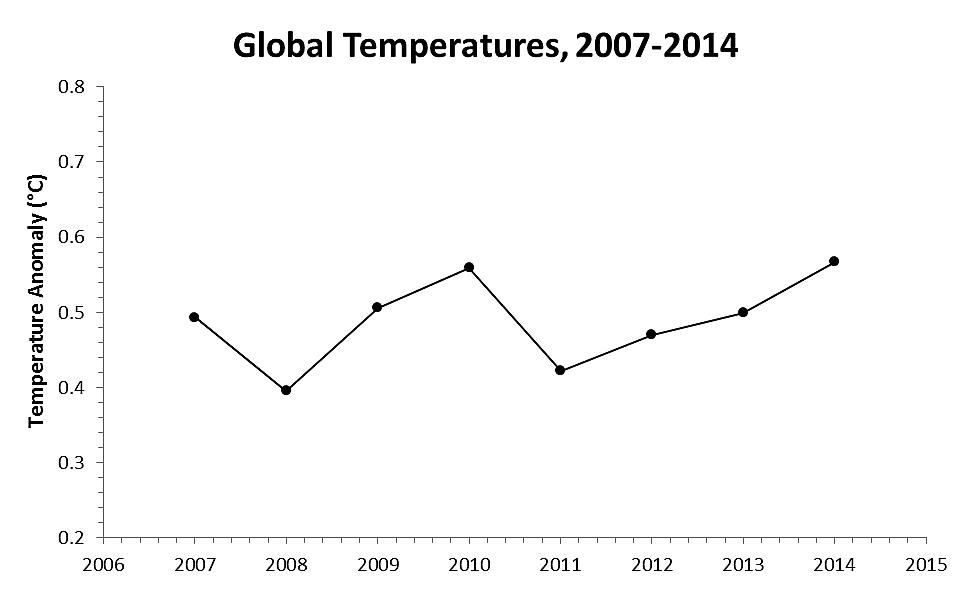
Also disturbing is the glib statement on “climate-sensitive natural emissions.” Attention, Schaefer et al.: Your study covers from 2007 through 2014. The figure below shows annual global surface temperature departures from an arbitrary mean. There is no climate change to be “sensitive” to during this period. Further, the statement is at odds with much of the text of the article, which largely points to an anthropogenic biogenic source for the change. One can’t help but wonder if some crusading reviewer insisted on the climate statement as the price for publication. Such a thing happened to one of us (Michaels) as a condition for publication in the prestigious “EOS—Transactions of the American Geophysical Union” many moons ago, despite the fact that the paper in question specifically determined such a link was not the case.
And, to keep things interesting, a paper was published just days after the Schaefer et al. Science piece, by a team of researchers led by Petra Hausmann of Germany’s Karlsruhe Institute of Technology. These researchers investigated the growth in atmospheric methane concentrations alongside the growth in atmospheric ethane concentrations –a tracer for methane emission from fossil fuels. By analyzing the increase in ethane, Hausmann et al. concluded that about half of the growth in methane emissions between 2007 and 2014 came from fossil fuel sources correlated to the oil and natural gas fracking boom in the U.S. In their press release, they note that their result fits with the Turner et al. results of a significant increase in US methane emissions and contrasts with the US EPA estimates. The authors also note the discrepancy with the Schaefer et al. findings.
Pretty clearly, no one knows quite what is going on.
And into this confusion, the EPA has decided (no doubt from the President’s urging) to issue regulations pertaining to the allowable amount of methane emissions from US oil and gas recovery and delivery operations—in the name of mitigating future climate change.
As we pointed out when the regulations were first announced, the impact on future climate change is so tiny as to be immaterial. And now, with the great uncertainty as to what exactly is behind the recent rise in atmospheric methane concentrations, the EPA’s regulations may not only be insignificant, but wrong-headed as well.
What is certain, is that if you don’t understand the cause of a situation, taking steps to “fix” it is probably a bad idea. The Obama Administration’s “While under debate, regulate!” mantra is a poor operating protocol destined to fail. Or worse.
References:
Hausmann, P., R. Sussmann, and D. Smale, 2016. Contribution of oil and natural gas production to renewed increase in atmospheric methane (2007–2014): top–down estimate from methane and methane column observations. Atmospheric Chemistry and Physics, 16, 3227–3244, doi:10.5194/acp-16–3227-2016.
Schaefer, H, et al., 2016. A 21st century shift from fossil-fuel to biogenic methane emissions indicated by 13CH4. Science, doi:10.1126/science.aad2705.
Turner, A.J., et al., 2016. A large increase in US methane emissions over the past decade inferred from satellite data and surface observations. Geophysical Research Letters, doi: 10.1002/2016GL067987.
When the Common Core debate was exploding three or four years ago, a primary pro-Core strategy seemed to be ignoring substantive objections to the Core and dismissing opponents as ignorant, maybe even loony. Over time, that strategy appeared to energize and expand opposition, and many Core supporters shelved it. But not, it seems, the Center for American Progress, which just posted to the website Funny or Die a video mocking Core-concerned parents.
You can watch the vid here, but basically two parents are sending their daughter to kindergarten and letting her know that she’ll have no need for books but will need a disguise, an ever-so-hilarious tin foil hat, and a ray gun, among other things, because her school uses Common Core and that means no to book-larnin’, yes to “Pod People” mind-reading. Thankfully, before the little girl sets off, her older sister, about to start her first year of college, walks by the little girl’s room and sets her goofball parents straight. “Common Core is just some standards my teachers use,” she exasperatedly explains. “So, you know, we can get into college, and get a job, and hopefully move out of our crazy parent’s house.”
Oh, is that it?
Not only insulting to Core opponents and dismissive of their concerns, the video is highly misleading. The Core is a specific set of standards – not just “some” standards – and states make teachers use them, quite likely in response to federal coercion. There is also no meaningful evidence that the Core enables students to get a job and leave the house of either their crazy or their sane parents. And a student entering college this year would have had little Core-aligned education – they would not have gone through it many years ago, as the video implies – because classroom implementation only began in the last two or three years.
Now, some opponents certainly ascribe things to the Core they should not. Sometimes these are politicians or education analysts, but often they are regular people with normal lives who cannot spend hours combing through laws and regulations to get all the right information. But CAP and many other Core defenders do, or at least should, know the whole truth, yet like this video they often put out misleading or woefully incomplete information, often with the stated goal of setting opponents straight. Indeed, just last week I responded to such “fact-checking” on the website of The Seventy Four. And what, by the way, did folks at The Seventy Four say about CAP’s video? They called it “hilarious” and reprinted a bunch of their flawed fact-check.
You can judge for yourself, of course, whether the video is hilarious. But there is little funny about dismissing the concerns of real parents and citizens who have had Common Core imposed on them, nor is it chuckle-inducing when, in the name of correcting others, Core fans keep distorting reality.