Why was the recent $10 billion public school bailout bad for kids as well as taxpayers? How much does Ben Chavis’ #1 ranked middle school in California spend per pupil? Does Michelle Rhee expect to still be DC schools superintendent after Mayor Fenty leaves office? Why do I use the word “unicorn” in describing public school budgets? Tune in tonight to find out: “Stossel,” Fox Business News, 9:00pm Eastern/6:00pm Pacific.
Cato at Liberty
Cato at Liberty
I must be losing my touch. I’ve let nearly two months pass without responding to Ezra Klein’s defense of RomneyCare, ObamaCare, and other centrally planned health care systems. (For those who want to get up to speed: his original post, my reply, and his response.) So here goes.
Klein notes that he and I had each used flawed measures of RomneyCare’s impact on health insurance premiums in Massachusetts. Fair enough. But Klein ignores the study I cited by John Cogan, Glenn Hubbard, and Dan Kessler, which estimates that RomneyCare increased premiums in Massachusetts by 6 percent. The CHK study has limitations, but it is the best estimate available. I hope Klein addresses it.
Klein’s fallback position is that even if RomneyCare increases premiums, that’s not an indictment of the law because cost-control was not one of its goals. Never mind that Mitt Romney boasted, “the costs of health care will be reduced.” Klein knows political rhetoric when he sees it. Yet he oddly sees no parallels between the phony-baloney promises of cost-control used to sell RomneyCare and the phony-baloney promises of cost-control used to sell ObamaCare — despite ample assistance from people like Medicare’s chief actuary and Alain Enthoven (“the American people are being deceived”).
Then Klein throws down his trump card:
[E]ven a cursory read of the evidence would show that whatever the drawbacks of central planning, it covers people at an extremely low cost. Romney Care’s cost problem is a result of pasting a coverage-oriented quick fix atop our insane health-care system. Compare its costs to the British system, the French system, the German system, or any other system, and whatever your conclusions, you won’t walk away unimpressed by the ability of centralized systems to cover whole populations for much less money than we spend.
Oy, where to begin? First, Klein violates Cannon’s First Rule of Economic Literacy: he writes that centrally planned systems cost less, when what he means is that they spend less.
Second, the phrase “whatever the drawbacks of central planning” is some serious hand-waving. Those “drawbacks” include (among other things): the Medicare program’s suppression of comparative-effectiveness research, error-reduction efforts, care coordination, and other delivery innovations; Canada’s human-rights violating Medicare system; and the suppression of untold innovations in health insurance and medical treatment by government price controls. Other than a few drawbacks, Mrs. Lincoln…
Third, our “insane health-care system,” as I blogged previously, “is the product of the old raft of government price & exchange controls, mandates, and subsidies.” Prior to ObamaCare, government already controlled half of all U.S. health care spending directly, granted control over another quarter to employers, and regulated health care more heavily than perhaps any other sector of the economy. Klein and his fellow central planners can’t deny paternity. Our “insane health-care system” is the product of central planning.
Finally, only a cursory read of the evidence could lead to the conclusion that central planning contains health care spending. Klein posts the following charts and concludes that since all those (other) centrally planned systems spend less on health care than the United States, central planning must result in lower health care spending.
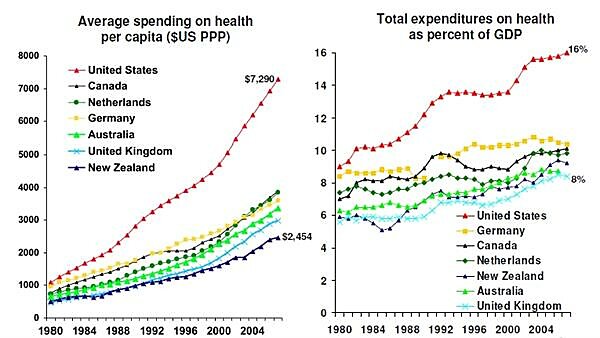
Photo credit: By Robert Giroux/Getty Images[/caption]
But if that were true, then one would expect per-capita spending on elderly Americans — who have universal coverage through the centrally planned Medicare program — would not be far out of line when compared to how much other nations spend per elderly resident. Yet the United States is just as far out of here as overall. According to the OECD, the United States spends about twice as much per elderly person as Canada, and more than twice as much as Australia spends. (Alas, I’m not cherry-picking; these are the only four nations for which the OECD provides recent data.)
[caption align=“aligncenter”]
(One could argue that the reason for this is that Medicare exists alongside the world’s largest (ostensibly) private health care sector, whose evils spill over into Medicare. If that were the case, then moving all Americans into Medicare should reduce U.S. health care spending, bringing it back into line with other nations. But consider that Klein and The New Republic’s Jonathan Chait both acknowledge that Congress had to throw $2 at the health care industry for every $1 that ObamaCare cut from future Medicare spending. How exactly could Congress move 250 million Americans into Medicare (which presumably would reduce overall spending), or reduce Medicare spending later, given those constraints? How, exactly, would an independent rationing board survive the political dynamics that produce such outcomes? Prediction: it won’t. The narrative that central planning contains health care spending just doesn’t hold water.)
Klein, The New Republic’s Jonathan Cohn, and others have taken a big step by acknowledging that RomneyCare is struggling. When they shift the blame to “the American health care system,” however, they obscure what’s really happening. As I closed my previous post: “RomneyCare and its progeny ObamaCare are attempts by the Left’s central planners to clean up their own mess. If Klein and Cohn want to defend those laws, pointing to the damage already caused by their economic policies won’t do the trick. They need to explain why government price & exchange controls, mandates, and subsidies will produce something other than what they have always produced.”
Related Tags
I was privileged last night to get an advance look at the Chicago Council on Global Affairs’ new study on public opinion. I was struck by several things.
First, the report reflects a strong desire to get our own house in order. Asked the question whether it “is more important at this time for the United States to fix problems at home or address challenges to the United States from abroad,” a stunning 91 percent selected the former, with only 9 percent pointing to the latter. (In 2008 the numbers were 82–17.)
That said, there is not as much appetite for cutting the defense budget as I would like to see:
When asked whether defense spending should be expanded, kept about the same, or cut back, 43 percent of Americans prefer to keep spending about the same as it is now, a steady position since 2004, with 30 percent saying expand and 27 percent saying cut back. At the same time, Americans do recognize the need for moderation if federal budget cuts are necessary to reduce the deficit. When asked whether the defense budget should be cut along with other programs in an effort to address the federal budget deficit, a majority (58%) favors at least some cuts—less than other programs (29%), about the same as other programs (20%), and greater than other programs (9%). A substantial number (41%), however, say defense should not be cut at all. Along with the 29% who say it should be cut less than other programs, there is a considerable majority that clearly sees defense spending as a high priority.
Second, the report does a good job of highlighting the fact that although a historically high number of Americans (49%) agree with the idea that America should “mind its own business internationally and let other countries get along the best they can on their own,” this is not, as it is frequently advertised, “isolationism.” One needs to define what “our own business” is before one can characterize such a belief.
But perhaps the most striking findings, to my mind, pertained to the U.S.-Israel relationship. On a general question regarding whether various other countries are “very important” to the United States, Israel fell 7 points from the 2008 figure (from 40 percent to 33 percent), but every country except China suffered a decline, except Iraq, South Korea, and Turkey, which stayed the same. But the report asked a number of specific questions pertaining to Israel–and U.S. policy toward Iran–that produced answers that were surprising to me:
• On the issue of Iran acquiring nuclear weapons, Americans are at present reluctant to resort to a military strike on Iran’s nuclear facilities, preferring economic sanctions and diplomacy. [Only 18 percent support a strike.]
• Very strong majorities do not think it is likely that a military strike would cause Iran to give up trying to have a nuclear program. They also think a strike would likely result in retaliatory attacks against U.S. targets in neighboring states as well as in the United States itself. [28 percent say it is “not at all likely” and 48 percent say “not very likely” that striking would lead Iran to give up trying to have a nuclear program.]
• If all efforts fail to stop Iran, Americans are about evenly divided on whether to conduct a military strike. [47 percent would favor a strike, 49 percent would oppose. This surprised me a lot.]
• If Iran were to allow UN inspectors permanent and full access throughout Iran to make sure it is not developing nuclear weapons, a slight majority of Americans believe that Iran should be allowed to produce nuclear fuel for producing electricity. [52 percent would support, 45 percent would oppose, which reflects a slight shift away from allowing Iran enrichment from the findings in 2008.]
But perhaps most striking were these findings, which I would imagine will cause heartburn for Binyamin Netanyahu:
[Americans] also appear to be very wary of being dragged into a conflict prompted by an Israeli strike on Iran’s nuclear facilities. In this survey, conducted in June 2010, a clear majority of Americans (56%) say that if Israel were to bomb Iran’s nuclear facilities, Iran were to retaliate against Israel, and the two were to go to war, the United States should not bring its military forces into the war on the side of Israel and against Iran…
[…]
Americans continue to show wariness about defending Israel from an attack by its neighbors. Despite an increase in the percentage of Americans who think military conflict between Israel and its Arab neighbors is a critical threat (from 39% in 2008 to 45% today), Americans are divided on using U.S. troops to defend Israel if it were attacked by “its neighbors” (50% opposed, 47% in favor, see Figure 52). This question was also asked with a slightly different wording in surveys from 1990 to 2004 (if Arab forces invaded Israel). In none of these surveys was there majority support for an implicitly unilateral use of U.S. troops.
Food for thought.
Related Tags
Wisconsin has become a battleground over the Obama administration’s plan to create a national system of high-speed rail. Of the $8 billion in HSR grants awarded to the states in the stimulus bill, $810 million of it went toward a high-speed route between Milwaukee and Madison.
Ironically, this Wisconsin “high-speed” route would only achieve speeds of 79 mph initially and 110 mph by 2016. As a Cato essay on high-speed rail points out, HSR aficionados don’t even consider 110 mph to be true high-speed. In fact, passenger trains were being run at speeds of 110 mph or more back in the 1930s. And those “high-speed” trains didn’t prevent the decline of passenger trains after World War II.
The Cato essay also notes that the 85-mile line between Milwaukee and Madison “is only a tiny portion of the eventual planned route from Chicago to Minneapolis, and no one knows who will pay the billions necessary to complete that route.” In fact, to build a national system of true high-speed rail on the 12,800 mile network envisioned by the administration, the cost could be close to $1 trillion.
Where would the money come from? State governments are hoping that it would be all from federal taxpayers. As I recently discussed, the states’ interest in grabbing new federal HSR money has dropped now that Congress is requiring a 20 percent state match:
The states already have dedicated revenue sources for federal highway aid matching requirements (also 20 percent). With state tax revenues flat due to the recession, where would the money come from to pay for high-speed rail projects? Proposing new taxes to fund high-speed rail would probably be political suicide. And most state policymakers recognize that shifting money away from more popular programs to pay for high-speed rail won’t be any more politically rewarding.
The issue is even affecting elections in states that are in line to receive federal funding for high-speed rail. Scott Walker, a Republican candidate for governor in Wisconsin, recently said he’d send back the $810 million in stimulus funds the state has received for a rail line between Madison and Milwaukee. Walker appears to understand that his state has more pressing infrastructure needs and that high-speed rail could become a fiscal black hole.
On Tuesday, Walker won the GOP primary to replace outgoing Democratic Governor Jim Doyle, who is an ardent supporter of the Milwaukee-Madison route. Walker’s Democratic opponent, Milwaukee mayor Tom Barrett, supports the route’s construction. According to Stateline.org, the outgoing Doyle administration plans to have $300 million of the money under contract by January, which Walker says he would cancel if elected.
Wisconsin Democrats have made hay out of the fact that former Republican Governor Tommy Thompson first championed the idea of a regional network of high-speed rail. Unfortunately for HSR proponents, Thompson’s past involvement with federally-subsidized rail is a reason not to build the route.
From a Cato essay on Amtrak subsidies:
Amtrak reform legislation in 1997 stipulated that its board be replaced with a “reform board” of directors. The Clinton administration nominated, and the Senate confirmed, politicians that included the then-governor of Wisconsin, Tommy Thompson, and the mayor of Meridian, Mississippi, John Robert Smith. Mayor Smith tried to create a route that would have lost millions linking Atlanta and Dallas via Meridian. Governor Thompson succeeded in creating a route from Chicago to Janesville, Wisconsin. It was eventually discontinued after Thompson’s departure from the board due to low ridership and financial losses.
As is the case with Amtrak, HSR can’t compete with more efficient modes of transportation like automobiles and airplanes without massive subsidies. At a time when the federal debt is heading toward the moon, policymakers should be looking to the private sector to take care of our transportation needs. The country simply can’t afford to sink taxpayer money into high-speed rail when it makes so little economic sense.
The Montana Supreme Court overturned more than 100 years of state property law concerning navigable waters by effectively converting the title in hundreds of miles of riverbeds to the State. The majority of that court ruled that the entirety of the Missouri, Clark Fork, and Madison rivers were navigable at the time of Montana’s statehood, producing a broad holding that eradicates property rights to the rivers and riverbanks that Montanans had enjoyed for over a century.
Before this case, the hydroelectric energy company PPL Montana and thousands of other private parties exercised their property rights over these non-navigable stretches that the state never claimed. Today, Cato joined a brief filed by the Montana Farm Bureau Federation supporting the PPL Montana’s request that the U.S. Supreme Court review the Montana high court’s ruling for possible Takings Clause violations under the Fifth Amendment.
We argue two main points. First, that the Court should adhere to its standard for navigability rights set out in Utah v. U.S. in 1933. Unlike the approach taken by the Montana Supreme Court’s majority — that entire rivers were navigable simply because certain reaches of the river were navigable — the U.S. Supreme Court in Utah used an approach of meticulously analyzing the rivers at issue section-by-section. Second, this arbitrary ruling against rights long protected by Montana law amounts to a “judicial taking,” as explained last term Stop the Beach Renourishment v. Florida Dept. of Environmental Protection (in which Cato also filed a brief). There, a plurality of the Court held that there is no “textual justification” for limiting takings claims deriving from executive or legislative action, thereby extending it to a judicial action of the same nature (and two other members of the Court found potential relief in the Fourteenth Amendment’s Due Process Clause). Here, the Montana court did exactly that, violating due process rights that the Montana legislature could not and further violating the procedural due process rights of the thousands harmed by the decision in not affording them notice or a hearing.
The U.S. Supreme Court should thus review the case to reinforce its Utah precedent and ensure that arbitrary judicial takings of this sort cannot continue. The name of the case is PPL Montana, LLC v. Montana. The Court will decide later this fall whether to take it up.
Most of the debate over extending the Bush tax cuts has focused on whether to extend slightly lower marginal rates for higher earners who already bear a huge burden. But at the other end of the income spectrum, a growing share of Americans don’t pay income taxes. Indeed, the Bush tax cuts increased the share of U.S. households that pay no income taxes.
From the Wall Street Journal:
Efforts to tame America’s ballooning budget deficit could soon confront a daunting reality: Nearly half of all Americans live in a household in which someone receives government benefits, more than at any time in history.
At the same time, the fraction of American households not paying federal income taxes has also grown—to an estimated 45% in 2010, from 39% five years ago, according to the Tax Policy Center, a nonpartisan research organization.
A little more than half don’t earn enough to be taxed; the rest take so many credits and deductions they don’t owe anything. Most still get hit with Medicare and Social Security payroll taxes, but 13% of all U.S. households pay neither federal income nor payroll taxes.
As the price of something drops, the demand increases. For a growing share of Americans, government services are effectively “free,” so they are demanding even more and policymakers are giving it to them.
As the following chart shows, federal payments to individuals as a share of the economy have reached an all-time high after seventy years of steady growth:
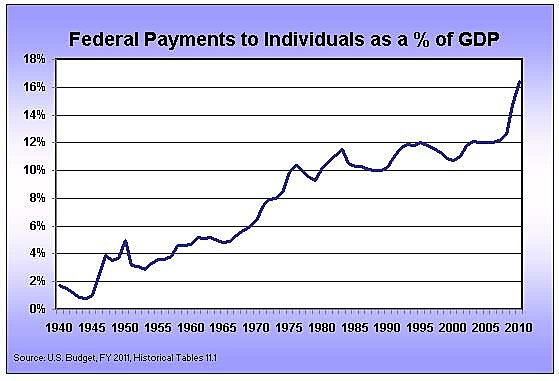
George Bernard Shaw said that “A government which robs Peter to pay Paul can always depend on the support of Paul.” In order to head off the coming fiscal train wreck, Paul is going to need to be convinced that robbing Peter is no longer in his best interests. However, by foisting a larger share of the burden of government onto a smaller and smaller group of taxpayers, policymakers will make it more and more difficult for Paul to see the error of his ways.
Related Tags
Despite every major US bank being declared by regulators as “well capitalized” prior to the financial crisis, we still found ourselves watching the government plow hundreds of billions of capital into said banks. How can this be? The answer is quite simple: we were lied to. Maybe that’s a little harsh, after all these banks did meet the regulatory definition of “well capitalized”. But when push came to shove, market participants rightly ignored regulatory capital. After all you cannot use things like “deferred tax losses” to pay your bills with.
It is hard to improve upon Martin Wolf’s observation in today’s Financial Times: “This amount of equity is far below levels markets would impose if investors did not continue to expect governments to bail out creditors in a crisis.” This point is best illustrated by the trend in bank capital over the last 100 years. Back when banks were actually subject to market forces and were not explicitly subjected to government capital standards, they held significantly more capital. In 1900 the average US bank capital ratio was close to 25%, now it’s closer to 5%. The trend is unmistakable: the more government has regulated bank capital, the less capital banks have ended up holding.
Despite the claims of the banking industry, what the bank regulators have just delivered with “Basel III” is simply another fraud upon the public and investors. Any framework that continues to treat say Greek or Fannie Mae debt as largely risk-free is a sham.
The real solution is to first end the various government bailouts, guarantees and subsidies behind the banking system, subjecting bank creditors to actual losses, while also abandoning the charade that is capital regulation. Sadly politicians (see the Dodd-Frank Act) and regulators continue to simply tweak a flawed and morally bankrupt system.