A former Heritage Foundation colleague has returned to youtube.com with a video asking taxpayers whether examples of government waste are true or false.
Cato at Liberty
Cato at Liberty
Government and Politics
Rep. Paul Ryan (R‑WI) ably defends his “Roadmap for America’s Future” in today’s Washington Post. He doesn’t mention Paul Krugman’s attacks thereon, nor should he. (To read why, consult The Atlantic’s Megan McArdle and Ted Gayer of the Tax Policy Center.)
I haven’t officially weighed in on the health-care aspects of the Roadmap, but hope to do so in the near future. For the moment, I’ll use Ryan’s oped to stress a distinction that is crucial to thinking clearly about health care costs.
Ryan writes of the dangers of an un-reformed Medicare program (emphasis added):
Under an ever-expansive, all-consuming central government, costs will be contained with Washington’s heavy hand imposing price controls, slashing benefits and arbitrarily rationing seniors’ care.
While those forms of government rationing may reduce spending, that’s not the same as reducing costs. On the contrary, those rationing measures may increase health care costs.
Suppose Medicare set its prices for hip and knee replacements so low that no medical-device manufacturer would provide the hardware and no surgeon would perform the procedures. Medicare spending on hip and knee replacements would fall. But costs may rise: more seniors would be walking around — or not walking around — in severe pain. Pain and reduced mobility are costs, even if they don’t show up in the federal budget or household budgets. (Indeed, those costs would be so severe that overall Medicare spending could rise as seniors bought more wheelchairs, sought treatment for pressure sores, etc.). This is the main reason conservatives criticize Canada’s Medicare system and the British National Health Service: reducing health care spending often increases costs.
I therefore request universal compliance with Cannon’s First Rule of Economic Literacy: Never say costs when you mean spending.
Related Tags
[caption align=right]

Science![/caption]
A few odds and ends from the social science blogosphere:
- A rare Michael Kinsley stumble.
- The danger of data without theory.
- General David Petraeus will receive the Hubert H. Humphrey Award in recognition of notable public service by a political scientist at this year’s American Political Science Association annual meeting in Washington.
Related Tags
Cal Thomas, who bills himself as “America’s #1 nationally syndicated columnist,” rose to fame as the vice president of Jerry Falwell’s Moral Majority in its heyday, though you won’t find that fact in any of his official biographies. But you could figure it out by reading his columns. In his latest, on the California gay marriage decision, he ranges from factual inaccuracy to a revelation of just how reactionary and authoritarian he really is, to a really striking biblical citation.
He starts by denouncing the “decision by a single, openly gay federal judge.” Not true. Judge Vaughn Walker may be gay, but he has never said so. And Salon magazine demonstrates that any such “evidence” is extraordinarily thin. So this is an extraordinary statement by a man who calls himself a journalist of 40 years’ standing. Not to mention an offensive suggestion that gay people shouldn’t serve as judges. Thomas went so far as to call former attorney general Ed Meese, who recommended Walker to President Ronald Reagan, to ask how such a thing could have happened, and Meese assures him, “There was absolutely no knowledge, rumor or suspicion” of Vaughn Walker being a homosexual at the time of his nomination by Ronald Reagan. Well, thank God. You’d hate to think that Ronald Reagan would have put an accomplished Republican lawyer on the federal bench if he’d been a homosexual.
Thomas goes on to complain that this (not) “openly gay federal judge” has struck down “the will of 7 million Californians.” Well, yes. Of course, 6.4 million Californians voted the other way, so I guess on net he struck down the will of 600,000 Californians. And that’s what judges do when they strike down unconstitutional laws. The Supreme Court in Brown v. Board and Loving v. Virginia “struck down the will of tens of millions of Americans.” Libertarians and conservatives asked the Court in the Kelo case to strike down the duly enacted eminent-domain laws of Connecticut.
The sentence continues: The judge also struck down “tradition dating back millennia” — though for much of that time marriage involved one man and more than one woman. And of course traditions are not to be followed blindly. No doubt Cal Thomas thinks that millions, even billions, of Jews, Muslims, Hindus, and Buddhists should leave the faiths of their fathers and follow Christ.
And then the sentence moves to Thomas’s real concern: The judge also struck down “biblical commands, which the judge decided, in his capacity as a false god, to also invalidate.” Does Thomas really believe that the judges of the United States, operating under a Constitution that makes no mention of God, should obey “biblical commands”? It’s true that the Virginia trial judge who convicted the Lovings of miscegenation did rule that “Almighty God created the races white, black, yellow, malay and red, and he placed them on separate continents. And but for the interference with his arrangement there would be no cause for such marriages. The fact that he separated the races shows that he did not intend for the races to mix.” He thought he was following biblical commands. But the Supreme Court overruled that judge.
Thomas is fulminating against gay marriage and against “judicial vigilantism.” But his real objections to American law and life go much deeper:
We have been spiraling downward for some time, beginning in the ’50s with the Playboy philosophy that gave men permission to avoid the bonds of marriage if they wanted to have sex. In rapid succession came the birth control pill (sex without biological consequences), “no-fault divorce” (nullifying “until death us do part”), cohabitation, easily available pornography, and a tolerance for just about anything except those who deem something intolerable.
Cal Thomas would like to take American life back somewhere before the 1950s, before adults could make their own decisions about sex, before birth control and cohabitation and tolerance. The American people may still be split 50–50 on gay marriage, but they would overwhelmingly reject Thomas’s reactionary vision for society.
How reactionary? Well, consider this:
Muslim fanatics who wish to destroy us are correct in their diagnosis of our moral rot: loss of a fear of God, immodesty, especially among women, materialism and much more.
Which sort of follows from his earlier point:
No less a theological thinker than Abraham Lincoln concluded that our Civil War might have been God’s judgment for America’s toleration of slavery. If that were so, why should “the Almighty,” as Lincoln frequently referred to God, stay His hand in the face of our celebration of same-sex marriage?
A more loving Christian might think that God would punish a nation that practiced slavery, but not a nation that allowed everyone to make a commitment to the person they loved. But surely Katrina, the financial crisis, 9/11, and the BP oil spill are enough punishment, even for a nation that displays a “tolerance for just about anything.” Anything that’s peaceful, anyway, as Leonard Read put it.
Toleration really is the thing that Thomas doesn’t like:
What we tolerate, we get more of, and we have been tolerating a lot since the Age of Aquarius generation began the systematic destruction of what past generations believed they had sacrificed, fought and died to protect.
I wonder how many American soldiers really believed that they went into battle to prevent gay people from marrying the person they love. I’ll bet more of them said they were fighting to protect our freedom, our Constitution, and indeed our religious freedom — for everyone.
Thomas ends his column with a biblical citation for those who want to “understand what happens to people and nations that disregard God”:
“In those days Israel had no king; everyone did as he saw fit.” (Judges 21:25)
Two books later in the Old Testament, in I Samuel 8, the story of Israel and its lack of a king is continued. This is actually one of the most famous passages in the history of liberty and of Western civilization. As we’ll see in a moment, the rest of the story served as a constant reminder that the origins of the State were by no means divinely inspired:
1: And it came to pass, when Samuel was old, that he made his sons judges over Israel.
3: And his sons walked not in his ways, but took bribes, and perverted judgment.
4: Then all the elders of Israel came to Samuel,
5: And said unto him, Behold, thou art old, and thy sons walk not in thy ways: now make us a king to judge us like all the nations.
6: But the thing displeased Samuel, And Samuel prayed unto the LORD.
7: And the LORD said unto Samuel, Hearken unto the voice of the people
9: yet protest solemnly unto them, and shew them the manner of the king that shall reign over them.
10: And Samuel told all the words of the LORD unto the people that asked of him a king.
11: And he said, This will be the manner of the king that shall reign over you: He will take your sons, and appoint them for himself, and some shall run before his chariots.
12: And he will set them to ear his ground, and to reap his harvest, and to make his instruments of war, and his chariots.
13: And he will take your daughters to be cooks, and to be bakers. 14: And he will take your fields, and your vineyards, and your oliveyards, even the best of them, and give them to his servants.
15: And he will take the tenth of your seed, and of your vineyards, and give to his officers, and to his servants.
16: And he will take your menservants, and your maidservants, and your goodliest young men, and your asses, and put them to his work.
17: He will take the tenth of your sheep: and ye shall be his servants.
18: And ye shall cry out in that day because of your king which ye shall have chosen; and the LORD will not hear you in that day.
19: Nevertheless the people refused to obey the voice of Samuel; and they said, Nay; but we will have a king over us;
20: That we also may be like all the nations; and that our king may judge us, and go out before us, and fight our battles.
21: And Samuel heard all the words of the people, and he rehearsed them in the ears of the LORD.
22: And the LORD said to Samuel, Hearken unto their voice, and make them a king.
God’s warning to the people of Israel — you will be sorry if you choose a king to rule over you — resonated not just in ancient Israel but on down to modern times. Thomas Paine cited it in Common Sense to remind Americans that “the few good kings” in the 3000 years since Samuel could not “blot out the sinfulness of the origin” of monarchy. The great historian of liberty, Lord Acton, assuming that all 19th-century British readers were familiar with it, referred casually to Samuel’s “momentous protestation.” And now Cal Thomas thinks this seminal warning against tyranny is a capstone to his tirade against freedom, tolerance, and equality under the law. How sad.
An article in today’s The USA Today titled, “With Many Still in Dark, Groups Shed Light on Health Care Law,” aims to correct misinformation about ObamaCare. Ironically, the article is itself a monument to misinformation.
It begins:
True or false: The new health care law will cut Medicare benefits for seniors. It will slash Medicare payments to doctors. It will ration health care.
In three polls conducted last month, large percentages of Americans answered “true” to each statement. All three are false.
In fact, two of the three statements are 100-percent true.
First, ObamaCare will cut payments to the private health insurance companies that provide coverage to the 20 percent of Medicare enrollees who participate in the Medicare Advantage program. That will eliminate many types of coverage for seniors in Medicare Advantage. That should be painfully obvious, but if you require confirmation, visit FactCheck.org. ObamaCare will also ratchet down the price controls that Medicare uses to pay hospitals and many other health care providers. It should likewise be obvious that that will reduce access to services that are ostensibly “guaranteed” to all enrollees. But again, if you need confirmation, check in with Medicare’s chief actuary, who works for President Obama. We can debate whether that’s good or bad. What’s not up for debate: ObamaCare in fact “will cut Medicare benefits for seniors.”
Second, it is also true — ipso facto – that ObamaCare “will ration health care.” To ration is to limit consumption. When ObamaCare reduces coverage for Medicare Advantage enrollees and reduces access to care for all Medicare enrollees, it limits seniors’ consumption of medical care. We can debate whether that’s good or bad. What’s not up for debate: that is rationing.
Finally, yes, it is technically false that ObamaCare “will slash Medicare payments to doctors.” But since current law will slash Medicare payments to doctors if Congress does nothing, and since an earlier version of ObamaCare would have eliminated those cuts, but ObamaCare’s architects dropped that provision so as to make ObamaCare appear deficit-neutral… well, perhaps the public can be forgiven if it confuses “eliminating a provision that would have prevented cuts in Medicare payments to doctors” with “slashing Medicare payments to doctors.”
USA Today continues:
The debunked idea raised by opponents during congressional debate that “death panels” could make end-of-life decisions is seen as real by nearly half of those surveyed.
I’ll rate this statement misinformed and misleading.
First, Sarah Palin’s claim about “death panels” was true at the moment she said it, even if she didn’t know why.
Second, by rationing Medicare enrollees’ access to medical services (see above), ObamaCare will effectively make end-of-life decisions for seniors. According to Medicare’s chief actuary, ObamaCare could force one in six hospitals to stop accepting Medicare patients. If ObamaCare results in there no longer being a hospital bed waiting for Grandma at the end of her life, that’s an end-of-life decision. It wasn’t a personalized decision. It’s not even necessarily the wrong decision. But let’s drop this nonsense about ObamaCare not making end-of-life decisions for seniors. And ObamaCare did create a panel that will make many of these implicit rationing decisions. It’s called the Independent Payment Advisory Board.
But my guess is that people tell pollsters that ObamaCare will make end-of-life decisions because they understand the Golden Rule, and that he who pays the piper calls the tune. So long as the government purchases medical care, it will be the government that decides who receives it and who doesn’t. And ObamaCare gave government a lot more of the gold.
USA Today packed a lot of misinformation into this one sentence:
The National Council on Aging posed 12 questions about the law to 636 seniors and found that fewer than 17% of them knew half the answers.
Actually, it’s NCOA that doesn’t know the answers. Here are a few of their poll’s true-false questions:
- “The new law will result in future cuts to your basic Medicare benefits.” A plurality of seniors (42 percent) responded “true.” And they’re right: as Medicare’s chief actuary has explained and as NCOA should know, ObamaCare will reduce access to care for Medicare enrollees. That’s a benefit cut, unless you think “coverage without care” counts as a benefit. Yet according to NCOA, the correct answer is “false.” Just 22 percent of seniors agreed.
- “Under the new health reform law, Medicare Advantage plans will cut benefits and increase premiums.” NCOA says the correct response is “don’t know,” and that’s the answer that 56 percent of seniors gave. Perhaps seniors haven’t read the chief Medicare actuary’s report, which found that ObamaCare “will result in less generous benefits packages” in Medicare Advantage and “when the MA provisions will be fully phased in, enrollment in MA plans will be lower by about 50 percent.” But NCOA should have read that report, and should therefore know that the correct answer is “true.”
- “The new law is projected to increase the federal budget deficit over the next ten years and beyond.” Again, a plurality (49 percent) responded “true.” Again, they’re right. Yet NCOA thinks the correct response is “false.” No doubt NCOA would point to the Congressional Budget Office projections that ObamaCare will reduce the deficit. But those projections are valid only if ObamaCare “remain[s] unchanged throughout the next two decades, which is often not the case for major legislation.” The CBO wrote this would particularly be a problem with ObamaCare, which “would maintain and put into effect a number of policies that might be difficult to sustain over a long period of time.” So one could reasonably interpret the CBO to have projected an increase, not a decrease in the deficit. Alternatively, seniors could have been thinking about former CBO director Douglas Holtz-Eakin, who projected in The New York Times that ObamaCare “would raise, not lower, federal deficits, by $562 billion.” There are lots of reasons why “true” is in fact the correct answer. (One of them is that NCOA used the passive construction “is projected.”) Only 14 percent of seniors agreed with NCOA.
- “As a result of the new law, the solvency of the Medicare Trust Fund will be extended by about 9 years to 2026.” A majority of seniors responded “don’t know” (54 percent), while another 22 percent responded “false.” Either answer is more correct than NCOA’s preferred answer (“true”). There are no assets in the Medicare “trust fund.” Thus there is no date by which those non-assets will be exhausted. Indeed, the “trust fund” has absolutely no effect on Medicare’s solvency. The very premise of this question is a fraud. Someone needs to educate seniors about the Medicare trust fund, but NCOA is not the group to do it.
- “The health care reform law will cut Medicare payments to doctors.” A plurality of seniors responded “true” (45 percent), while only 14 percent of seniors gave NCOA’s preferred response (“false”). But again, perhaps seniors can be forgiven on this one (see above).
USA Today should have dug a little deeper.
More misinformation:
More than four in 10 people in the Kaiser poll wrongly believe the law included a government panel to make end-of-life decisions for Medicare patients.
Again, ObamaCare does include a panel that would implicit rationing decisions, including for Medicare patients at the end of life (see above).
More misinformation still:
As the Department of Health and Human Services issues the regulations needed to implement the law, it’s trying to get the facts out through its website, healthcare.gov. The Centers for Medicare and Medicaid Services is helping, most recently with a cable TV ad featuring Andy Griffith.
FactCheck.org found that Andy Griffith used “weasel words” to “mislead” seniors about ObamaCare. How is USA Today not aware of that?
Related Tags
Peter Wallsten of the Wall Street Journal writes, “Libertarianism is enjoying a recent renaissance in the Republican Party.” He cites Ron Paul’s winning the presidential straw poll earlier this year at the Conservative Political Action Conference, Rand Paul’s upset victory in the Kentucky senatorial primary, and former governor Gary Johnson’s evident interest in a libertarian-leaning presidential campaign. Johnson tells Wallsten in an interview that he’ll campaign on spending cuts — including military spending, on entitlements reform, and on a rational approach to drug policy.
Meanwhile, on the same day, Rand Paul had a major op-ed in USA Today discussing whether he’s a libertarian. Not quite, he says. But sort of:
In my mind, the word “libertarian” has become an emotionally charged, and often misunderstood, word in our current political climate. But, I would argue very strongly that the vast coalition of Americans — including independents, moderates, Republicans, conservatives and “Tea Party” activists — share many libertarian points of view, as do I.
I choose to use a different phrase to describe my beliefs — I consider myself a constitutional conservative, which I take to mean a conservative who actually believes in smaller government and more individual freedom. The libertarian principles of limited government, self-reliance and respect for the Constitution are embedded within my constitutional conservatism, and in the views of countless Americans from across the political spectrum.
Our Founding Fathers were clearly libertarians, and constructed a Republic with strict limits on government power designed to protect the rights and freedom of the citizens above all else.
And he appeals to the authority of Ronald Reagan:
Liberty is our heritage; it’s the thing constitutional conservatives like myself wish to preserve, which is why Ronald Reagan declared in 1975, “I believe the very heart and soul of conservatism is libertarianism.”
Reagan said that several times, including in a Reason magazine interview and in a 1975 speech at Vanderbilt University that I attended. A lot of libertarians complained that he should stop confusing libertarianism and conservatism. And once he began his presidential campaign that fall, he doesn’t seem to have used the term any more.
You can see in both the Paul op-ed and the Johnson interview that major-party politicians are nervous about being tagged with a label that seems to imply a rigorous and radical platform covering a wide range of issues. But if you can call yourself a conservative without necessarily endorsing everything that William F. Buckley Jr. and the Heritage Foundation — or Jerry Falwell and Mike Huckabee — believe, then a politician should be able to be a moderate libertarian or a libertarian-leaning candidate. I wrote a book outlining the full libertarian perspective. But I’ve also coauthored studies on libertarian voters, in which I assume that you’re a libertarian voter if you favor free enterprise and social tolerance, even if you don’t embrace the full libertarian philosophy. At any rate, it’s good to see major officials, candidates, and newspapers talking about libertarian ideas and their relevance to our current problems.
Related Tags
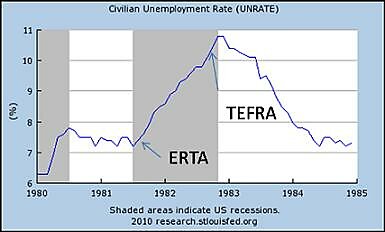
I’m still dealing with the statist echo chamber, having been hit with two additional attacks for the supposed sin of endorsing Reaganomics over Obamanomics (my responses to the other attacks can be found here and here). Some guy at the Atlantic Monthly named Steve Benen issued a critique focusing on the timing of the recession and recovery in Reagan’s first term. He reproduces a Krugman chart (see below) and also adds his own commentary.
Reagan’s first big tax cut was signed in August 1981. Over the next year or so, unemployment went from just over 7% to just under 11%. In September 1982, Reagan raised taxes, and unemployment fell soon after. We’re all aware, of course, of the correlation/causation dynamic, but as Krugman noted in January, “[U]nemployment, which had been stable until Reagan cut taxes, soared during the 15 months that followed the tax cut; it didn’t start falling until Reagan backtracked and raised taxes.”
This argument is absurd since the recession in the early 1980s was largely the inevitable result of the Federal Reserve’s misguided monetary policy. And I would be stunned if this view wasn’t shared by 90 percent-plus of economists. So it is rather silly to say the recession was caused by tax cuts and the recovery was triggered by tax increases.
But even if we magically assume monetary policy was perfect, Benen’s argument is wrong. I don’t want to repeat myself, so I’ll just call attention to my previous blog post which explained that it is critically important to look at when tax cuts (and increases) are implemented, not when they are enacted. The data is hardly exact, because I haven’t seen good research on the annual impact of bracket creep, but there was not much net tax relief during Reagan’s first couple of years because the tax cuts were phased in over several years and other taxes were going up. So the recession actually began when taxes were flat (or perhaps even rising) and the recovery began when the economy was receiving a net tax cut. That being said, I’m not arguing that the Reagan tax cuts ended the recession. They probably helped, to be sure, but we should do good tax policy to improve long-run growth, not because of some misguided effort to fine-tune short-run growth.
The second attack comes from some blog called Econospeak, where my newest fan wrote:
I’m scratching my head here as I thought the standard pseudo-supply-side line was that the deficit exploded in the 1980’s because government spending exploded. OK, the truth is that the ratio of Federal spending to GDP neither increased nor decreased during this period. Real tax revenues per capita fell which is why the deficit rose but this notion that the burden of government fell is not factually based.
Those are some interesting points, and I might respond to them if I wanted to open a new conversation, but they’re not germane to what I said. In my original post (the one he was attacking), I commented on the “burden of government” rather than the “burden of government spending.” I’m a fiscal policy economist, so I’m tempted to claim that the sun rises and sets based on what’s happening to taxes and spending, but such factors are just two of the many policies that influence economic performance. And with regard to my assertion that Reagan reduced the “burden of government,” I’ll defer to the rankings put together for the Economic Freedom of the World Index. The score for the United States improved from 8.03 to 8.38 between 1980 and 1990 (my guess is that it peaked in 1988, but they only have data for every five years). The folks on the left may be unhappy about it, but it is completely accurate to say Reagan reduced the burden of government. And while we don’t yet have data for the Obama years, there’s a 99 percent likelihood that America’s score will decline.
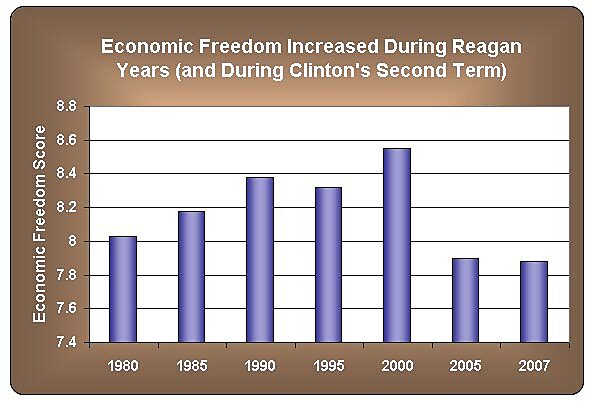
This is not a partisan argument, by the way. The Economic Freedom of the World chart shows that America’s score improved during the Clinton years, particularly his second term. And the data also shows that the U.S. score dropped during the Bush years. This is why I wrote a column back in 2007 advocating Clintonomics over Bushonomics. Partisan affiliation is not what matters. If we want more prosperity, the key is shrinking the burden of government.
Last but not least, I try to make these arguments to the folks watching MSNBC.