Did anyone think the U.S. Department of Justice was really up for a flood of “pool closes for fear of ADA liability” stories over Memorial Day weekend? So instead they’ve announced another delay in their rules, this time carrying them until safely after the election, specifically Jan. 31. The Department is murmuring about being “flexible” when it eventually gets around to enforcing the mandatory permanent-lift regulations, which have raised a storm of criticism (more here and here) as unreasonably burdensome to pool operators. The House has passed a rider cutting off funds for the enforcement of the regulation, over objections from Rep. Steny Hoyer (D‑MD) and others, but the fate of the rider in the Senate is considered less promising.
Cato at Liberty
Cato at Liberty
Government and Politics
University of Texas law professor Sanford Levinson has an op-ed in today’s New York Times on the thesis of his new book, Framed. He makes the observation that too many Americans “have seemingly lost their capacity for thinking seriously about the extent to which the Constitution serves us well. Instead, the Constitution is enveloped in near religious veneration.” That’s a fair point. I have no doubt that if, say, podcast interviews were around in the 1790s, Patrick Henry, George Mason, James Madison, and the other leaders of that time would tell us very frankly what they disliked about the Constitution and what improvements they thought would be beneficial. Such discussions are pretty rare nowadays and that is lamentable. A few weeks ago, Professor Levinson stopped by Cato for an informal luncheon to discuss his book and reform proposals.
Professor Levinson and Cato scholars tend to disagree about his view of political “gridlock” and whether it is responsible for the electorate’s low opinion of the Congress and of the federal government more generally. Speaking only for myself, I agree with Professor Levinson that the Article V amendment procedure has proven to be a defect and I explain why here (pdf).
The Supreme Court has waded back into the affirmative action thicket, taking up the issue of the proper role, if any, of race in college admissions, in the case of Fisher v. University of Texas at Austin, which it will be hearing this fall, likely in October.
Abigail Fisher, who is white, was denied admission to the University of Texas at Austin even though her academic credentials exceeded those of many admitted minority applicants. She challenged UT-Austin’s consideration of race in selecting its incoming freshmen but lost before the district court in light of the Supreme Court’s 2003 ruling in Grutter v. Bollinger.
In Grutter, a divided Court held that using race as a factor (but not one tied to a set number of points or quotas) was justified in the name of diversity. But UT-Austin’s admissions program treats race in a different way, and gets different results, than did the admissions program Grutter upheld at the University of Michigan Law School.
The Fifth Circuit panel nevertheless affirmed the district court, but Judge Emilio Garza specially concurred to say that while he was bound by Grutter, that decision seemed to conflict with other precedent and with the Fourteenth Amendment’s Equal Protection Clause. The Fifth Circuit then voted 9–7 against rehearing the case en banc (before all judges on the court), over a sharp dissent from Chief Judge Edith Jones that emphasized how the ruling would allow states to play fast-and-loose with Grutter’s narrow-tailoring requirement.
Now before the Supreme Court, Cato filed an amicus brief supporting Abby Fisher and arguing that the Fifth Circuit showed blind deference to UT’s policy rather than the constitutionally demanded strict scrutiny. The lower court explicitly declined to evaluate the merits of UT’s decision to consider race, instead assuming the institution’s good faith. Under this rule, a public university’s mere assertion of a diversity interest, irrespective of the university’s precise circumstances or actual motivations, trumps an applicant’s right to be treated as an individual rather than a racial specimen.
We also point out that the Fifth Circuit ignored the Supreme Court’s requirement (from the 1989 case of City of Richmond v. J.A. Croson Co.) that the government demonstrate a “strong basis in evidence” for racial classifications in order to smoke out the illegitimate motivations that can underlie such schemes. That is, Grutter upheld Michigan’s racial preferences because the school showed that minority enrollment would have plummeted to almost nothing without them, while UT had already achieved real diversity (beyond even that created by Michigan’s preferences) with a race-neutral law that guarantees admission to anyone graduating in the top 10 percent of a Texas public school.
Finally, we note that even if UT could show that racial preferences were necessary for some legitimate reason, its chosen paradigm for applying such preferences is arbitrary. For example, UT justifies preferences to Hispanics by pointing to the need for a “critical mass” of such students, even as it denies preferences to Asians, who comprise a smaller portion of the student body.
We urge the Supreme Court to reign in UT’s unbridled use of race in admissions decisions and take an important step toward ensuring that young Americans are judged on their qualifications and character rather than their skin color.
In Sunday’s New York Daily News, I deplore the efforts of politicians and regulators to drag successful companies into the parasite economy of Washington, the most recent example being Apple. As the article says,
Heard of “too big to fail”? Well, to Washington, Apple is now too big not to nail.
I was prompted to these reflections by a recent article in Politico. The Wall Street Journal used to call itself “the daily diary of the American dream.” Politico is the daily diary of the rent-seeking class. And that class is very upset with Apple for not hiring many lobbyists, as illustrated by Politico’s front-page cartoon:
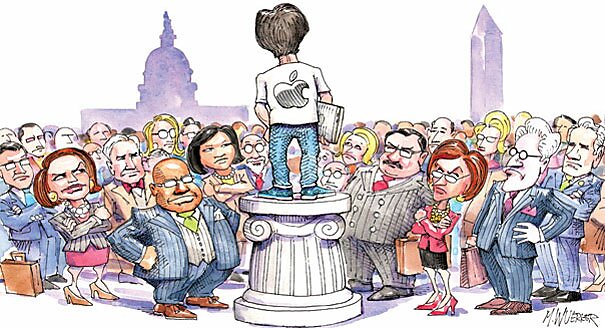
The story begins:
Apple is taking a bruising in Washington, and insiders say there’s a reason: It’s the one place in the world where the company hasn’t built its brand.
In the first three months of this year, Google and Microsoft spent a little more than $7 million on lobbying and related federal activities combined. Apple spent $500,000 — even less than it spent the year before.
The nerve of them! How do they expect lobbyists to feed their families? Then comes my favorite part:
The company’s attitude toward D.C. — described by critics as “don’t bother us” — has left it without many inside-the-Beltway friends.
“Don’t bother us”—yes! Don’t tread on me. Laissez nous faire. Leave us alone. Just let us sit out here in Silicon Valley, inventing cool stuff and distributing it to the world. We won’t bother you. Just don’t bother us.
But no pot of money can be left unbothered by the regulators and rent-seekers.
Apple is mostly on its own when the Justice Department goes after it on e‑books, when members of Congress attack it over its overseas tax avoidance or when an alphabet soup of regulators examine its business practices.
And what does the ruling class say to productive people who try to just avoid politics and make stuff? Nice little company ya got there, shame if anything happened to it:
“I never once had a meeting with anybody representing Apple,” said Jeff Miller, who served as a senior aide on the Senate Judiciary Committee’s Antitrust Subcommittee for eight years. “There have been other tech companies who chose not to engage in Washington, and for the most part that strategy did not benefit them.”
As I noted in the Daily News, back in 1998 Microsoft was in the same situation—a successful company on the West Coast, happily ignoring politics, getting too rich for politics to ignore it—and a congressional aide told Fortune’s Jeff Birnbaum, “They don’t want to play the D.C. game, that’s clear, and they’ve gotten away with it so far. The problem is, in the long run they won’t be able to.” All too true.
Watch out, aspiring entrepreneurs. You too could become too big not to nail.
Related Tags
Last week, I jumped into the surreal debate about whether Obama has been the most fiscally conservative president in recent history.
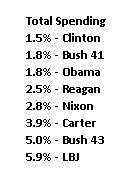
I sliced the historical data from the Office of Management and Budget a couple of ways, showing that overall spending has grown at a relatively slow rate during the Obama years. Adjusted for inflation, both total spending and primary spending (total spending minus interest payments) have been restrained.
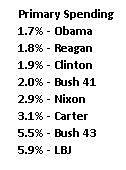
So does this make Obama a fiscal conservative?
And how can these numbers make sense when the President saddled the nation with the faux stimulus and ObamaCare?
Good questions. It turns out that Obama’s supposed frugality is largely the result of how TARP is measured in the federal budget. To put it simply, TARP pushed spending up in Bush’s final fiscal year (FY2009, which began October 1, 2008) and then repayments from the banks (which count as “negative spending”) artificially reduced spending in subsequent years.
The combination of those two factors made a big difference in the numbers. Here’s another table from my prior post, looking at how the presidents rank when you subtract both defense and the fiscal impact of deposit insurance and TARP.
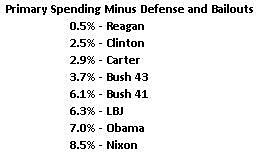
All of a sudden, Obama drops down to the second-to-last position, sandwiched between two of the worst presidents in American history. Not exactly a ringing endorsement.
But this ranking is incomplete. At that point, I was trying to gauge Obama’s record on domestic spending, and the numbers certainly provide some evidence that he is a stereotypical big-spending liberal.
But the main debate is about which president was the biggest overall spender. So I’ve run through the numbers again, and here’s a new table looking at the rankings based on average annual changes in inflation-adjusted primary spending, minus the distorting impact of deposit insurance and TARP.
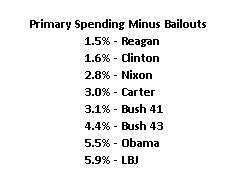
Obama is still in the second-to-last position, but spending is increasing by “only” 5.5 percent per year rather than 7.0 percent annually. This is obviously because defense spending is not growing as fast as domestic spending.
Reagan remains in first place, though his score drops now that his defense buildup is part of the calculations. Clinton, conversely, stays in second place but his score jumps because he benefited from the peace dividend after Reagan’s policies led to the collapse of the Soviet Empire.
Let’s now look at these numbers from a policy perspective. Rahn Curve research shows that government is far too big today, so the goal of fiscal policy should be to restrain the burden of government spending relative to economic output.
This means that policy moves in the right direction when government grows more slowly than the private sector, as it did under Reagan and Clinton.
But if government spending is growing faster than the productive sector of the economy, as has been the case during the Bush-Obama years, then a nation eventually will become Greece.
Related Tags
In Sunday’s Washington Post, U.S. Naval Academy professor John Nagl notes that “For the first time in modern American history, neither major candidate for the presidency has any military experience.” That reminded me of a post I wrote as the 2008 presidential campaign got underway, with only one veteran in the mix. I’ll bring the last line of that post up to the front: “At the very least, candidates who have never served in a war should have some special humility in urging that other Americans be sent to war.”
Some of the other commentary in that post seems still relevant today:
“As some of the leading presidential candidates trooped before the Veterans of Foreign Wars in Kansas City this week, there was one thing largely missing at the lectern — veterans of foreign wars,” writes Peter Baker in the Washington Post, contrasting this year’s campaign with past election years.
Baker grades both former presidents and current candidates on a steep curve. He writes, “Every president from Harry S. Truman to George H.W. Bush served.” But LBJ, already a congressman, went on investigative missions for FDR, admittedly flying around the South Pacific combat zone. And the nearsighted Ronald Reagan made propaganda films in Los Angeles. He even counts George W. Bush as a veteran on the basis of his Texas Air National Guard service.
As for the current candidates,“The torch is being passed to a new generation that’s never worn a uniform,” said Kenneth T. Jackson, a military historian at Columbia University. “It’s a significant change. It means people are now coming of age who are really the post-Vietnam generation.”
But is that really true? The leading Democratic candidates are a woman and a man born in 1961. But John Edwards, born in 1953, Bill Richardson (1947), and Joe Biden (1941) are not “the post-Vietnam generation.” They’re the non-Vietnam generation. A blogger has some more details about the Vietnam records of 2008 candidates here.
As for the Republicans, John McCain famously served, as Baker notes. But Mitt Romney (1947), Rudy Giuliani (1944), Fred Thompson (1942), and Newt Gingrich (1947) are, like their Democratic counterparts, within the age cohorts who went to Vietnam. They weren’t post-Vietnam, just nowhere-near-Vietnam. Mike Huckabee (1955) and Sam Brownback (1956), along with Barack Obama, would seem to the only candidates who are actually from the post-Vietnam generation.
Does this matter? It used to matter to voters. When I asked my parents in the 1960s, about 20 years after the end of World War II, why all the local candidates listed themselves as veterans on all their campaign literature, my mother told me that you’d wonder what was wrong with a man who hadn’t served in “the war.” Today, some worry that military veterans might be more eager to go to war. Historian Jackson sees it differently: “When you have leaders who haven’t gone [to war], I do think it changes the equation a little bit,” he told the Post. “It’s a little bit worrisome. People who have actually been to war … are actually a little less inclined to go to war. Generals know what war’s about, and they’re less enthusiastic to go rocketing off than civilians.”
That reminds me of Robert Heinlein’s novel Starship Troopers, often denounced as militaristic or even fascist, especially by people who have only seen the movie. In the novel, only military veterans were citizens with voting rights. But the basis for that was classical republicanism: that only those who were willing to defend the society, and who by facing combat had come to understand the real meaning of power and war and violence, could be trusted to lead the society.
At the very least, candidates who have never served in a war should have some special humility in urging that other Americans be sent to war.
Related Tags
While campaigning for former Hawaii governor Linda Lingle, who is now running for U.S. Senate, Rep. Tom Cole (R‑OK), the only Native American in Congress, said that opposition to the Akaka Bill is “arrogant” meddling in local affairs. (The Akaka Bill, which I’ve covered extensively, would create a race-based governing entity that would negotiate with the federal and state governments over all sorts of issues—effectively carving out an unconstitutional system of racial spoils.)
As quoted in the Honolulu Star-Advertiser ($):
“Hawaii has told us again and again, on a bipartisan basis, this is what we want to do,” Cole said. “I’d have to tell you, I think it’s incredibly arrogant, whether it’s a Republican or a Democrat that opposes tribal sovereignty — in this case sovereignty for Native Hawaiians—when the people of Hawaii have told us we’d like it. Who are we to impose our opinions?”
Cole’s attack is not only a calumny on those who oppose the Akaka Bill in good faith—including all but six of his House Republicans who voted against it in 2010 after years of deliberation, public vetting, and a 2006 Department of Justice conclusion that the bill was unwise as a policy matter and presented serious constitutional difficulties—but itself displays a dangerous misunderstanding of the issues involved.
It’s easy to think of the Akaka Bill as being “merely” another request for self-governance by native peoples as was extended to Aleuts upon Alaskan statehood, but that’s simply not what’s going on in Hawaii. Hawaiians, “Native” and otherwise, have a different history and political sociology from the tribes that are accommodated in our (dubious and counterproductive) Indian law, which itself is a unique compromise with pre-constitutional reality. Congress can’t simply define Hawaiians as an “Indian tribe” because that term has a fixed meaning, limited to preexisting North American tribes that were “dependent nations” at the time of the Founding. Such tribes, to benefit from the protections of Indian law, must have an independent existence and “community” apart from the rest of American society, and their separate government structure must have a continuous history for at least the past century. By these standards, Hawaiians don’t qualify.
Moreover, it’s false to say that Hawaiians support the Akaka Bill or ethnic/racial preferences more broadly. There has never been a public referendum—Akaka Bill supporters resist such a move—but a November 2009 Zogby poll revealed that 51% of Hawaiians oppose the bill, 60% opposed if you remove the undecideds. In addition, 76% would oppose tax increases to pay for the Akaka nation-tribe (which would be inevitable), only 7% favor separate laws and regulations for a new native government, and only 28% say the bill is fair with respect to racial discrimination. Perhaps most importantly, 58% would want a chance to vote before the Akaka Bill could become law, with only 28% saying that would be unnecessary.
Finally, and quite apart from the policy and political considerations, the Akaka Bill has serious constitutional defects. As mentioned above, the Constitution’s anamolous Indian law exception was created by the document itself and Congress still retains a great amount of oversight. Once the Constitution was ratified, no government organized under it could create another government that can exempt itself from the Bill of Rights. Even setting these structural issues aside, the Akaka Bill is facially disallowed by the Fifth and Fourteenth Amendments’ explicit proscription against any state action that treats people differently based on their race or ethnicity. The Supreme Court has found Native Hawaiians to be an ethnic group, so Congress cannot pass a law giving them rights denied other Americans.
I respect Rep. Cole’s right to hold a different view of the Akaka Bill’s merits than mine, in which case he could have said something like, “Some folks have principled objections to this. I think they’re wrong. I think they misread the Constitution and don’t appreciate Hawaii’s unique history. We need to show them why they should come over to our side, and Linda Lingle can help me do that.” Instead, he accuses us critics of arrogance, ignorance, and willfully thwarting Hawaiians’ dreams of self-determination.
With all due respect, Rep. Cole (and Gov. Lingle to the extent she associates herself with his remarks), if you want to pass the Akaka Bill, you need to do a better job of answering some very valid concerns rather than engaging in base demagoguery. And these concerns aren’t limited to parochial issues relevant only to Hawaiians. So long as Hawaii remains part of the United States, all Americans have a stake in the future of the state and how it treats its citizens.
h/t Steven Duffield