Cato at Liberty
Cato at Liberty
Government and Politics
Paul Krugman recently tried to declare victory for Keynesian economics over so-called austerity, but all he really accomplished was to show that tax-financed government spending is bad for prosperity.
More specifically, he presented a decent case against the European-IMF version of “austerity,” which has produced big tax increases.
But what happens if nations adopt the libertarian approach, which means “austerity” is imposed on the government, rather than on taxpayers?
In the past, Krugman has also tried to argue that European nations have erred by cutting spending, but this has led to some embarrassing mistakes.
- He asserted that “British growth has stalled” because of “spending cuts,” but he overlooked the elementary fact that government spending in the U.K. was growing twice as fast as inflation.
- And in the case of Estonia, where there actually were genuine spending cuts, he wanted people to somehow think that those cuts in 2009 were responsible for an economic downturn that occurred in 2008.
Now we have some additional evidence about the absence of spending austerity in Europe. A leading public finance economist from Ireland, Constantin Gurdgiev, reviewed the IMF data and had a hard time finding any spending cuts:
…in celebration of that great [May 1] socialist holiday, “In Spain, Portugal, Greece, Italy and France tens of thousands of people took to the streets to demand jobs and an end to years of belt-tightening”. Except, no one really asked them what did the mean by ‘belt-tightening’. …let’s check out expenditure side of Europe’s ‘savage austerity’ story… The picture hardly shows much of any ‘savage cuts’ anywhere in sight.
As seen in his chart, Constantin compared government spending burdens in 2012 to the average for the pre-recession period, thus allowing an accurate assessment of what’s happened to the size of the public sector over a multi-year period.
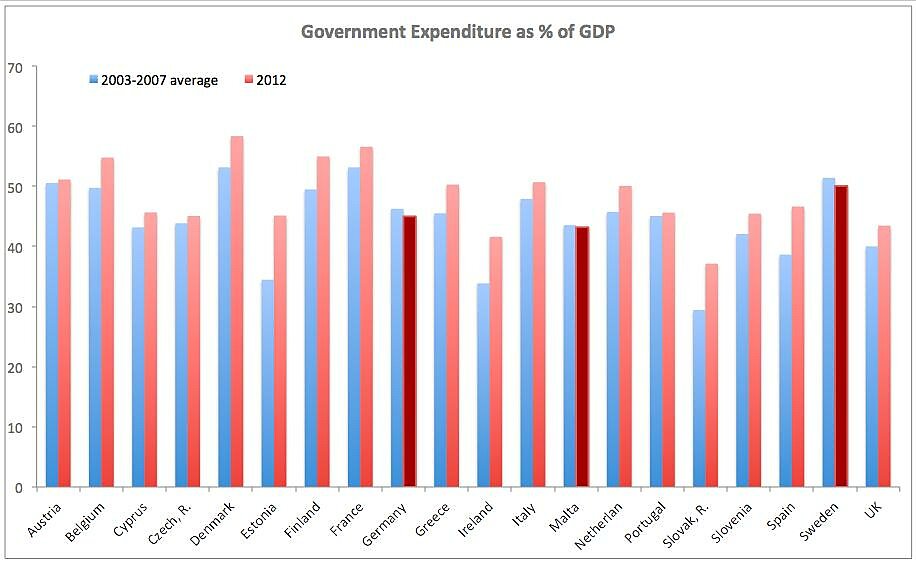
Here are some of his conclusions from reviewing the data:
Of the three countries that experienced reductions in Government spending as % of GDP compared to the pre-crisis period, Germany posted a decline of 1.26 percentage points (from 46.261% of GDP average for 2003–2007 period to 45.005% for 2012), Malta posted a reduction of just 0.349 ppt and Sweden posted a reduction of 1.37 ppt.
No peripheral country — where protests are the loudest — or France et al have posted a reduction. In France, Government spending rose 3.44 ppt on pre-crisis level as % of GDP, in Greece by 4.76 ppt, in Ireland by 7.74 ppt, in Italy by 2.773 ppt, in Portugal by 0.562 ppt, and in Spain by 8.0 ppt.
Average Government spending in the sample in the pre-crisis period run at 44.36% of GDP and in 2012 this number was 48.05% of GDP. In other words: it went up, not down.
…All in, there is no ‘savage austerity’ in spending levels or as % of GDP.
I’ll add a few additional observations.
Sweden and Germany are among the three nations that have reduced the burden of government spending as a share of GDP, and both of those nations are doing better than their European neighbors.
Switzerland isn’t an EU nation, so it’s not included in Constantin’s chart, but government spending as a share of economic output also has been reduced in that nation over the same period, and the Swiss economy also is doing comparatively well.
The moral of the story is that reducing the burden of government spending is the right recipe for sustainable and strong growth. Growth also is far more likely if lawmakers refrain from class-warfare tax policy and instead seek to collect revenue in ways that minimize the damage to prosperity.
Unfortunately, that’s not happening in Europe…and it’s not happening in the United States.
A few countries are moving in the right direction, such as Canada, but with still a long way to travel.
The best role models are still Hong Kong and Singapore, and it’s no coincidence that those two jurisdictions regularly dominate the top two spots in the Economic Freedom of the World rankings.
Related Tags
A lot of people are writing about the Oregon Health Insurance Experiment results, released yesterday, which found zero evidence that expanding Medicaid to the most vulnerable people targeted by ObamaCare’s Medicaid expansion improves their physical health. Here’s my take on the study and its implications. Megan McArdle, Shikha Dalmia, Avik Roy, and Peter Suderman are making solid contributions to the debate. Zeke Emanuel gets points for making an admission against interest (“It’s disappointing”). Points also to Jennifer Rubin for her take on what the OHIE says about ObamaCare’s Medicaid expansion: “If there had been a giant trial of a heart medication with lousy results we wouldn’t proceed in mass-marketing the drug; we might even take it off the shelves.” Not a bad idea. Ezra Klein and Evan Soltas call for more such experiments. Yes! Let’s have more randomized, controlled trials of the effects of Medicaid, on pre-ObamaCare populations, in big states like California, New York, Texas, Florida, and Illinois, where we can harnass even more statistical power. The only unethical thing would be to keep spending trillions on this program without knowing whether it’s even effective (much less cost-effective).
Others are making less-solid contributions. Here’s a question for them.
Since the OHIE shows that Medicaid makes no difference in the diagnosis or use of medication to treat high blood pressure or high cholesterol, and has no effect on blood-sugar levels despite increasing diabetes diagnoses and medication use, would you support eliminating Medicaid coverage for these screenings and medications?
If not, why not?
Related Tags
I often argue that we need to preserve tax competition and tax havens in order to limit the greed of the political class.
Without some sort of external constraint, they will over-tax and over-spend, creating the kind of downward economic spiral already happening in some European nations.
Speaking of which, new evidence from Europe bolsters my case.
Back in 2009, facing pressure from the big G‑20 nations, all of the world’s major low-tax jurisdictions — even Switzerland — acquiesced to the notion that human rights laws protecting financial privacy no longer would apply to foreign investors.
In other words, high-tax governments now have much greater ability to track — and tax — flight capital.
So how have they responded since that time? Well, look at this chart from the European Union’s new report on taxation trends. Tax rates have begun to increase, reversing a very positive trend (which began with the Reagan and Thatcher tax cuts, though this chart only shows data since 1995).
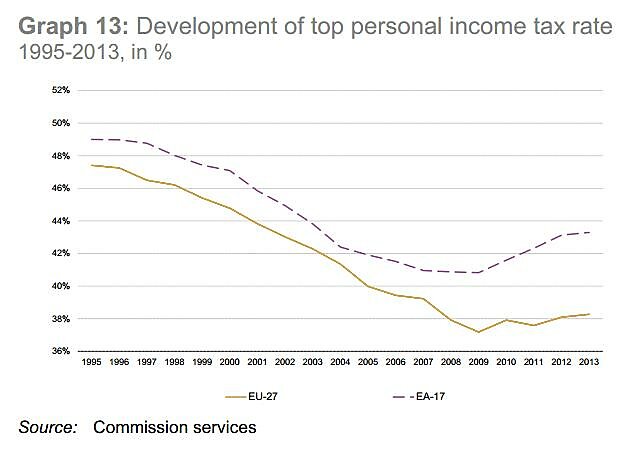
We can’t say, of course, that the increase in tax rates since 2009 is because tax competition was eroded. Just like we can’t say the reduction of tax rates in the preceding years was because of tax competition.
But we do know that simple economic theory tells us that monopolists are more likely to raise prices than firms in competitive markets. Likewise, governments are more likely to raise tax rates if they think taxpayers don’t have escape options.
And we also know that the proponents of higher tax rates, such as the statist bureaucrats at the Paris-based OECD, are also the biggest opponents of tax competition. The OECD even complained in one of its reports that tax competition “may hamper the application of progressive tax rates.”
Well, those international bureaucrats (who, by the way, get tax-free salaries) are getting their wish. Tax rates are increasing.
- So the political class can breathe a sigh of relief.
- But what about the people of Europe? Well, economic growth is almost non-existent and unemployment is at record levels.
However, you can’t make an omelet without breaking a few eggs. As a past representative of Europe’s political elite once remarked, “let them eat cake.”
Marie Antoinette eventually may have regretted her choice of words, but Europe’s current politicians are probably more clever and have contingency plans. When the you-know-what hits the fan and Europe descends into social disarray and economic chaos, ordinary people will be the ones at risk.
Unfortunately, the United States is on the same path, as shown by these sobering charts from the Bank for International Settlements (and also as illustrated by these very funny Michael Ramirez and Bob Gorrell cartoons).
For more information on the important liberalizing impact of tax competition, here’s the video I narrated for the Center for Freedom and Prosperity.
But remember that restraining fiscal burdens is not the only reason to preserve tax competition and tax havens. There also are very important moral reasons to support low-tax jurisdictions.
Related Tags
On Monday, I reported here and on the WashingtonWatch.com blog how Congress was trying to push through a bill that hadn’t been passed in the same form by both the House and Senate.
Well, the Senate solved the problem by lying. It said that the Secretary of the Senate had erred in engrossing the bill–preparing it for transmittal to the House.
There was no error on the part of the Secretary of the Senate. The Senate passed a bill that used only the word “account” and the House-passed bill said “accounts.” The bills weren’t identical, but the Senate is calling it the Secretary’s error.
The “fixed” bill now includes a quite non-grammatical sentence. I detailed that in a new WashingtonWatch.com post entitled: “From Farce to Tragedy.” But who needs precision when you’re moving a mere quarter-billion dollars around?
Were he to enforce it, President Obama’s Sunlight Before Signing promise would require more careful deliberation than this. The public would have five days to review legislation, exposing errors like this and bringing disrepute on those responsible. But the president received the bill on Tuesday and signed it on Wednesday.
Related Tags
President Bush imposed a so-called stimulus plan in 2008 and President Obama imposed an even bigger “stimulus” in 2009. Based upon the economy’s performance over the past five-plus years, those plans didn’t work.
Japan has spent the past 20-plus years imposing one Keynesian scheme after another, and the net effect is economic stagnation and record debt.
Going back further in time, Presidents Hoover and Roosevelt dramatically increased the burden of government spending, mostly financed with borrowing, and a recession became a Great Depression.
That’s not exactly a successful track record, but Paul Krugman thinks the evidence is on his side and that it’s time to declare victory for Keynesian economics.
Those of us who have spent years arguing against premature fiscal austerity have just had a good two weeks. Academic studies that supposedly justified austerity have lost credibility; hard-liners in the European Commission and elsewhere have softened their rhetoric. The tone of the conversation has definitely changed.
But Krugman doesn’t just want to declare victory. He also spikes the football and does a dance in the end zone.
I’m always right while the people who disagree with me are always wrong. And not just wrong, they’re often knaves or fools. …look at the results: again and again, people on the opposite side prove to have used bad logic, bad data, the wrong historical analogies, or all of the above. I’m Krugtron the Invincible!
So why does Krugman feel so confident about his position, notwithstanding the evidence? Veronique de Rugy has a concise and fair assessment of the Keynesian rationale. Simply stated, no matter how bad the results, the Keynesians think the economy would have been in even worse shape in the absence of supposed stimulus.
…the country’s economic performance of the last four or five years can hardly be described has a rousing success for Keynesian economics, at least as implemented by the administration. In fact, measured by the unemployment rate, it hasn’t been a success by the administration’s own standards. To that, Krugman says that the stimulus implemented by the administration wasn’t big enough and, as such, that Keynesian economics hasn’t been tried yet.
Veronique, by the way, points out why this argument is utterly unpersuasive by using the same logic to declare victory for markets.
But by this logic, free-market economics is doing pretty well, too: I think we can all agree that free-market economics wasn’t tried. The economy hasn’t really recovered properly. This must mean free-market economics has won.
But I think the best part of Veronique’s article is the section explaining that not all austerity is created equal. Simply stated, why expect better economic performance if “austerity” means that taxes go up and the burden of government spending stays the same?
Here’s some of what Veronique wrote on this issue.
…austerity, as defined by economists, represents the measures implemented by a government in order to reduce the debt-to-GDP ratio. Unlike Keynesians, I do not think that debt is good for economic growth, but I would prefer the word “austerity” to describe the measures implemented to shrink the size and scope of government… In other words, the important question about austerity has less to do with the size of the austerity package than what type of austerity measures are implemented. …when governments try to reduce the debt by raising taxes, it is likely to result in deep and pronounced recessions, possibly making the fiscal adjustment counterproductive. …austerity measures implemented in Europe are not the kind of austerity we actually need. In fact, the data shows that it has mostly consisted in raising taxes.
Since I’ve repeatedly made these same points, you can understand why I’m a big fan of her analysis.
Moreover, I think this gives us some insight into why Krugman may actually think he has prevailed. Simply stated, he’s comparing Keynesianism to the IMF/European version of austerity.

But that type of “austerity” — as you can see from one of Veronique’s charts — is overwhelmingly comprised of tax hikes.
Yet is anybody surprised that we haven’t seen much — if any — growth in tax-happy nations such as Greece, Portugal, Italy, Ireland, Spain, and the United Kingdom?
What we really need are examples of nations that have reduced the burden of government spending. Then we can compare those results with nations that have tried Keynesianism and nations that have tried tax increases.
Sadly, we only have a few examples of this smaller-government approach. But we get very positive results.
The burden of government spending was reduced during the Reagan years and Clinton years, for instance, and the economy enjoyed good growth in both periods.
Canada was even more aggressive about reducing the size of the state during the 1990s. Their economy also did quite well, notwithstanding Keynesian dogma.
I suspect Keynesians would respond to these examples by asserting it’s okay — at least in theory — to restrain spending if the economy isn’t in recession.*

But then how do they respond to the experience of the Baltic nations? When the financial crisis hit a few years ago, those governments imposed genuine spending cuts and largely avoided the big tax hikes that have plagued other European nations.
Now Estonia, Lithuania, and Latvia are enjoying impressive growth while the nations that raised taxes seem stuck in perpetual recession.**
So let’s recap. When nations try Keynesianism, they get bad results because more government spending isn’t conducive to growth.
When nations raise taxes, they get bad results because you don’t get more growth by penalizing work, saving, investment, and entrepreneurship.
But when nations reduce the burden of government spending and leave more resources in the productive sector, the economy recovers.
Seems like one side can declare victory and spike the football, but it’s not Paul Krugman and the Keynesians.
*I’m guessing one would be hard pressed to find any examples of modern-day Keynesians ever supporting fiscal restraint.
**Krugman tried to undermine the Baltic model of fiscal restraint by attacking Estonia, but wound up with egg on his face.
Related Tags
Today, the nation’s top health economists released a study that throws a huge “STOP” sign in front of ObamaCare’s Medicaid expansion.
The Oregon Health Insurance Experiment, or OHIE, may be the most important study ever conducted on health insurance. Oregon officials randomly assigned thousands of low-income Medicaid applicants — basically, the most vulnerable portion of the group that would receive coverage under ObamaCare’s Medicaid expansion — either to receive Medicaid coverage, or nothing. Health economists then compared the people who got Medicaid to the people who didn’t. The OHIE is the only randomized, controlled study ever conducted on the effects of having health insurance versus no health insurance. Randomized, controlled studies are the gold standard of such research.
Consistent with lackluster results from the first year, the OHIE’s second-year results found no evidence that Medicaid improves the physical health of enrollees. There were some modest improvements in depression and financial strain–but it is likely those gains could be achieved at a much lower cost than through an extremely expensive program like Medicaid. Here are the study’s results and conclusions:
We found no significant effect of Medicaid coverage on the prevalence or diagnosis of hypertension or high cholesterol levels or on the use of medication for these conditions. Medicaid coverage significantly increased the probability of a diagnosis of diabetes and the use of diabetes medication, but we observed no significant effect on average glycated hemoglobin levels or on the percentage of participants with levels of 6.5% or higher. Medicaid coverage decreased the probability of a positive screening for depression [by 30 percent], increased the use of many preventive services, and nearly eliminated catastrophic out-of-pocket medical expenditures…
This randomized, controlled study showed that Medicaid coverage generated no significant improvements in measured physical health outcomes in the first 2 years, but it did increase use of health care services, raise rates of diabetes detection and management, lower rates of depression, and reduce financial strain.
As one of the study’s authors explained to me, it did not find any effect on mortality because the sample size is too small. Mortality rates among the targeted population – able-bodied adults 19–64 below 100 percent of poverty who aren’t already eligible for government health insurance programs – are already very low. So even if expanding Medicaid reduces mortality among this group, and there is ample room for doubt, the effect would be so small that this study would be unable to detect it. That too is reason not to implement the Medicaid expansion. This is not a population that is going to start dying in droves if states decline to participate.
There is no way to spin these results as anything but a rebuke to those who are pushing states to expand Medicaid. The Obama administration has been trying to convince states to throw more than a trillion additional taxpayer dollars at Medicaid by participating in the expansion, when the best-designed research available cannot find any evidence that it improves the physical health of enrollees. The OHIE even studied the most vulnerable part of the Medicaid-expansion population — those below 100 percent of the federal poverty level — yet still found no improvements in physical health.
If Medicaid partisans are still determined to do something, the only responsible route is to launch similar experiments in other states, with an even larger sample size, to determine if there is anything the OHIE might have missed. Or they could design smaller, lower-cost, more targeted efforts to reduce depression and financial strain among the poor. (I propose deregulating health care.) This study shows there is absolutely no warrant to expand Medicaid at all.