A former Heritage Foundation colleague has returned to youtube.com with a video asking taxpayers whether examples of government waste are true or false.
Cato at Liberty
Cato at Liberty
Tax and Budget Policy
Over at Downsizing Government, we focused on the following issues this week:
- Central planners at the U.S. Department of Agriculture are “confounded” by tight sugar supplies. Hayek would be shocked.
- Department of Housing and Urban Development officials continue the agency’s legacy of engaging in politics.
- President Obama says he wants to “invest in our people without leaving them a mountain of debt.” Maybe he meant to say that he wants to “spend other people’s money and leave them with a mountain of debt”?
- Meet the privileged class: federal civilian employees.
- The federal government is a lucrative “industry.”
Related Tags
The White House Office of Management and Budget homepage currently features the following quote from the president:

President Obama says he wants to “invest in our people without leaving them a mountain of debt.”
That’s a curious statement because the Congressional Budget Office’s analysis of the president’s current budget proposal projects that publicly held debt as a share of the economy would reach levels last seen at the end of the Second World War.
When the CBO’s numbers are plugged into a bar chart, the projected Obama debt levels (red bars) look like…the upward slope of a mountain (!):

To be fair, Obama’s predecessors — particularly the previous Bush administration — share in the responsibility for the mountainous rise in federal debt. However, that’s all the more reason for the Obama administration to work toward a peak instead of a steeper incline.
Related Tags
An article in today’s The USA Today titled, “With Many Still in Dark, Groups Shed Light on Health Care Law,” aims to correct misinformation about ObamaCare. Ironically, the article is itself a monument to misinformation.
It begins:
True or false: The new health care law will cut Medicare benefits for seniors. It will slash Medicare payments to doctors. It will ration health care.
In three polls conducted last month, large percentages of Americans answered “true” to each statement. All three are false.
In fact, two of the three statements are 100-percent true.
First, ObamaCare will cut payments to the private health insurance companies that provide coverage to the 20 percent of Medicare enrollees who participate in the Medicare Advantage program. That will eliminate many types of coverage for seniors in Medicare Advantage. That should be painfully obvious, but if you require confirmation, visit FactCheck.org. ObamaCare will also ratchet down the price controls that Medicare uses to pay hospitals and many other health care providers. It should likewise be obvious that that will reduce access to services that are ostensibly “guaranteed” to all enrollees. But again, if you need confirmation, check in with Medicare’s chief actuary, who works for President Obama. We can debate whether that’s good or bad. What’s not up for debate: ObamaCare in fact “will cut Medicare benefits for seniors.”
Second, it is also true — ipso facto – that ObamaCare “will ration health care.” To ration is to limit consumption. When ObamaCare reduces coverage for Medicare Advantage enrollees and reduces access to care for all Medicare enrollees, it limits seniors’ consumption of medical care. We can debate whether that’s good or bad. What’s not up for debate: that is rationing.
Finally, yes, it is technically false that ObamaCare “will slash Medicare payments to doctors.” But since current law will slash Medicare payments to doctors if Congress does nothing, and since an earlier version of ObamaCare would have eliminated those cuts, but ObamaCare’s architects dropped that provision so as to make ObamaCare appear deficit-neutral… well, perhaps the public can be forgiven if it confuses “eliminating a provision that would have prevented cuts in Medicare payments to doctors” with “slashing Medicare payments to doctors.”
USA Today continues:
The debunked idea raised by opponents during congressional debate that “death panels” could make end-of-life decisions is seen as real by nearly half of those surveyed.
I’ll rate this statement misinformed and misleading.
First, Sarah Palin’s claim about “death panels” was true at the moment she said it, even if she didn’t know why.
Second, by rationing Medicare enrollees’ access to medical services (see above), ObamaCare will effectively make end-of-life decisions for seniors. According to Medicare’s chief actuary, ObamaCare could force one in six hospitals to stop accepting Medicare patients. If ObamaCare results in there no longer being a hospital bed waiting for Grandma at the end of her life, that’s an end-of-life decision. It wasn’t a personalized decision. It’s not even necessarily the wrong decision. But let’s drop this nonsense about ObamaCare not making end-of-life decisions for seniors. And ObamaCare did create a panel that will make many of these implicit rationing decisions. It’s called the Independent Payment Advisory Board.
But my guess is that people tell pollsters that ObamaCare will make end-of-life decisions because they understand the Golden Rule, and that he who pays the piper calls the tune. So long as the government purchases medical care, it will be the government that decides who receives it and who doesn’t. And ObamaCare gave government a lot more of the gold.
USA Today packed a lot of misinformation into this one sentence:
The National Council on Aging posed 12 questions about the law to 636 seniors and found that fewer than 17% of them knew half the answers.
Actually, it’s NCOA that doesn’t know the answers. Here are a few of their poll’s true-false questions:
- “The new law will result in future cuts to your basic Medicare benefits.” A plurality of seniors (42 percent) responded “true.” And they’re right: as Medicare’s chief actuary has explained and as NCOA should know, ObamaCare will reduce access to care for Medicare enrollees. That’s a benefit cut, unless you think “coverage without care” counts as a benefit. Yet according to NCOA, the correct answer is “false.” Just 22 percent of seniors agreed.
- “Under the new health reform law, Medicare Advantage plans will cut benefits and increase premiums.” NCOA says the correct response is “don’t know,” and that’s the answer that 56 percent of seniors gave. Perhaps seniors haven’t read the chief Medicare actuary’s report, which found that ObamaCare “will result in less generous benefits packages” in Medicare Advantage and “when the MA provisions will be fully phased in, enrollment in MA plans will be lower by about 50 percent.” But NCOA should have read that report, and should therefore know that the correct answer is “true.”
- “The new law is projected to increase the federal budget deficit over the next ten years and beyond.” Again, a plurality (49 percent) responded “true.” Again, they’re right. Yet NCOA thinks the correct response is “false.” No doubt NCOA would point to the Congressional Budget Office projections that ObamaCare will reduce the deficit. But those projections are valid only if ObamaCare “remain[s] unchanged throughout the next two decades, which is often not the case for major legislation.” The CBO wrote this would particularly be a problem with ObamaCare, which “would maintain and put into effect a number of policies that might be difficult to sustain over a long period of time.” So one could reasonably interpret the CBO to have projected an increase, not a decrease in the deficit. Alternatively, seniors could have been thinking about former CBO director Douglas Holtz-Eakin, who projected in The New York Times that ObamaCare “would raise, not lower, federal deficits, by $562 billion.” There are lots of reasons why “true” is in fact the correct answer. (One of them is that NCOA used the passive construction “is projected.”) Only 14 percent of seniors agreed with NCOA.
- “As a result of the new law, the solvency of the Medicare Trust Fund will be extended by about 9 years to 2026.” A majority of seniors responded “don’t know” (54 percent), while another 22 percent responded “false.” Either answer is more correct than NCOA’s preferred answer (“true”). There are no assets in the Medicare “trust fund.” Thus there is no date by which those non-assets will be exhausted. Indeed, the “trust fund” has absolutely no effect on Medicare’s solvency. The very premise of this question is a fraud. Someone needs to educate seniors about the Medicare trust fund, but NCOA is not the group to do it.
- “The health care reform law will cut Medicare payments to doctors.” A plurality of seniors responded “true” (45 percent), while only 14 percent of seniors gave NCOA’s preferred response (“false”). But again, perhaps seniors can be forgiven on this one (see above).
USA Today should have dug a little deeper.
More misinformation:
More than four in 10 people in the Kaiser poll wrongly believe the law included a government panel to make end-of-life decisions for Medicare patients.
Again, ObamaCare does include a panel that would implicit rationing decisions, including for Medicare patients at the end of life (see above).
More misinformation still:
As the Department of Health and Human Services issues the regulations needed to implement the law, it’s trying to get the facts out through its website, healthcare.gov. The Centers for Medicare and Medicaid Services is helping, most recently with a cable TV ad featuring Andy Griffith.
FactCheck.org found that Andy Griffith used “weasel words” to “mislead” seniors about ObamaCare. How is USA Today not aware of that?
Related Tags
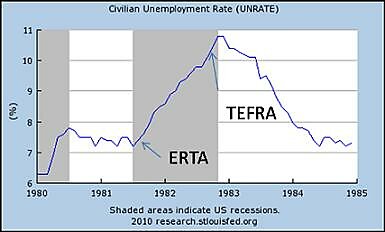
I’m still dealing with the statist echo chamber, having been hit with two additional attacks for the supposed sin of endorsing Reaganomics over Obamanomics (my responses to the other attacks can be found here and here). Some guy at the Atlantic Monthly named Steve Benen issued a critique focusing on the timing of the recession and recovery in Reagan’s first term. He reproduces a Krugman chart (see below) and also adds his own commentary.
Reagan’s first big tax cut was signed in August 1981. Over the next year or so, unemployment went from just over 7% to just under 11%. In September 1982, Reagan raised taxes, and unemployment fell soon after. We’re all aware, of course, of the correlation/causation dynamic, but as Krugman noted in January, “[U]nemployment, which had been stable until Reagan cut taxes, soared during the 15 months that followed the tax cut; it didn’t start falling until Reagan backtracked and raised taxes.”
This argument is absurd since the recession in the early 1980s was largely the inevitable result of the Federal Reserve’s misguided monetary policy. And I would be stunned if this view wasn’t shared by 90 percent-plus of economists. So it is rather silly to say the recession was caused by tax cuts and the recovery was triggered by tax increases.
But even if we magically assume monetary policy was perfect, Benen’s argument is wrong. I don’t want to repeat myself, so I’ll just call attention to my previous blog post which explained that it is critically important to look at when tax cuts (and increases) are implemented, not when they are enacted. The data is hardly exact, because I haven’t seen good research on the annual impact of bracket creep, but there was not much net tax relief during Reagan’s first couple of years because the tax cuts were phased in over several years and other taxes were going up. So the recession actually began when taxes were flat (or perhaps even rising) and the recovery began when the economy was receiving a net tax cut. That being said, I’m not arguing that the Reagan tax cuts ended the recession. They probably helped, to be sure, but we should do good tax policy to improve long-run growth, not because of some misguided effort to fine-tune short-run growth.
The second attack comes from some blog called Econospeak, where my newest fan wrote:
I’m scratching my head here as I thought the standard pseudo-supply-side line was that the deficit exploded in the 1980’s because government spending exploded. OK, the truth is that the ratio of Federal spending to GDP neither increased nor decreased during this period. Real tax revenues per capita fell which is why the deficit rose but this notion that the burden of government fell is not factually based.
Those are some interesting points, and I might respond to them if I wanted to open a new conversation, but they’re not germane to what I said. In my original post (the one he was attacking), I commented on the “burden of government” rather than the “burden of government spending.” I’m a fiscal policy economist, so I’m tempted to claim that the sun rises and sets based on what’s happening to taxes and spending, but such factors are just two of the many policies that influence economic performance. And with regard to my assertion that Reagan reduced the “burden of government,” I’ll defer to the rankings put together for the Economic Freedom of the World Index. The score for the United States improved from 8.03 to 8.38 between 1980 and 1990 (my guess is that it peaked in 1988, but they only have data for every five years). The folks on the left may be unhappy about it, but it is completely accurate to say Reagan reduced the burden of government. And while we don’t yet have data for the Obama years, there’s a 99 percent likelihood that America’s score will decline.
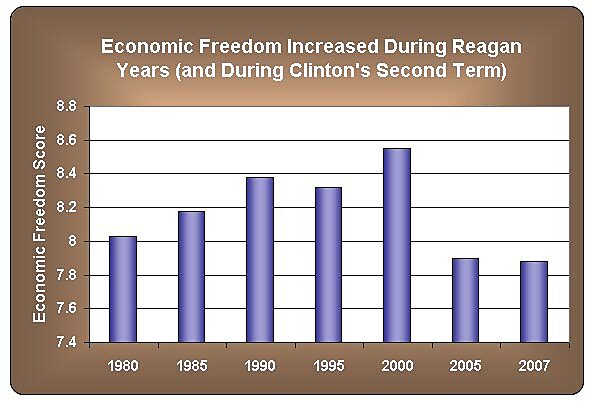
This is not a partisan argument, by the way. The Economic Freedom of the World chart shows that America’s score improved during the Clinton years, particularly his second term. And the data also shows that the U.S. score dropped during the Bush years. This is why I wrote a column back in 2007 advocating Clintonomics over Bushonomics. Partisan affiliation is not what matters. If we want more prosperity, the key is shrinking the burden of government.
Last but not least, I try to make these arguments to the folks watching MSNBC.
Related Tags
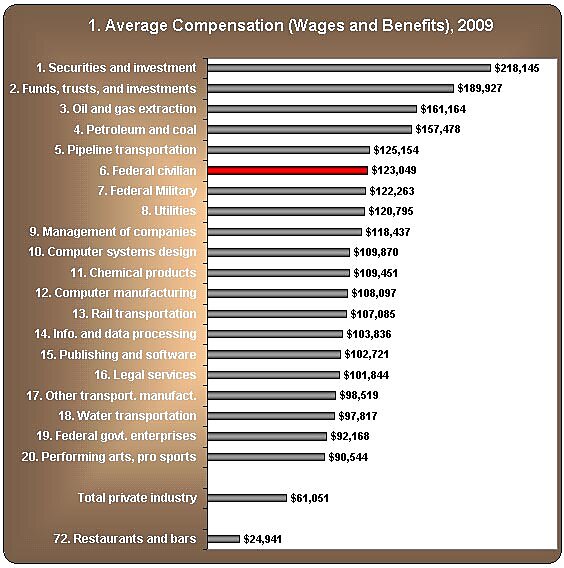
The Bureau of Economic Analysis latest release of industry compensation levels shows that the average federal worker ranks up at the top along with employees in the finance and energy industries. That’s not exactly popular company these days.
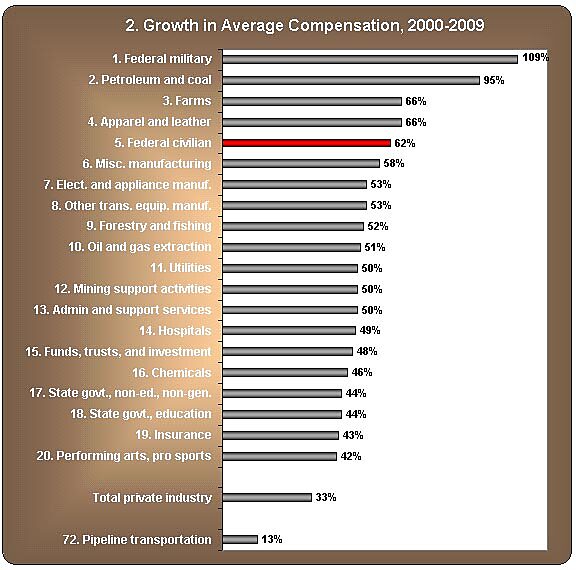
The BEA presents compensation data for 72 industries that span the U.S. economy. Figure 1 shows the 20 industries with the highest levels of average compensation, which includes wages and benefits. It also shows the average for all U.S. private industries and the average for the industry with the lowest compensation. (The names of the industries have been simplified in some cases).
Federal civilian workers have the sixth highest average compensation of the 72 industries:
As yesterday’s post showed, federal employee compensation has exploded over the course of the decade. Figure 2 shows that this federal employee compensation growth has been the fifth highest of the 72 industries measured by the BEA:
Related Tags
In the gag-inducing tradition of National Education Association propaganda, President Obama’s “Organizing for America” has released the video below taking issue with House Minority Leader John Boehner (R‑OH) calling teachers a “special interest.” Watch…and wince.
Now, certainly many teachers want nothing more than to teach and do a good job. Some might even do it as much “for the kids” as their own personal satisfaction. But teachers, at least as represented by the NEA and the American Federation of Teachers, sure as heck are a special interest. Indeed, they might be called a super-special interest, with unparalled sway over Democrats especially, and an incredible ability to get money out of taxpayers.
But what about teachers’ saintliness?
Certainly many teachers work hard and spend some money out of their own pockets for the kids. But no public-school teacher is so poor that, unlike the no doubt intentionally bedgraggled-looking Jeff in the video, he or she can’t afford anything other than an undershirt to wear. Indeed, as I made clear in my PA Unbearable Burden? Living and Paying Student Loans as a First-Year Teacher, even the lowest-paid public school teachers can afford nice apartments, good food, and much beyond life’s essentials. And the average teacher, on an hourly basis, earns more than the average accountant, nurse, or insurance unerwriter.
Ah, but teachers work “twelve, thirteen hours” a day, right? I mean, isn’t that what destitute Jeff said?
Again, maybe some do, but the vast majority do not. Indeed, according to time-diary research done a few years ago, during the months when teachers are actually working as teachers — so not including lengthy summer and other vacations — the average teacher only does about 7.3 hours of education work inside or outside the school on weekdays, and about two hours on weekends. That’s 18 minutes less per day than the average person in a comparable, full-time professional job. And again, that doesn’t account for teachers’ long, built-in vacations.
So get off it, teacher unionists and apologists. Teacher unions are a gigantic special interest, and all the super-earnest-sounding, unkempt video subjects in the world aren’t going to change that.