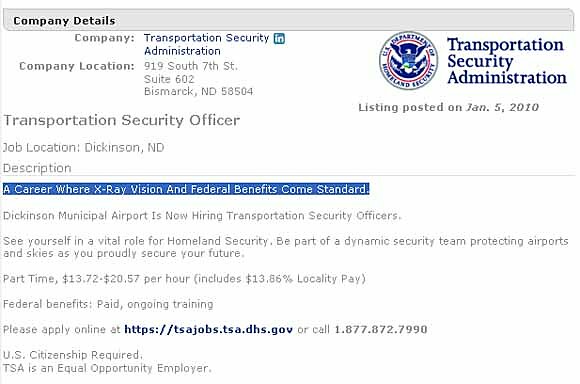
That’s the slogan the Transportation Security Administration is apparently using to entice people to apply for jobs as airport screeners. Now that they’re preparing to expand the use of whole body imaging scanners, which can produce moderately detailed nude images of travelers, maybe they should consider a tagline that doesn’t sound like it’s designed to recruit voyeurs.
Cato at Liberty
Cato at Liberty
Topics
How the Media Are Covering ‘Head Start’s’ Failure
A day after it was released, here’s a roundup of how the mainstream media are covering the HHS study showing that America’s $100 billion plus investment in Head Start is a failure:
[…crickets…]
Nada. Zilch. Rien du tout, mes amis.
That’s based on a Google News search for [“Head Start” study]. The only media organs to touch on this topic so far have been blogs: Jay Greene’s, The Heritage Foundation’s, the Independent Women’s Forum, and the one you’re reading right now.
Okay. There was one exception. According to Google News, one non-blog — with a print version no less — covered this story so far. The NY Times? The Washington Post? Nope: The World, a Christian news magazine. And they actually did their homework, linking to this recent and highly relevant review of the research on pre‑K program impacts.
And for those other publications in the MSM still standing at the edge of the pool: the water’s warm folks, c’mon in.
What’s really interesting, though, is that the HHS had the moral fibre to actually issue a press release about this damning study. That showed courage — and a certain panache. I particularly liked this, from HHS Secretary Kathleen Sebelius: “Research clearly shows that Head Start positively impacts the school readiness of low-income children.”
Umm, yes Ms. Secretary, but the same research shows those effects vanish by the end of first grade. I guess that information is on a need-to-not-know basis. The public needs to not know about it or the administration hasn’t got a snowball’s chance in Kauai of getting American tax payers to throw another $100 billion or so at government pre‑K, as President Obama is so very keen to do.
Update:
In my original review of the coverage on this story I missed the blog that first broke the story: Early Ed Watch at the New America Foundation. One thing that distinguishes New America’s supporters of big government pre‑k programs from those in the Obama administration is that the former have a good grasp of the implications of this study, writing that: “The next few weeks are probably going to be rocky ones for the Head Start community. Results released today from the Impact Study show that children’s gains from participating in Head Start, documented in a 2005 installment of the study, do not last through the end of 1st grade.”
But if the folks at the NAF recognize this reality, that begs an important question: will they now redirect their efforts to the support of programs whose benefits for disadvantaged children actually grow in magnitude the longer kids stay in school, or will they continue to push for programs like Head Start that have been proven costly failures?
Related Tags
Thursday Links
- Nat Hentoff: If you’re looking for reform in Cuba, don’t rest your hopes on Raul Castro.
- Tim Carney, author of Obamanomics: How Barack Obama Is Bankrupting You and Enriching His Wall Street Friends, Corporate Lobbyists, and Union Bosses gives the inside scoop on why big government is good for big business.
- The Patriot Act: What should go, and what should stay?
- Dear Poor People- “Please remain poor.” Sincerely, Obamacare.
- Podcast: “Obamanomics in Health Care” featuring Tim Carney.
Related Tags
Madeleine Albright’s Confusion
Former secretary of state Madeleine K. Albright writes in Parade magazine that 20 years after the Berlin Wall, “We Must Keep Freedom Alive.” A commendable sentiment, but the article is a bit confused, notably in that it seems to use “freedom” and “democracy” interchangeably. But as Fareed Zakaria and Tom Palmer, among others, have demonstrated, they’re not the same thing. Freedom is the right and ability of individuals to make the important decisions about their lives. Democracy — especially constitutional democracy, with separation of powers, the rule of law, and constraints on government — can be the most effective way to protect liberty. But democracy isn’t liberty, and we shouldn’t confuse the relationship.
Albright writes:
democracy is a prerequisite to economic growth.
That seems clearly, spectacularly wrong. Consider some historical cases of great economic growth: Hong Kong, Singapore, and Taiwan grew rapidly in recent decades without being democracies. (And I would say that that growth led to Taiwan’s becoming a democracy.) Beyond that, look at the United States and Great Britain during the unprecedented growth of the 19th century; neither was a democracy by modern standards. And of course China has been experiencing rapid growth in the past 30 years without democracy.
But look at Albright’s complete sentence:
In fact, democracy is a prerequisite to economic growth, which only flourishes when minds are encouraged to produce, invent, and explore.
That is a much stronger hypothesis. Indeed economic growth flourishes “when minds are encouraged to produce, invent, and explore.” And the condition in which that happens is actually called freedom, not democracy. So perhaps the problem is just that Albright is using the terms “freedom” and “democracy” loosely. And if by democracy she means the modern Western conception of a system of individual rights, private property, and market exchange protected by a limited constitutional government featuring divided powers, an independent judiciary, and free and independent media, then it would be true that that kind of “democracy” is a solid foundation for economic growth — though not a prerequisite, as the examples above demonstrate.
The relationships between the rule of law, popular participation in government, constraints on government, protection of property, the market economy, and economic growth deserve serious study, and that study should start with conceptual clarity.
HHS Bureaucracy Is Not up to the Task
One aspect of the health care debate that has not been sufficiently addressed is how the Department of Health and Human Services will handle all its new responsibilities given the massive fraud and abuse that already plagues its existing programs.
It seems that every week there’s a new report of government health care being bilked. Since what’s reported is typically only what is caught, one can only imagine how much isn’t being caught. Harvard’s Malcolm Sparrow, a top specialist in health care fraud, estimates that up to 20 percent of federal health program budgets are consumed by improper payments, which would be a staggering $150 billion a year for Medicare and Medicaid.
New York Times columnist David Leonhardt did raise the question this week of whether the HHS bureaucracy is up to the task. He notes that the president is yet to choose a nominee to head the HHS’s Centers for Medicare and Medicaid Services (CMS), and he suggests that “the lack of a Medicare nomination suggests that the White House is not giving enough attention to what will happen once Mr. Obama signs a bill.” Well that’s because most politicians are primarily concerned with getting accolades for passing bills, but don’t worry too much about how programs actually work.
As I mentioned in an earlier post on this subject, CMS is the reincarnation of a previous HHS bureaucracy with a poor reputation. David Hyman recounts in his book, Medicare Meets Mephistopheles, that in 2001 HHS’s Health Care Financing Administration became CMS in an attempt to rebrand the universally disliked HCFA. CMS Administrator Tom Scully told Congress in 2003:
The fact is, the health care market…is extremely muted and extremely screwed up and it’s largely because of my agency. For those of you who don’t follow CMS, which used to be called HCFA, we changed the name because it was so well loved. I always say it’s kind of like when Enron comes out of bankruptcy, they’ll probably change their name. So, HCFA—Secretary Thompson and I decided to confuse everybody. We changed the name to CMS for a couple of years so people wouldn’t realize we’re actually HCFA. So far, it’s worked reasonably well.
Oh sure, the president is promising that this time it will be different. But Leonhardt relates a story from former CMS administrator Mark McClellan that shows why the president’s promise will be impossible to keep:
[Mark McClellan] likes to tell the story of a Medicare demonstration project that Congress approved in 2003. Once the bill passed, officials had to devise the project’s details, decide how to measure the results and choose the locations. All of that took until 2009. The first round of projects — coordinating care across medical specialties, in Indiana and North Carolina — has only recently started. Years more will pass before the results are in.
Sadly, McClellan’s solution is “adding in a few billion dollars to give Medicare the resources to act more quickly.” In other words, more bureaucracy.
Leonhardt concludes by comparing the HHS bureaucracy to “old-line” private companies:
The agencies that will be managing health reform are often the same ones that have helped build the current system. Many talented people work in these agencies, and unlike the Medicare administrator, they are already in place. But there are all sorts of reasons to be skeptical of how easily a sprawling, existing organization can innovate.
People at old-line organizations tend to rationalize the usual ways of doing business and to worry about the downsides of change. I.B.M. didn’t invent Windows or the Mac. Newspapers didn’t invent Craigslist. Medicare and Medicaid will, to a significant degree, have to reinvent government-provided medical care and, in the process, help create a template for private insurers.
Although I’m sympathetic to this comparison, I’m not completely buying it. Market forces demand that private companies innovate to satisfy customers; otherwise they’re apt to disappear, assuming they don’t get government bailouts. Government bureaucracies face no such forces. As I mentioned, HHS’s previous bungling Medicare/Medicaid bureaucracy simply changed its name and kept right on losing taxpayer money.
Also, in a new CNN.com article, the chief of the FBI’s Health Care Fraud Unit, Rob Montemorra, explains why big government administered healthcare programs are more susceptible to fraud than their private sector counterparts:
One key reason having Medicare information is a virtual “gold mine” for fraudsters, according to Montemorra, is the system’s “pay and chase” system – under the law, Medicare must send out payments within a very short time period.
He said private insurers are better at preventing fraud – although not immune from it – because they’re so much smaller.
Montemorra said the process heightens the potential for fraud and other forms of abuse because the government is more often reacting to cases of abuse instead of preventing them before they happen.
For more on fraud and abuse in government programs, see this Cato essay.
Related Tags
Why Do You Want to Tax ‘Cadillac’ Health Care Plans?
The battle is intensifying between Democratic leaders and their labor supporters over a proposal to tax higher premium employer-provided health care plans. The proposal, which is contained in the Senate Democrats’ health care bill and supported by President Obama, would add a 40% excise tax to any amount above $8,500 paid for an individual worker’s coverage, or above $23,000 for a worker’s family. Labor leaders claim that a quarter of unionized workers would be subject to the tax, and government analysts estimate that 22 percent of all workers would be subject to it in 10 years.
A reasonable policy argument can be made for taxing employer-provided health coverage (more on this anon). That argument is not the one that the media (uncritically) reports is the chief motivation for President Obama and Senate Democrats. According to the press, the president and Senate Democrats want the tax so as to disincentivize employers from buying more comprehensive and elaborate coverage for their workers, which would mean that insurers would pay less for workers’ care and thus “lower the cost curve.” That thinking does not make for good public policy.
To be sure, the public worries about the rising cost of health care. But that doesn’t mean that we should embrace any policy that lowers that cost; otherwise, we would simply outlaw surgery and cancer treatments. Instead, what people want is to pay no more than they have to for the health care they want. Put more carefully, people want greater efficiency in health care (that is, more bang for their buck), not a cap or threshold tax on the care they receive.
Higher-premium health coverage does not violate this demand for efficiency. A so-called “Cadillac” plan can be broadly comprehensive and elaborate, and still be efficient, while a “Yugo” plan can be horribly inefficient. Just as important, the purchaser of that coverage (the employer, acting in place of the worker) has plenty of motivation and opportunity to consider different levels of coverage at different prices from different providers that compete on efficiency (and other dimensions). If the employer selects an expensive plan as part of its workers’ compensation, what’s the policy issue?
Sharp readers will point out that there is a policy issue in that employer-provided health care is an untaxed benefit, whereas most other forms of compensation — especially wages — are taxed. This brings us to the “anon” from above: The different tax treatments distort worker compensation, resulting in workers receiving more health care benefits and less wages than they would if all forms of compensation were treated equally. But notice that this distortion occurs when any amount of employer-provided health care is untaxed, not just the amount over $8,500 per worker or $23,000 per family.
The distortion problem is seldom mentioned in press coverage of the “Cadillac” tax proposal, and when it is discussed, it’s portrayed as a minor justification for the tax, behind the chief justification of “bending the cost curve.” And it is the latter, bogus justification that President Obama, Senate Democrats, and the press seem to be focused on.
Related Tags
Head Start EPIC FAIL
Andrew’s earlier post is a great overview of the context for the Head Start findings.
I thought we should also highlight the description of the Head Start Impact Study findings in the report itself (p.215/4–31):
Looking at effects on participants does not change the overall patterns found in the main analysis, which show that Head Start improved children’s language and literacy development during the program year but not later and had only one strongly confirmed impact on math ability in a negative direction. (For the 3‑year-old cohort, kindergarten teachers reported poorer math skills for children in the Head Start group than children in the control group.)
This is a devastating report for proponents of government-run early childhood initiatives.
It’s past time we turn to the education reform that has proven itself through multiple random-assignment studies; school choice.