- Please join us this Thursday, April 21 at 4:00 p.m. Eastern for a book forum and debate on “green energy” policy, following the recent release of the Cato book The False Promise of Green Energy. On Thursday, University of Alabama Professor of Law and Business Andrew P. Morriss (one of the book’s authors) and Center for American Progress Vice President for Energy Policy Kate Gordon will debate the merits of the “green” economic agenda, moderated by Cato Institute Senior Fellow Jerry Taylor. Complimentary registration is required of all attendees by noon TOMORROW, Wednesday, April 20. We hope you can join us in person and for the reception following the event–if you cannot attend in person, we hope you’ll tune in online or on Facebook.
- “Nothing in international law, however, can change the United States Constitution’s procedures for when the United States can go to war — which require the consent of Congress.”
- Nothing says it’s time to convert Medicaid to block grants like letters from 17 governors opposing the idea.
- Nothing would spur economic recovery like a “liberate to stimulate” regulatory agenda.
- Nothing says “failure” like 37,000 dead and climbing.
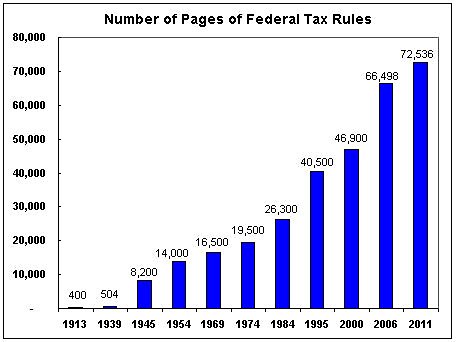
- Nothing is more complicated and convoluted than the U.S. tax code, which changed 579 times in the last year–more than one change every day:
Cato at Liberty
Cato at Liberty
What do these federal agencies and programs have in common?
Agricultural Research Service, Animal & Plant Health Inspection Service, Rural Development programs, Women, Infants & Children, Foreign Agricultural Service, National Institute of Standards & Technology, National Oceanic & Atmospheric Administration, Economic Development Administration, National Telecommunications & Information Administration, Small Business Administration, State Department foreign aid, Fund for African Development, International Development assistance, Economic Support Fund, Peacekeeping Operations, Trade Development Agency, Army Corps of Engineers, Bureau of Land Management, Fish and Wildlife Service, National Park Service, Bureau of Reclamation, National Forest System, Appalachian Regional Commission, Department of Energy administration, Fossil Energy Research & Development, energy conservation programs, National Endowment for the Arts, National Endowment for the Humanities, National Gallery of Art, Community Service Employment for Older Americans, National Institutes of Health, Centers for Disease Control, Low Income Home Energy Assistance, Administration on Aging, Youthbuild, Adult Education, programs for K‑12 and higher education, Corporation for Public Broadcasting, Federal Aviation Administration, Federal Highway Administration, rail subsidies, Federal Transit Administration, Financial Management Service, Veterans Affairs construction projects, Housing Counseling Assistance, public housing programs, Community Development Financial Institutions Funds, Corporation for National & Community Service, Legal Services Corporation, Environmental Protection Agency, National Aeronautics & Space Administration, and the National Science Foundation.
They were all cut in 1995 under a rescissions package engineered by then-Speaker Newt Gingrich and cut last week in the budget agreement reached by Republican and Democratic leaders.
The lesson here is that there’s a big difference between spending cuts and terminating entire agencies and their programs. Like the mythological Hydra, the stump has to be burned after the head is cut off or else it’ll grow back.
Just as they did back in 1995, Republicans are doing a lot of talking about cutting the size of the federal government. However, they aren’t doing much talking about reducing the scope of the federal government’s activities. The Gingrich Republicans failed to reduce the scope of federal activities, and the result was a bipartisan spending orgy that has left the country’s finances in shambles. We literally can’t afford for history to repeat itself.
Related Tags
According to tax publisher CCH, there are now 72,536 pages of federal tax code rules, regulations, and IRS rulings.
Related Tags
As Iain Murray points out at National Review’s “Corner,” there’s no date on the calendar each year that reminds us, the way income tax filing day does, of the huge share of our economic labors that the government commands in the name of regulation. In part this is because the costs of regulation are even better disguised than those of taxation: while paycheck withholding may lull us into complacency about our income tax burden, it is downright transparent compared with the costs of regulation, which the ordinary citizen may never recognize when passed along in the form of higher utility bills or sluggish performance by some sector of the economy. Iain notes the good work done by his colleagues at the Competitive Enterprise Institute:
Regulations cost $1.75 trillion in compliance costs, according to the Small Business Administration. That’s greater than the record federal budget deficit — projected at $1.48 trillion for FY 2011 — and greater even than all corporate pretax profits. This is only one of many findings of the new edition of Wayne [Crews’] “Ten Thousand Commandments: An Annual Snapshot of the Federal Regulatory State,” a survey of the cost and compliance burden imposed by federal regulations.
As is now becoming evident, the Obama Administration is presiding over one of the most extraordinary expansions of regulation in all American history, in areas from health care to consumer finance, university governance to “obesity policy,” labor and employment law to the environment. Not all these developments originated with Obama appointees — some had their start under President George W. Bush or with lawmakers in Congress — but this administration has pursued stringent regulatory measures with extraordinary zeal, notwithstanding the odd feint to soothe business-sector misgivings.
Here are three more or less random samplings from recent days of the quiet momentum that’s built up in Washington toward a much bigger regulatory state:
- Reflecting the historical development of the Food and Drug Administration, the introduction of new medical devices such as pacemakers and joint replacements is still somewhat less intensively regulated than the introduction of new pharmaceutical compounds. As Emory’s Paul Rubin relates at Truth on the Market, pressure is building in Washington to correct this supposed anomaly by intensifying the regulation of devices. As Rubin notes, “virtually all economists who have studied the FDA drug approval process have concluded that it causes serious harm by delaying drugs,” yet the premise of the new campaign for regulation “is that we should duplicate that harm with medical devices.”
- Much of the new regulation of consumer finance has taken the form of rules governing what information lenders can ask for or consider about borrowers’ situation in extending credit. One such proposed rule, from the Federal Reserve, “would require credit card issuers to consider only a person’s independent income, and not the household’s income, when underwriting credit cards in an effort to protect young adults unable to repay debt.” Great big unforeseen consequence: many stay-at-home parents will now be unable to establish credit in their own names (via).
- Among a slew of other high-profile regulations, the Environmental Protection Agency (EPA) has chosen this moment to demand very rapid new reductions in emissions from industrial boilers (“Boiler MACT” rules). Per ShopFloor, Thomas A. Fanning, who runs one of the nation’s largest electric utilities, the Southern Company, thinks trouble lies ahead:
EPA has proposed Utility MACT rules under timelines that we believe will put the reliability and affordability of our nation’s power system at risk. EPA’s proposal will impact plants that are responsible for nearly 50 percent of total electricity generation in the United States. It imposes a three-year timeline for compliance, at a time when the industry is laboring to comply with a myriad of other EPA mandates. The result will be to reduce reserve margins—generating capacity that is available during times of high demand or plant outages—and to cause costs to soar. Lower reserve margins place customers at a risk for experiencing significant interruptions in electric service, and costs increases will ultimately be reflected in service rates, which will rise rapidly as utilities press ahead with retrofitting and projects to replace lost generating capacity due to plant retirements.
At least we’ll be able to avert brownouts by switching over readily to fracked-natural-gas, Alberta tar-sands, and latest-generation-nuclear options — or we would had all those options not been put under regulatory clouds as well.
Related Tags
In a high-profile speech last week, President Obama said: “We cannot afford $1 trillion worth of tax cuts for every millionaire and billionaire in our society. We can’t afford it. And I refuse to renew them again.”
Mr. President, it’s their money, not yours. And note that your speechwriters gave you a wildly exaggerated dollar figure for tax hikes on millionaires and billionaires.
What Americans “cannot afford” is the president’s ongoing demonization of high earners. Yahoo Finance ran an interesting story yesterday describing the crucial role played by high earners in the economy. Rather than the cartoonish image of high earners propagated by the political left, the article notes:
Today, most of those folks with a net worth of $1 million or more have earned it themselves. They’re mostly entrepreneurs who create everything from high-speed networks to garbage haulers. They dig ditches and build houses and grow corn and make jewelry. They deal stamps or coins or artwork and control pests and cut lawns. They also cure people and give them new teeth.
Perhaps the president wants to hike taxes on the wealthy because they were just lucky or benefited from misguided greed. Instead, the well-known researchers of the wealthy, Thomas Stanley and William Danko, note in the article:
It is seldom luck or inheritance or advanced degrees or even intelligence that enables people to amass fortunes … Wealth is more often the result of a lifestyle of hard work, perseverance, planning, and, most of all, self discipline.
Ironically, those are probably the traits that made President Obama a successful political entrepreneur. Yet he doesn’t seem to appreciate that the same traits drive market entrepreneurs to generate growth and earn profits. Profits are the reward for “good behavior” in the free market, so punishing them with higher taxes makes no economic sense.
Rather than breeding resentment against the wealthy, the president should use his bully pulpit to encourage people to emulate their success by working hard, increasing their savings, and eschewing debt. Unfortunately, those are the attributes that today’s income tax punishes, and on this Tax Day the president is pushing policies to make the situation even worse.
Related Tags
Some items from my inbox:
- The Department of Justice late Friday announced it had indicted 11 online poker executives, charging them with money-laundering and bank fraud. (HT: Jonathan Blanks). This crackdown is far stronger than any seen from the Bush administration, and is disappointing people like me, who had hoped for a better stance on civil liberties from the Obama administration. To quote my former colleague Radley Balko (language warning): “Good to know where the DOJ’s priorities lie. In this case, it’s preventing millions of people from consensually wagering money in online card games, an exchange that causes no harm to anyone else.”
- Ironically Insanely, the indictments came just days after the District of Columbia announced it would allow internet gambling.
- In keeping with the new set of talking points the farm lobby has devised (“we already gave at the office through crop insurance reforms” and “agriculture should face cuts no larger than the average of other programs”), the Democratic members of the House Agriculture Committee on Friday sent out a press release complaining about the “disproportionate” cuts agriculture would face if the House-passed FY2012 budget resolution went into effect. While Agriculture would face a 23 percent cut, they say, other committees’ program areas would face an average cut of 14 percent. And they complain that Defense faces only minimal cuts. I’ve said it before, but I’ll say it again: all government programs are not created equal. Some — like Defense, although clearly there is significant room for cuts there — are legitimate uses of government’s power. Others — like farm subsidies — are not.
- An interesting article on the non-link between farm subsidies and obesity, by political scientist Robert Paarlberg (co-author of an excellent book on American farm policy). He cites Cato as being one of the groups engaging in “careless thinking” on this issue, and although I have in the past linked farm subsidies to certain food consumption patterns, over the past year or so I have become increasingly skeptical of that view, mainly as a result of reading stuff like this from smart folks at UCDavis.
Everyone knows that students have First Amendment rights, that the Constitution proverbially doesn’t stop at the schoolhouse door. Yet students in the Plano Independent School District in Texas (against whose speech code Cato previously filed a brief) were prohibited from handing out pencils with messages such as “Jesus is the reason for the season” and “Jesus loves me, this I know, for the Bible tells me so,” or sending holiday cards to retirement homes that said “Merry Christmas.”
The students, through their parents, sued the district on First Amendment grounds, and were successful through a Fifth Circuit panel ruling that “qualified immunity,” a doctrine that prevents government officials from being held personally liable under certain circumstances for violating constitutional rights, did not apply in this case. The panel’s holding is as important as it is unremarkable: School officials have fair warning that viewpoint-based discrimination against student speech during non-curricular activities violates the First Amendment. The government certainly cannot do so simply because the speech happens to be religious.
The Fifth Circuit en banc (as a whole) vacated the panel’s decision, however, and decided to rehear the case. Cato has filed a brief supporting the students and their parents; not only is it settled law that students have the right to free speech in public schools, but school officials should be held liable for violating those rights on the basis of the content of that speech.
Indeed, if the First Amendment means anything, it is that the government cannot suppress speech based solely on its content. More specifically, when an area of the law is “clearly established,” officials cannot escape liability under the doctrine of qualified immunity. Qualified immunity simply doesn’t apply to public school officials who suppress speech in a non-curricular setting merely because the school district points to some legal disagreement in a dissent, concurrence, or other non-binding judicial opinion that disagrees with settled doctrine regarding viewpoint-based discrimination against student speech.
The en banc Fifth Circuit will hear the case, Morgan v. Swanson, later this spring. Thanks to legal associate Michael Wilt for his help with the brief and this post.