If you’re familiar with Cato’s project HumanProgress.org, then you probably know that according to the available data, people today are wealthier, healthier, better educated, and less exposed to violence than in the past. HumanProgress.org provides you with the tools to explore how the state of humanity has changed over time. But even if you have visited the website before, you may not be aware of every feature it offers. Did you know that HumanProgress.org allows you to compare datasets of human wellbeing against one another, allowing you to see if the datasets correlate? Or that you can download a customized chart or map with the click of a mouse? Our new introduction video offers a rundown of all our current features. Check it out:
Cato at Liberty
Cato at Liberty
I blogged last year about efforts to promote free trade within Canada, through an improved “Agreement on Internal Trade.” Some Canadians are now attempting a new approach to addressing this problem: Invoking the Canadian Constitution.
Here’s what happened to trigger the constitutional litigation, via the Canadian Constitution Foundation:
On October 6, 2012, New Brunswick resident Gerard Comeau decided to go to Quebec on a booze run. As a result of his trip, Mr. Comeau was surprised to find himself charged with violating New Brunswick’s Liquor Control Act.
Here is the strange part: Mr. Comeau’s purchase of beer and liquor in Quebec was entirely legal. His alleged crime was bringing it home to New Brunswick.
…
Mr. Comeau was stopped in Campbellton, New Brunswick just after crossing the bridge spanning the Quebec-New Brunswick border. He had been followed by the RCMP while he made two stops to buy liquor in Quebec. He was charged with violating the ban on bringing in more than 12 pints of beer or liquor from an out-of-province source (per s. 43 of the Act). As a New Brunswick resident, you can legally buy larger amounts only from a New Brunswick Liquor Corporation store. This crown corporation holds a legally enforced monopoly on liquor sales in the province, and it effectively protects its monopoly across provincial borders through the Liquor Control Act’s prohibitions on importation.
So what does the Canadian Constitution say about all this? Section 121 of the Constitution Act, 1867 states that: “121. All Articles of the Growth, Produce, or Manufacture of any one of the Provinces shall, from and after the Union, be admitted free into each of the other Provinces.” You might think that would be enough to ensure free trade, but apparently there is a 1921 Supreme Court decision narrowly interpreting the provision so that it only prohibits customs duties imposed at the border.
The Canadian Constitution Foundation is bringing the litigation in this case, and is arguing for a broader view of the provision, which would allow Canadians to bring goods accross provincial borders more generally. They argue that:
If Comeau is successful in restoring the correct, original meaning of s. 121 of the constitution, many forms of internal trade barriers may also be invalidated. The implications go beyond the liquor and beer industries. Restrictions on interprovincial trade in eggs, poultry and dairy products—often referred to as supply management—may likewise be considered unconstitutional.
Through NAFTA, Canadians have (mostly) free trade with the United States. It would be nice if they also had free trade with each other.
The Republican presidential race is heating up and Florida Sen. Marco Rubio is talking foreign policy. Alas, he believes intervention and war to be a first resort and seems willing to sacrifice American lives, wealth, and prosperity for almost any reason.
Rubio shares the common delusion on the Right that the world has grown more dangerous since the end of the Cold War. Actually, the end of the Soviet Union and Warsaw Pact has made it much safer for America.
Rubio claimed that “Turmoil across the world can impact American families almost as much as turmoil across town.” But that is only if the United States allows it. During most of America’s history, Washington avoided involvement in foreign tragedies.
Rubio worried about rising prices from foreign instability. Far more consequential is the expense of military intervention, human and financial.
But Rubio was right when he declared: “foreign policy is domestic policy.” It is difficult to maintain a democratic republic with a limited government committed to individual liberty while pursuing an imperial foreign policy. Americans’ freedom ends up as an afterthought.
In Rubio’s view, America’s ideals “have been replaced by, at best, caution, and at worse, outright willingness to betray those values for the expediency of negotiations with repressive regimes.” That actually sounds like Washington’s persistent support for the dictatorial allies that Rubio cherishes.
He wouldn’t admit any error in invading Iraq “because the president was presented with intelligence that said Iraq had weapons of mass destruction.” Never mind that the supposed evidence variously was manipulated, based on lies, and carefully scrubbed.
But Rubio blamed Barack Obama for the current Iraq imbroglio, criticizing support for Nouri al-Maliki, who became prime minister under George W. Bush. Rubio urged an American return to Iraq: “It’s not nation-building. We are assisting them in building their nation.” That fine distinction might earn a good grade in law school, but it won’t fool the American people.
Rubio also backed the Obama administration’s Libya misadventure. Yet he complained that “Anytime there’s a vacuum created anywhere in the Middle East it becomes a magnet for these sorts of terrorist groups.”
The United States must “reinforce our alliances,” he insisted, particularly in Europe. Never mind that it has more money and people than America yet continues to underfund defense.
Worse, Washington must “reaffirm that the open door policy is still intact and applies to any NATO aspirant, including Ukraine if it so chooses.” But the burden of defending any new member would fall on the United States.
As I point out on Forbes online: “Because Kiev is stuck in conflict America might face an immediate call to fulfill NATO’s Article 5 security commitment—against a nuclear-armed power. Does Rubio want to start World War III?”
Rubio complained that “Most threatening of all, we’ve seen Iran expand its influence.” Actually, Iran is a wreck and poses little danger to the United States. Moreover, the most important impetus for Tehran’s increased clout was Bush’s invasion of Iraq, which Rubio endorsed.
Rubio attempted to add a humanitarian gloss to his disastrous proposals: “Oppressed peoples still turn their eyes toward our shores, wondering if we can hear their cries.” He also argued that “we have a responsibility to support democracy.” Does his heart-warming concern apply to friendly oppressors in Egypt, Bahrain, Saudi Arabia, and Central Asia?
Yet Rubio also would turn the military into an agent of corporate America through his plan for “the protection of the American economy in a globalized world.” The United States is insulated from much tumult overseas. Shouldn’t other nations take the lead when they are directly affected? How many lives is he prepared to sacrifice to sustain corporate jobs and profits?
Of course, with this agenda there must be more military spending. But America already is stronger than every other nation. If more than 40 percent of the world’s military spending isn’t enough, how much is?
Most of the other GOP candidates sound similar to Rubio. Unfortunately, Republican group-think won’t make the United States more secure. The GOP needs to engage in a real debate over foreign and military policy.
Related Tags
The Spin Cycle is a reoccurring feature based upon just how much the latest weather or climate story, policy pronouncement, or simply poo-bah blather spins the truth. Statements are given a rating between 1–5 spin cycles, with less cycles meaning less spin. For a more in-depth description, visit the inaugural edition.
—
President Obama is keen on calling carbon dioxide emitted from our nation’s fossil fuel-powered energy production, “carbon pollution.” For example, last week, when introducing EPA’s Clean Power Plan—new regulations limiting carbon dioxide emissions from the power plants that currently produce 67 percent of the country’s electricity—he used the term “carbon pollution” ten times. For example:
Right now, our power plants are the source of about a third of America’s carbon pollution. That’s more pollution than our cars, our airplanes and our homes generate combined. That pollution contributes to climate change, which degrades the air our kids breathe. But there have never been federal limits on the amount of carbon that power plants can dump into the air. Think about that. We limit the amount of toxic chemicals like mercury and sulfur and arsenic in our air or our water — and we’re better off for it. But existing power plants can still dump unlimited amounts of harmful carbon pollution into the air. [emphasis added]
Clearly, he is trying to paint a picture for the American public whereby carbon dioxide emissions are thought of as dirty, noxious substances that invade the air we breathe and make us sick. Who wouldn’t support regulation to try to limit such a menace?
But, this is scientifically inaccurate and, no doubt, intentionally misleading. It reflects poorly on the president and on his scientific advisors.
First and foremost, carbon dioxide is a colorless, odorless gas that is non-toxic to humans at concentrations below some tens of thousands of parts per million (ppm). The current carbon dioxide concentration in the atmosphere is 400 ppm and even worst case projections by the end of the century only put the concentration at 800–1000ppm. This is still some 5–6 times below the government’s recommended exposure limits. No one breathing open, well-mixed air* has ever been sickened from breathing carbon dioxide—nor ever will be.
Secondly, far from being sickened, the planet’s plant life is invigorated by carbon dioxide—the more the merrier. High concentrations (~1,000ppm) of carbon dioxide are routinely used in commercial greenhouses to produce faster growing and more robust plants. Scientific studies have shown that as carbon dioxide concentrations rise, plants become more resilient to environmental stressors, more efficient in their use of water, and more productive. A recent estimate has pegged the economic contribution of human carbon dioxide emissions to date, acting via increased crop production, at $3.2 trillion over the past 50 years and estimates an additional $10 trillion by mid-century. Pretty good for a “harmful” pollutant.
Thirdly, referring to carbon dioxide as “carbon pollution” is just plain scientifically inaccurate.
A carbon dioxide molecule is made up of two atoms of oxygen and one atom of carbon. Under the president’s apparent logic, wouldn’t it be twice as apt to term carbon dioxide “oxygen pollution”? But, we think, everyone would agree that would be deeply misinformative. So, too, everyone should agree, is applying the term “carbon pollution.”
In fact, carbon pollution already exists—it is more commonly called “soot,” the tiny elemental carbon particles that result from incomplete combustion. Soot is black, dirty, and oily, and not only makes an environmental mess, but is also dangerous to breathe. It is just what you expect a “pollutant” to be. And, it is already highly regulated by the EPA. So Obama’s statement that “existing power plants can still dump unlimited amounts of harmful carbon pollution into the air” is factually incorrect.
And finally, the carbon dioxide emitted from power plants is part and parcel of the chemistry of combustion. It is not some sort or gas or particle that is produced as a result of impurities in the fuels and can be separated from the process—it IS the process. Adding heat to hydrocarbons, such as fossil fuels (like coal, natural gas, or oil) in the presence of oxygen starts a chemical reaction that releases more heat (in excess of what was original applied) along with carbon dioxide and water (CO2, and H2O)**. Consequently, the power plants that the President refers to as being able to “dump unlimited amounts of harmful carbon pollution into the air” aren’t so much polluting as simply doing their job, the one that we ask of them—to produce the power that drives modern society and our way of life.
By calling carbon dioxide emissions “carbon pollution” President Obama and his EPA seek not to be scientifically accurate, but rather to sway public opinion in support of voluminous regulations aimed to restrict energy choice, not only here, but through his leadership aspirations, abroad (e.g., at the upcoming UN climate conference this December in Paris). For this, we award him 2.5 spin cycles—somewhere between Slightly Soiled and Normal Wash—in other words, the standard modus operandi of the federal government.

*There have been documented, although quite rare, occurrences of sudden carbon dioxide outgassing events associated with volcanic activity that have led to high fatalities in affected areas.
** In fact, it is similar to the process your body uses to power itself (in this case metabolism rather than combustion), breaking apart carbohydrates into carbon dioxide and water and liberating energy. Just as power plants emit H2O and CO2 into the air, so do you. The biggest difference, from a climate standpoint anyway, is that the carbohydrates you ingest were taken out of the air recently by plants (via photosynthesis), while the hydrocarbons ingested by power plants were taken out of the air by plants millions of years ago (and have been geologically converted and stored in the form of fossil fuels). Consequently, the collective breath of humanity does not lead to a build-up of CO2 in the atmosphere, whereas the collective breath of fossil fuel-powered electricity generating facilities does.
Related Tags
SHENYANG, CHINA—North Korea is a major topic of interest in this provincial capital in China’s northeast. The “Hermit Kingdom” is just a couple hours away by car. Again, the North’s harvest does not look good. Observers warn that another famine may be coming.
The first reports of drought appeared earlier this year. The United Nations warned that 70 percent of North Korea’s population faces a food shortage.
Another famine is a grievous embarrassment. Several hundred thousand, and perhaps as many as two million, North Koreans died between 1995 and 1997 from a brutal, extended famine. The North since has been dependent on the generosity of others to feed its people.
The DPRK again has begun to bang its tin cup, seeking aid. The People’s Republic of China remains the North’s most important food supplier. The Chinese government almost certainly will continue to stand by its ally.
Between 1995 and 2005, Seoul provided nearly $1.2 billion in food and fertilizer alone. South Korea largely cut off general support after Pyongyang’s military attacks in 2010.
Still, the South remains willing to restart humanitarian transfers. In June, Unification Minister Hong Yong-pyo said: “If North Korea faces tougher situations, South Korea is willing to provide the necessary support.”
Japan has episodically provided food assistance, but aid generally has reflected the state of relations, which in recent years remains tainted by the controversy over North Korea’s abduction of Japanese citizens. With the Abe government adopting a more assertive foreign policy, it is unlikely to come to the North’s rescue.
Washington has provided aid in the past—roughly $1.1 billion worth, about 60 percent of which was food, between 1995 and 2005. Since then, assistance has been only little and occasional.
Alas, Pyongyang has tended to take the money and, if not run, at least ignore its promises to behave better. In fact, in early 2012, the North almost immediately violated a new agreement negotiated with Washington trading aid for nuclear restraint with a new rocket launch.
So far the administration is saying no. The State Department’s East Asia-Pacific spokeswoman, Katina Adams, explained that “the U.S. has no plans to provide humanitarian assistance to North Korea at this time.”
However, as I point out in National Interest, “having succeeded in engaging the pariah states of both Cuba and Iran, the Obama administration might decide to make another try with Pyongyang. And the threat of famine offers an obvious excuse for another aid effort.”
Of course, no one wants the North Koreans to starve. But famine is a self-inflicted disaster. The North has socialized its agriculture and used food to reward political loyalty. Moreover, Pyongyang has devoted scarce resources to nukes, other weapons, and luxuries for the nomenklatura that otherwise could be used to purchase food.
Tempting though it might be to try again, such an effort would certainly be a bad idea. Pyongyang would treat official aid as support for the regime; any resources transferred inevitably free-up resources for use elsewhere. U.S. support would increase popular hardship over the long-term.
However, Washington should allow truly private aid. Such assistance carries no imprimatur of political support.
Moreover, the North appears to be less vulnerable to disaster than two decades ago because farmers produce more food privately, which increasingly is distributed through private markets.
Indeed, that is how many North Koreans survived during the 1990s famine. Such a process will help distribute even limited food supplies to people today.
Refusing to provide aid does not mean Washington should not talk with the North. The United States just should keep its expectations quite low—and not pay anything for mere promises.
North Korea is a continuing tragedy. There is no easy or simple policy guaranteed to end confrontation on the peninsula.
Almost everything the United States has failed so far, including providing government aid to the DPRK. If famine again does strike, the United States and its allies should tell Pyongyang no.
Related Tags
Scott Walker touts his record as a fiscal conservative. But this morning, reports the Associated Press,
Wisconsin Gov. Scott Walker took a break from the presidential campaign trail Wednesday to commit $250 million in taxpayer money to pay for a new arena for the Milwaukee Bucks.
Walker’s come under a lot of criticism from both left and right for his arena funding plan, including an article I wrote at the Huffington Post after he defended his plan on ABC’s “This Week.” Such deals are paid for by average taxpayers to benefit millionaire players and billionaire owners. But millionaires and billionaires have more influence than average taxpayers, and the pictures around stadium deals are great:
Calling the new NBA stadium a “dynamic attraction for the entire state of Wisconsin,” Walker signed the bill at the Wisconsin State Fair Park surrounded by state lawmakers, local officials and Bucks team president Peter Feigin.
The economics, not so good. Walker has claimed a “return on investment” of three to one, which he says is “a good deal” for the taxpayers. Economists disagree. As Dennis Coates and Brad Humphreys wrote in a 2004 Cato study criticizing the proposed D.C. stadium subsidy, “The wonder is that anyone finds such figures credible.…
Our conclusion, and that of nearly all academic economists studying this issue, is that professional sports generally have little, if any, positive effect on a city’s economy. The net economic impact of professional sports in Washington, D.C., and the 36 other cities that hosted professional sports teams over nearly 30 years, was a reduction in real per capita income over the entire metropolitan area.
Republican voters are looking for fiscal conservatives and straight talkers. We’re hearing a lot of denunciations of corporate welfare and crony capitalism. And here’s a leading conservative candidate for president sitting down in front of cameras to sign a bill handing $250 million in taxpayers’ money (Bloomberg says $400 million with interest) to wealthy owners of a sports team (some of whom, no doubt coincidentally, are large donors to his campaign), in defiance of free-market advocates and virtually all economists. Will the other Republican candidates take him on? Will they denounce this wasteful extravagance?
Or will we have to rely on John Oliver to do the job small-government Republicans ought to be doing?
Related Tags
I never watched That ’70s Show, but according to Wikipedia, the comedy program “addressed social issues of the 1970s.”
Assuming that’s true, they need a sequel that addresses economic issues of the 1970s. And the star of the program could be the Congressional Budget Office, a Capitol Hill bureaucracy that apparently still believes — notwithstanding all the evidence of recent decades —
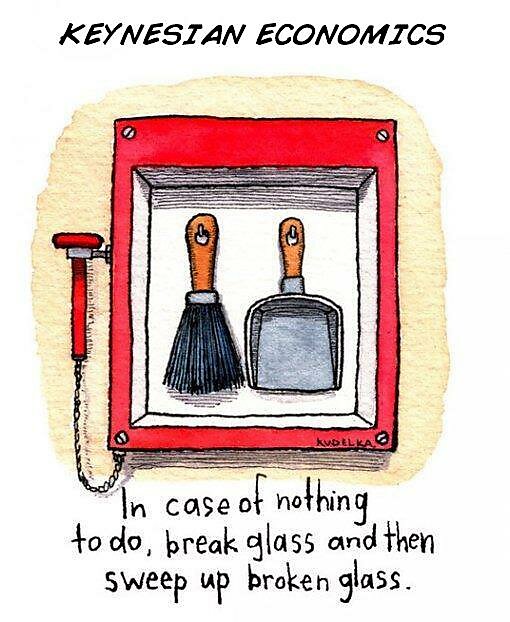
in the primitive Keynesian view that a larger burden of government spending is somehow good for economic growth and job creation.
I’ve previously written about CBO’s fairy-tale views on fiscal policy, but wondered whether a new GOP-appointed director would make a difference. And I thought there were signs of progress in CBO’s recent analysis of the economic impact of Obamacare.
But the bureaucracy just released its estimates of what would happen if the spending caps in the Budget Control Act (BCA) were eviscerated to enable more federal spending. And CBO’s analysis was such a throwback to the 1970s that it should have been released by a guy in a leisure suit driving a Ford Pinto blaring disco music.
Here’s what the bureaucrats said would happen to spending if the BCA spending caps for 2016 and 2017 were eliminated.
According to CBO’s estimates, such an increase would raise total outlays above what is projected under current law by $53 billion in fiscal year 2016, $76 billion in fiscal year 2017, $30 billion in fiscal year 2018, and a cumulative $19 billion in later years.
And here’s CBO’s estimate of the economic impact of more Washington spending.
Over the course of calendar year 2016,…the spending changes would make real (inflation-adjusted) gross domestic product (GDP) 0.4 percent larger than projected under current law. They would also increase full-time-equivalent employment by 0.5 million. …the increase in federal spending would lead to more aggregate demand than under current law. …Over the course of calendar year 2017…CBO estimates that the spending changes would make real GDP 0.2 percent larger than projected under current law. They would also increase full-time-equivalent employment by 0.3 million.
Huh?
If Keynesian spending is so powerful and effective in theory, then why does it never work in reality? It didn’t work for Hoover and Roosevelt in the 1930s. It didn’t work for Nixon, Ford, and Carter in the 1970s.
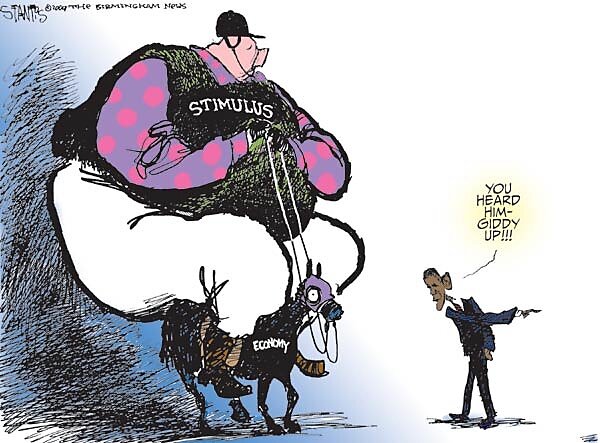
It didn’t work for Japan in the 1990s. And it hasn’t worked this century for either Bush or Obama. Or Russia and China.
And if Keynesianism is right, then why did the economy do better after the sequester when the Obama Administration said that automatic spending cuts would dampen growth?
To be fair, maybe CBO wasn’t actually embracing Keynesian primitivism. Perhaps the bureaucrats were simply making the point that there might be an adjustment period in the economy as labor and capital get reallocated to more productive uses.
I’m open to this type of analysis, as I wrote back in 2012.
…there are cases where the economy does hit a short-run speed bump when the public sector is pruned. Simply stated, there will be transitional costs when the burden of public spending is reduced. Only in economics textbooks is it possible to seamlessly and immediately reallocate resources.
But CBO doesn’t base its estimates on short-run readjustment costs. The references to “aggregate demand” show the bureaucracy’s work is based on unalloyed Keynesianism.
But only in the short run.
CBO’s anti-empirical faith in the magical powers of Keynesianism in the short run is matched by a knee-jerk belief that government borrowing is the main threat to the economy’s long-run performance.
…the resulting increases in federal deficits would, in the longer term, make the nation’s output and income lower than they would be otherwise.
Sigh. Red ink isn’t a good thing, but CBO is very misguided about the importance of deficits compared to other variables.
After all, if deficits really drive the economy, that implies we could maximize growth with 100 percent tax rates (or, if the Joint Committee on Taxation has learned from its mistakes, by setting tax rates at the revenue-maximizing level).
This obviously isn’t true. What really matters for long-run prosperity is limiting the size and scope of government.
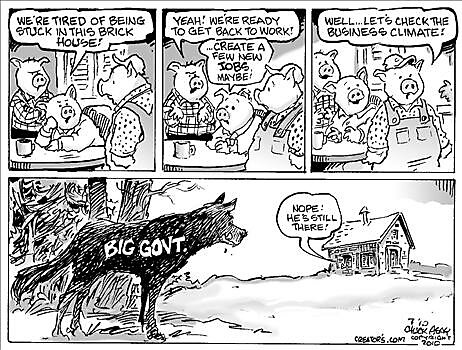
Once the growth-maximizing size of government is determined, then lawmakers should seek to finance that public sector with a tax system that minimizes penalties on work, saving, investment, risk-taking, and entrepreneurship.
Remarkably, even international bureaucracies such as the World Bank and European Central Bank seem to understand that big government stifles prosperity. But I won’t hold my breath waiting for the 1970s-oriented CBO to catch up with 21st-century research.
P.S. Here’s some humor about Keynesian economics.
P.P.S. If you want to be informed and entertained, here’s the famous video showing the Keynes vs. Hayek rap contest, followed by the equally clever sequel, which features a boxing match between Keynes and Hayek. And even though it’s not the right time of year, here’s the satirical commercial for Keynesian Christmas carols.