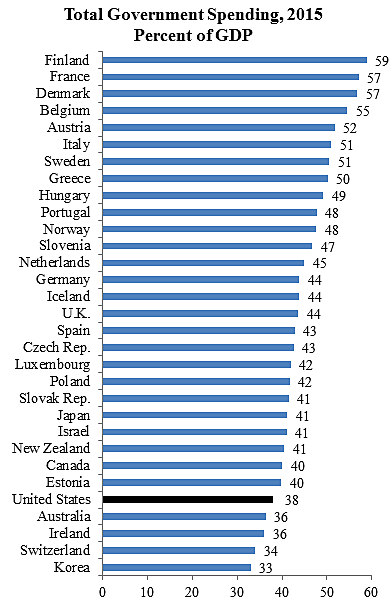
One measure of the government’s size is government spending as a share of gross domestic product. The OECD has released new data (Table 25) on this measure for 31 member countries, which I chart here for 2015. The spending includes all levels government: federal, state, and local.
Cato at Liberty
Cato at Liberty
Topics
DHS Computer Project: A Record Cost Overrun?
Politics and bureaucratic mismanagement drive up costs and generate failure in the federal government. More evidence comes from a Washington Post report today on a botched computer project at the Department of Homeland Security:
Heaving under mountains of paperwork, the government has spent more than $1 billion trying to replace its antiquated approach to managing immigration with a system of digitized records, online applications and a full suite of nearly 100 electronic forms.
A decade in, all that officials have to show for the effort is a single form that’s now available for online applications and a single type of fee that immigrants pay electronically. The 94 other forms can be filed only with paper.
This project, run by U.S. Citizenship and Immigration Services, was originally supposed to cost a half-billion dollars and be finished in 2013. Instead, it’s now projected to reach up to $3.1 billion, and be done nearly four years from now.
A six times cost overrun! That is epic. I’ve described Edwards law of Cost Doubling in government, but this DHS project rises to an elite screw-up category reached by the Big Dig, the San Francisco-Oakland Bay Bridge, and a veterans hospital in Denver, which all more than quadrupled in cost.
Other than “shoddy planning” and mismanagement, what else contributed to the latest DHS screw-up? The Post reports on the role of politics:
By 2012, officials at the Department of Homeland Security, which includes USCIS, were aware that the project was riddled with hundreds of critical software and other defects. But the agency nonetheless began to roll it out, in part because of pressure from Obama administration officials who considered it vital for their plans to overhaul the nation’s immigration policies, according to the internal documents and interviews.
… By 2012, the system’s fundamental flaws — including frequent computer crashes and bad software code — were apparent to officials involved with the project and, according to one of them, and it was clear that “it wasn’t going to work.”
But killing the project wasn’t really an option, according to officials involved at the time. President Obama was running for reelection and was intent on pushing an ambitious immigration reform program in his second term. A workable electronic system would be vital.
“There was incredible pressure over immigration reform,” a second former official said. “No one wanted to hear the system wasn’t going to work. It was like, ‘We got some points on the board, we can go back and fix it.’ ”
For more, see the new Downsizing Government essays Federal Government Cost Overruns and Bureaucratic Failure in the Federal Government.
Exciting New Technological Developments
In another installment of our series on how science and technology are working to improve lives and solve problems, we sum up some exciting new developments in robotics and 3‑D printing, and even news on a sonic tractor beam right out of Star Wars.
The Robots Chasing Amazon
In 2012, Amazon bought the warehouse robot maker, Kiva Systems, in order to keep the technology away from its competitors. This created a gap in demand for warehouse robots, giving Fetch Robotics and Harvest Automation a chance to enter the market. Both of these companies have created robots that follow warehouse employees around for the purpose of collecting and moving the inventory items that they take off the shelves. These robots have greatly improved efficiency and are cheaper than hiring more workers or introducing more infrastructure, such as conveyor belts. Fetch Robotics currently sells these robots for $25,000, while Harvest Automation will sell them for $15,000 or rent them for $1,000 a month beginning next year. Currently these robots are designed to work alongside warehouse employees, but Fetch Robotics has already begun working on warehouse robots that grab the items from the shelves themselves.
Robot Builder Designed for Construction Sites
Recently at ETH Zurich, a robot that is able to lay bricks in various designs was created. It is the first robot that can lay bricks without rigid design constraints, which could make construction sites much more efficient. The robot consists of a robotic arm attached to a mobile base unit and two computer systems. The first computer controls the arm, while the second generates a 3D version of the construction site, allowing it to envision its location. It is hoped that in the future, construction workers and these robots will be able to work together in order to efficiently erect various structures. ETH Zurich is also working on two other projects. One is a robot that can analyze pieces of rubble and then assemble them into a structure. The second robot uses the 3D-printing of mesh, along with the use of concrete filler, to replace older methods of using molds for making concrete pieces. A new robotic fabrication facility will hopefully open by September of 2016.
3D-printed hip and knee joints coming to a hospital near you
A new breakthrough has occurred in the world of hip and knee surgery. Dr. Clarke has created a technique where virtual models of patient’s bodies are generated for two purposes: One being so surgeons are able to practice the procedure beforehand. The second being so precision instruments for the surgery can be made. Currently, because the size and shape of everyone’s hip and knee joints are different, surgery involves a “trial and error” procedure in order to discover the correct fitting of instruments for an individual’s joint. But Dr. Clarke’s cutting-edge technique allows surgeons to know the size and shape of the patient’s joint beforehand, which lets them use 3D-printing to create surgical instruments that perfectly fit the specific person. This technique diminishes recovery time, allows for smaller incisions, and reduces blood loss.
Star Wars style sonic tractor beam invented by scientists
It has been portrayed in movies like Star Wars and Star Trek, but now it is a reality. Researches have created a tractor beam that can move, rotate, and suspend a four millimeter plastic bead in mid-air. It uses sixty-four miniature loud speakers that emit high frequency sound waves, which the human ear cannot detect. However, in order to lift larger objects, lower frequencies that humans can detect would have to be used, which poses an unfavorable sound problem. Other implications of this technology include performing surgical procedures inside the human body without making any incisions.
Florida’s Eminent Domain Shenanigans
It’s a belated round two for Florida’s legislation on eminent domain. In the 1980 case Webb’s Fabulous Pharmacies v. Beckwith, the Supreme Court struck down a Florida statute giving the state ownership over the interest earned on disputed funds—what lawyers call “interpleader” funds—held on deposit in the Florida court registry. The Court held that the statute effected unconstitutional takings under the Fifth and Fourteenth Amendments.
Now there’s a challenge to a similar statute, concerning “quick-take” deposit funds. Florida’s eminent domain law empowers condemning authorities to fast-track their appropriation of a desired property by allowing the authority to simply deposit the constitutionally required just compensation into the court registry and then taking title to the condemned property. The scheme further authorizes the court clerk to invest the deposited funds before a court renders a final valuation judgment. The interest on that investment is split 90/10 between the condemning authority and court clerk, respectively, with none of it going to the (now former) property owner.
Several property owners challenged this mechanism, wanting to recover the interest that accrued on compensatory funds that were indisputably theirs as a matter of state law. Florida’s intermediate appellate courts have evaded the Webb’s precedent and denied these challenges—and the state supreme court has thus far declined to review the rulings. Cato has filed a brief supporting the challengers’ request that the U.S. Supreme Court take the case.
The lower state courts have ruled that quick-take deposits are “public property” until final judgment and thus owners of condemned properties had no interest in the accrued interest, as it were. Yet Webb’s stands for the proposition that funds deposited with a court registry are “private property,” belonging to the ultimate beneficiary of the legal action. In announcing this holding, the Supreme Court applied the “interest follows principal” rule.
Twenty-five years later, eminent-domain condemnees stand in the shoes of the Webb’s plaintiffs and should be entitled to the interest earned on funds that were, after all, deposited in the court registry for their benefit. The Florida judiciary has again unduly deferred to a state legislative schemed that violates the Fifth and Fourteenth Amendments, so the U.S. Supreme Court should again take up this issue.
Silenced Spring: New York Attorney General Goes After Climate Wrongthink
Months of agitation promoting a government investigation of supposedly wrongful advocacy on the issue of climate change have begun to pay off. As Holman Jenkins notes, purportedly levelheaded Democrats and environmentalists are now jumping on the bandwagon for a probe of possible unlawful speech or non-speech by energy companies and advocacy groups they’ve backed. Perhaps the most remarkable name on that list is Hillary Clinton, who said the other day in New Hampshire, referring to Exxon, “There’s a lot of evidence that they misled people.” That’s right: Hillary Clinton, of all people, now wants to make it unlawful for those who engage in public controversy to mislead people.
The first high-profile law enforcer to bite, it seems, will be Eric Schneiderman, whose doings I’ve examined at length lately. “The New York attorney general has launched an investigation into Exxon Mobil to determine whether the country’s largest oil and gas company lied to investors about how global warming could hurt its balance sheets and also hid the risks posed by climate change from the public,” reports U.S. News. Show me the denier, as someone almost said, and I will find you the crime: “The Martin Act is a nearly empty vessel into which the AG can pour virtually any content that he wants,” as Reuters points out. More on the Martin Act here and here.
At Forbes, Daniel Fisher notes the possible origins of the legal action in an environmentalist-litigator confab in 2012 (“Climate Accountability Initiative”) in which participants speculated that getting access to the internal files of energy companies and advocacy groups could be a way to blow up the climate controversy politically. Fisher also notes that Justice Stephen Breyer, in the Nike v. Kasky case dismissed 12 years ago on other grounds, warned that it will tend to chill advocacy both truthful and otherwise by businesses if opponents can seize on disagreements on contentious public issues and run to court with complaints of consumer (or presumably securities) fraud.
Perhaps in this case chilling advocacy is the whole point. And very much related: my colleague Roger Pilon’s post last week, “Whatever Happened to the Left’s Love of Free Speech?“; Robert Samuelson (“The advocates of a probe into Exxon Mobil are essentially proposing that the company be punished for expressing its opinions.”)
[cross-posted from Overlawyered]
Redskins’ Trademarks Are Constitutionally Protected
Washington’s football team has been called the Redskins since 1933, and that team name has been a registered trademark since 1967. Nevertheless, last year, the Patent and Trademark Office (PTO) cancelled the Redskins’ trademarks on the basis that a “substantial composite” of Native Americans found the team name “disparaging” when those trademarks were first registered. The team challenged the cancellation on the ground that it was based on the content of the marks’ expression, in violation of the First Amendment.
The federal district court in Virginia held that the First Amendment is irrelevant here because the Redskins remained free to use their name and marks without registration and, in any event, trademarks are government speech and the government can decide how it wants to speak. The Redskins have appealed that decision to the Richmond-based U.S. Court of Appeals for the Fourth Circuit—read their entertaining brief—and Cato has filed a brief supporting the team.
Although the line between core political speech and commercial speech may at times be difficult to draw, both are entitled to First Amendment protection and, in any event, trademarks are used for more than commercial transaction. Furthermore, registration offers substantial rights and benefits to trademark owners—such as the right to license and to sue for misappropriation—which the government can’t deny simply because it doesn’t like the mark. And trademarks, among other types of intellectual property, don’t constitute government speech.
The lower court relied on the Supreme Court’s recent decision in Walker v. Texas Division (the Confederate flag license-plate case), but trademarks don’t satisfy Walker’s new test for government speech: (1) the government has not traditionally used trademarks to communicate messages, (2) nor has trademark registration historically been restricted to speech with which the government agrees, (3) nor do observers understand trademarks to be the speech of the government, (4) nor does the government maintain control over trademarks upon registration. Instead, the Lanham Act—the federal trademark statute—establishes a generally available regime allowing the expression of a variety of viewpoints. Because such expression is constitutionally protected, the Lanham Act’s registration process is subject to First Amendment review, which dooms the law’s “disparagement” bar.
Indeed, the PTO’s record reveals confusion, bordering on incoherence, from the highly subjective application of disparagement standards built on shifting attitudes. For instance, the office has registered a number of trademarks involving the words “dyke” and “fag” (our brief has many more colorful examples) but also at times denied registration for designations using those words.
Moreover, the disparagement bar enshrines the heckler’s veto. As the Supreme Court said in Texas v. Johnson (the 1989 flag-burning case), “If there is a bedrock principle underlying the First Amendment, it is that the government may not prohibit the expression of an idea simply because society finds the idea itself offensive or disagreeable.” Although there are categories of speech unprotected by the First Amendment—such as defamation or incitement of violence—disparaging speech is not one of them and courts do not have “freewheeling authority to declare new categories of speech outside the scope of the First Amendment.” The Lanham Act’s disparagement bar is content-based because it cannot be “justified without reference to the content of the regulated speech.”
Even worse, the bar compels viewpoint discrimination—a particularly pernicious form of censorship—by allowing positive references to a group or idea but not (arguably) negative ones. Even if trademarks were considered purely commercial speech, which enjoys less constitutional protection under current doctrine, the disparagement bar would fail because the government has no substantial interest unrelated to the suppression of speech.
For more on the case, which is formally called Pro-Football, Inc. v. Blackhorse, see my USA Today op-ed and Federalist Society podcast.
How to Think about the TPP
The full text of the Trans Pacific Partnership agreement was released last Thursday. At over 6,000 pages (by most estimates — I haven’t counted them myself!), it’s quite a challenge to digest. It’s easy to pick out obscure technical issues and discuss them with trade experts; it’s harder to talk about the big picture significance for a mass audience.
Economist Jeffrey Sachs tried to do this in an op-ed in the Boston Globe, and I think he offered a good starting point:
The agreement, with its 30 chapters, is really four complex deals in one. The first is a free-trade deal among the signatories. That part could be signed today. Tariff rates would come down to zero; quotas would drop; trade would expand; and protectionism would be held at bay.
The second is a set of regulatory standards for trade. Most of these are useful, requiring that regulations that limit trade should be based on evidence, not on political whims or hidden protectionism.
The third is a set of regulations governing investor rights, intellectual property, and regulations in key service sectors, including financial services, telecommunications, e‑commerce, and pharmaceuticals. These chapters are a mix of the good, the bad, and the ugly. Their common denominator is that they enshrine the power of corporate capital above all other parts of society, including labor and even governments.
The fourth is a set of standards on labor and environment that purport to advance the cause of social fairness and environmental sustainability. But the agreements are thin, unenforceable, and generally unimaginative. For example, climate change is not even mentioned, much less addressed boldly and creatively.
I would say he gets this about half right. Some clarifications are in order.
He’s right about the free trade part. We should do the tariff/quota reduction part today (or better yet, years ago!).
He’s also right about his third category of regulations, on investor rights, intellectual property, and services. As with most regulations, some are good, some are useless, and some are downright harmful. The TPP regulations are no different.
As for the second category, however, when you talk about international rules that require evidence-based regulation, or prohibit hidden protectionism, that’s already taken care of at the WTO. The WTO has a great track record of handling these cases. It’s not clear how the TPP would add much here.
Finally, he wants stronger labor and environmental rules in the TPP, but it’s not clear to me why those subjects are suited for trade agreements. Whatever you think about climate change, for example, if you are going to address that in a treaty, it seems appropriate to do so in a climate change treaty, not a trade treaty. Regardless, these regulations are really just part of the general category of regulations, along with investor rights, intellectual property, and services.
Summing this up, and narrowing his four categories to two, the TPP has two major aspects to think about: the trade liberalizing part, which is good; and the regulatory part, which is pretty mixed. The best way to evaluate the TPP over the next year — which many people are saying is how long we have until a Congressional vote — is to figure out how much liberalization is in there, and just how good/bad/ugly the regulatory aspects are, and weigh and balance the two.