Elena Kagan, with no judicial opinions and few legal writings, is the new “stealth” nominee for the Supreme Court. All the more reason senators should press her about the most important question before the country today: After ObamaCare, are there any longer any constitutional limits on government? For more, see my piece at Forbes.com.
Cato at Liberty
Cato at Liberty
The great thing about Cato policy papers is that even sometimes obscure topics are timeless, because government never rests when it comes to running our lives and restricting our choices.
Take the issue of bank ATM surcharges, those fees you can sometimes be charged for using another bank’s ATM. Back in 1998, then Senator Al D’Amato proposed capping those fees. Thankfully that effort failed. I would like to believe one of the reasons for its failure is a 1998 Cato Briefing Paper by John Charles Bradbury, describing how ATM surcharge fees actually increase consumer choice by funding ever increasing ATM locations.
Well the Senate is at it again. Senator Harkin has proposed an amendment to Dodd’s financial regulation bill that would cap ATM surcharge fees at 50 cents (it is not clear where Harkin came up with that number, perhaps his love of music). The same flaws in D’Amato’s scheme twelve years ago hold true today.
The other great thing about existing Cato briefing papers is that it saves me the work of writing on the topic. Just as well since I don’t believe I could improve upon Bradbury’s conclusions:
Consumers have the ability to obtain money from their bank accounts without paying a surcharge. ATM surcharges allow banks and other ATM operators to deploy machines in more convenient locations than might otherwise be possible. Customers who are unwilling to pay a surcharge incur the cost of inconvenience, while those who value the convenience more than the cost of the fee have the option of paying for it. Senator D’Amato, Rep. Bernie Sanders (I‑Vt.)–Congress’s self-proclaimed socialist–and numerous consumer groups have formed an unlikely coalition to put an end to ATM surcharges. If successful, that campaign would limit the options of consumers, since there would be no means to support the more convenient ATM machines. Prohibiting ATM surcharges would only harm consumers by slowing the expansion of ATMs and reducing the number of ATMs currently deployed without making anyone better off.
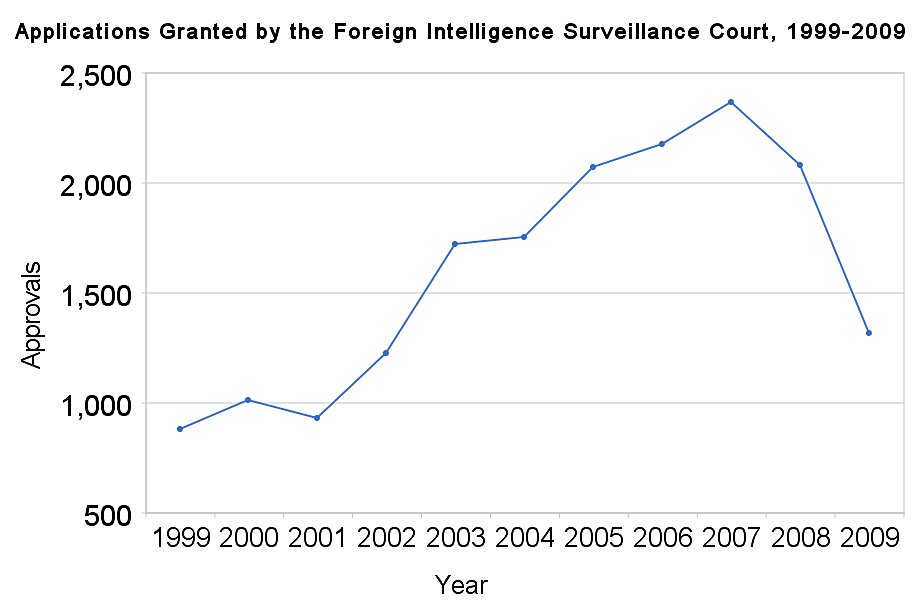
The invaluable Main Justice blog notes that we’ve just gotten our annual dribble of information from the Foreign Intelligence Surveillance Court, showing that the number of surveillance applications sought and approved by the court dropped for a second consecutive year, to their lowest level since 2002. Applications fell to 1,376—down from 2007’s record high of 2,370.
So does that mean there’s less FISA surveillance going on? Nope—according to an anonymous source at the Justice Department, you can’t infer much from the raw numbers, especially given the passage of the FISA Amendments Act of 2008, which empowered the executive branch to authorize broad programs of surveillance with slight court oversight:
“The number of Foreign Intelligence Surveillance Act applications submitted to the Foreign Intelligence Surveillance Court decreased in 2008 and again in 2009 due to significant changes in the legal authorities that govern FISA surveillance — specifically, the enactment of the FISA Amendments Act in 2008 — and shifting operational demands, but the fluctuation in the number of applications does not in any way reflect a change in coverage,” the official said.
I note with some disappointment that the normally astute folks at Main Justice repeat the canard that the FISA Amendments Act were a response to a 2007 court ruling that “surveillance of purely foreign communications that pass through a U.S. communications node was illegal without a warrant.” Boosters of broader executive power trumpeted that line, but as we learned in 2008, the court’s limitations were really centrally about certain kinds of e‑mail traffic; it has never been the case that purely foreign communications in general required a warrant if they passed through the U.S.—and indeed, nobody reading the plain text of the FISA law could possibly believe that to be the case.
In any event, as I suggested recently when last year’s criminal wiretap figures were released, this is one more reason to suspect that current reporting requirements amount to so much oversight theater—giving us the illusion that we have some understanding of the real scope of electronic surveillance, while providing (at best) a spotty and incomplete picture.
Last week I wrote about Senator Sanders’ “compromise” with Senator Dodd and the White House on auditing the Federal Reserve. To re-cap, the compromise would drop any auditing of monetary policy and simply focus on the Fed’s emergency lending facilities. See my previous post for why I believe that compromise is a big win for the Fed and a loss for the American public.
The good news is that Senator Sanders’ compromise does not end the debate. Senator Vitter has filed an amendment (#3760) that mirrors the original Sanders’ amendment, including an audit of monetary policy. With any luck, other Senators will be able to decide for themselves whether the Sanders-Dodd compromise offers sufficient transparency of the Fed’s actions.
I also highly suggest reading Arnold Kling’s recent Cato briefing paper on the issue, “The Case for Auditing the Fed Is Obvious.”
- Confirmation hearings are a “vapid and hollow charade”, or at least that’s what Elena Kagan wrote fifteen years ago. National Review Online invited me to contribute to a symposium on how Republican senators can keep the coming hearings from becoming such a charade, with results that can be found here.
- The First Amendment has been among Kagan’s leading scholarly interests, and yesterday in this space Ilya Shapiro raised interesting questions of whether she will make an strong guardian of free speech values. Eugene Volokh looks at her record and guesses that she might wind up adopting a middling position similar to that of Justice Ginsburg. As Radley Balko and Jacob Sullum have noted, the departing John Paul Stevens ran up at best a mixed record on First Amendment issues, so the overall impact on the Court is far from clear.
- Kagan’s other main scholarly topic has been administrative and regulatory law, and Nate Oman at Concurring Opinions warns that everything in her career “suggests that she is intellectually geared to look at the regulatory process from the government’s point of view.” Oman took an advanced seminar she taught, and brings back this cautionary report:
It was an interesting class, mainly focused on the competition between bureaucrats and political appointees. In our discussions businesses were always conceptualized as either passive objects of regulation or pernicious rent-seekers. Absent was a vision of private businesses as agents pursuing economic goals orthogonal to political considerations. We were certainly not invited to think about the regulatory process from the point of view of a private business for whom political and regulatory agendas represent a dead-weight cost.
- I’m not the only one who finds Kagan’s exclusion of military recruiters at Harvard wrongheaded, even while agreeing with her in opposing the gay ban. Peter Beinart made that argument in a widely noted post at The Daily Beast last month and now has a followup. Former Harvard law dean Robert Clark is in the Wall Street Journal today (sub-only) with an argument that Kagan’s policy was a continuation of his own and represented the sense of the law faculty as a whole. Emily Bazelon points out that the recruitment bar was overwhelmingly popular at top law schools at the time, an argument that as Ramesh Ponnuru points out may raise more questions than it answers. And Ilya Somin cautions against assuming that the wrongheadedness reflects any specifically anti-military bias.
- One of John Miller’s readers recalls John Hasnas’s wise words on “empathy” in judging. David Brooks at the Times runs with the “Revenge of the Grinds” theme. SCOTUSblog rounds up some other reactions (with thanks for the link). And Brad Smith, writing at Politico, advises us to be ready should Citizens United come up at the hearing.
Great stuff on Forbes.com today by the Center for College Affordability and Productivity’s Daniel Bennett. Bennett examines the income-based student-loan repayment provisions attached to the health-care reconciliation law, and itemizes how much of their monthly repayment bill borrowers in most federal loan programs will be able to skip out on, leaving taxpayers holding the bag.
Check out Bennett’s entire, handy chart in the article to see the savings for numerous levels of debt and income, and I’ll just highlight the savings for borrowers with $25,000 in debt — slightly more than the average for those graduates who have any debt.
Basically, any single person at that debt level making below a little more than $60,000 a year would see savings under IBR. A federal loan of $25,000, with a 6.8 percent interest rate, would normally carry a monthly repayment of $383. But a person earning $60,000 a year would only pay $365 under IBR, a $19 monthly savings. And, of course, the IBR savings to the borrower — and loss to the taxpayer — gets bigger as income goes down.
Oh, and that’s really only half the story: While anyone with a federal loan (excluding PLUS loans) is now eligible for IBR, if you go into saintly non-profit work — including assuming the incredible hardships of working for the government — your remaining loan balance will be forgiven after only ten years of on-time payments, versus twenty for any devil who dares produce things for which people voluntarily pay!
Related Tags
I was pleased last week to testify in Congress about a draft bill that would mandate “event data recorders” in all new cars. Automobile black boxes or “EDRs” are an issue that found me a few years ago when I commented on their privacy consequences to a newspaper and heard from concerned drivers across the country.
My testimony to the House Commerce Committee’s Subcommittee on Commerce, Trade, and Consumer Protection had three main themes:
1) The Constitution doesn’t give Congress authority to design automobiles or their safety features;
2) Only a relevant sample of crash data is needed to improve auto safety—overspending on a 100% EDR mandate will keep the poor in older, more dangerous cars and undermine auto safety for that cohort; and
3) The privacy protections in the bill help, but consumers should control the existence and functioning of EDRs in their cars.
A co-panelist taking a different view was Joan Claybrook, President Emeritus of Public Citizen and a former administrator of the National Highway Traffic Safety Administration. In her testimony, Claybrook called for a near quadrupling of NHTSA’s budget to $500 million per year. She also called for the construction of what might be called “Total Auto Awareness” infrastructure.
“[T]he bill should require that the data collected by the EDR be automatically transmitted to a NHTSA database,” Claybrook wrote. She probably meant only crash data, and she paid lip service to privacy, but this represents a probable goal of the auto safety community. Our money, our cars, and our data are instruments for them to use in pursuit of their goals.
If this auto surveillance infrastructure is mandated, what EDRs collect, store, and transmit to government databases will grow over time.
They’re going to keep you alive, damnit, if it burns up all your freedom and autonomy to do it! It’s the beating heart count that matters, not the reasons for living.