Cato at Liberty
Cato at Liberty
Topics
Maracich v. Spears: The Privacy Case Where Every Justice Switched Sides
Two weeks ago, in Maryland v. King, the Supreme Court was deeply split on a case pitting wider access to a government database for purposes of more thorough law enforcement versus fears about intrusion on privacy and unprofessional standards among law enforcers. Today, in the drivers’-license-database case Maracich v. Spears, the Court was once again pulled 5–4 between those two contending poles. And here’s the remarkable thing: every single Justice switched sides.
In Maracich, as in the earlier case, Justice Anthony Kennedy wrote the majority opinion on behalf of three fellow conservatives plus Justice Stephen Breyer, while three liberal justices joined by Justice Antonin Scalia dissented. (This time it was Justice Ruth Bader Ginsburg, rather than Scalia, who wrote the dissent.) And today it was the conservatives-plus-Breyer who chose to display a delicate regard for privacy and professionalism, while the liberals-plus-Scalia were suddenly the ones who didn’t want to tie the hands of law enforcement.
Now, to be sure, there are some fairly huge differences between the two cases. Maracich v. Spears, unlike Maryland v. King, was not a “big” or closely watched case, except perhaps among auto dealers and trial lawyers, and it raised no Constitutional issues under the Fourth Amendment. Instead it was a narrow case of statutory construction involving the precise scope of the Driver’s Privacy Protection Act of 1994 (DPPA), which forbids outside access to drivers’ license databases operated by state DMVs except for one of a specified list of reasons. In general, DPPA forbids access to drivers’ identities for purposes of commercial solicitation (sending new car owners a coupon for a free car wash, for example). But it does permit queries for the purpose of preparing for legal proceedings, including specifically the “investigation” that may precede the filing of a lawsuit. So the question is: does it allow database queries by lawyers looking for contact information so as to solicit car owners to join a lawsuit against car dealers? Does a commercially motivated query that would otherwise not be okay become okay because solicitation can serve as a stage in lawyers’ preparation and “investigation” of a lawsuit?
When every single justice switches sides you may suspect that ideology has played some role, and you might be right. Plaintiffs’ lawyers as a class in certain ways serve as the police or prosecutors of the civil justice system, launching a stream of enforcement actions some of which prove valid and non-abusive and others not. A durable feature of the ideological split between conservatives and liberals in law is that Justices (and professors and news commentators) who are suspicious of the motives of police are often considerably less suspicious of the motives of plaintiff’s lawyers, and vice versa. Thus Justice Ginsburg’s dissent leans over backwards to give the lawyers the benefit of the doubt, pointing out that the suit against car dealers that was promoted by the solicitation did obtain a settlement (from which we are presumably to deduce that it had some merit under South Carolina consumer protection law) and suggests it could be too hard for judges to distinguish legitimate investigational queries from mere solicitation (though in the episode at hand the lawyers’ letter was blazoned with a prominent label “SOLICITATION,” which might be one clue). Similarly, Kennedy’s majority opinion (which ruled that solicitation as such was not protected under the investigational or “in-connection-with” exemptions and sent the case back for further consideration in light of that) likewise went out of its way to warn about letting private lawyers on fishing expeditions gain access to sensitive database information about drivers’ Social Security numbers or disability status, though there was no indication at all that the South Carolina lawyers had used or misused any such aspect of the data.
As I say, Maracich by itself isn’t that big a deal, since if Congress thinks the Court has made DPPA too strict it can always go back to widen the exceptions a bit. But one can still daydream about a future bench equally sensitive to privacy menaces whether from police departments or the private bar.
Bad Arguments About Public Goods
Get a good education and you’ll probably lead a more fulfilling, more successful life than you would have without it. Since those benefits accrue directly to you, education is partly what economists call a “private good.” But while you’re busy earning a living and paying taxes, you aren’t dependent on government handouts or (probably) holding up liquor stores. So your whole community benefits, indirectly, from your education (especially the liquor stores). As a result, education is also partly a “public good.”
The thing about public goods is that the beneficiaries don’t have to pay for them. Economists fear that if the public doesn’t have to pay for something, it won’t; and that if something isn’t paid for, it won’t be produced in the first place. As a result, some economists theorize that government must step in to ensure that education delivers the public goods, either by operating schools of its own or by subsidizing and regulating the kind and quantity of schooling that teachers are allowed to offer and that families are allowed to consume.
This is the dominant economic argument for the existence of a major government role in K‑12 education, and it is based on a pair of unstated assumptions, both of which are testable and false.
The first assumption is that, left to their own devices, families would consume insufficient education, or the wrong kind of education, to produce the sought-after public benefits. If that’s true, it seems that we’d be most likely to see it in times and places where most parents had low levels of education themselves—places like early 19th century Britain and America. And, indeed, these are widely viewed as cases in which government education spending and mandatory attendance laws brought universal literacy and school attendance to a previously benighted populace.
Widely, but wrongly. As far back as 1965, economist E.G. West demonstrated that growing 19th century government education expenditures in the U.K. did not so much increase the consumption of schooling as displace pre-existing sources of private funding—in his phrase: “jumping in to the saddle of an already-galloping horse.”
In the 1994 update of his book Education and the State, West did much the same thing for the U.S. case, showing that the elementary enrollment rate was close to 90 percent and still rising in early 19th century New England, at a time when no state board of education yet existed, the majority of students attended private or home schools, and tax-funding made up only a small portion of total education spending—even in the semi-public “common” schools (which charged most families tuition).
Echoing this pattern, I pointed out in a chapter for the book Liberty and Learning (p. 105) that U.S. compulsory attendance laws had no noticeable effect on enrollment rates over the decades (1852 to 1918) in which they were introduced.
In modern times education researcher James Tooley has repeatedly shown that destitute families living in slums of the developing world are increasingly paying for ultra-low-cost private schooling themselves, despite the availability of better-funded “free” public schooling. They do this, they tell Tooley, because they feel the public schooling is inferior or even worthless. Tooley’s careful studies of these schools, reported in academic journals and his wonderful book The Beautiful Tree, confirms the parents’ view.
The second assumption of the public good argument is two-fold: first, that government is a better judge of how to create the public benefits of education than are families acting individually; and second, that government provision and/or regulation are capable of producing the outcomes which they nominally seek. Both are contradicted by the evidence.
One of the single most consistent lessons of the history of education from classical Greece to the present, which I chronicled in Market Education: The Unknown History, is that parents have tended to make better decisions for their own children than elected or appointed bureaucrats have made on their behalf. Since its publication, I have reviewed the world-wide, within-country statistical research comparing alternative school systems and found that the most parent-driven, market-like, least regulated school systems do the best job of serving families across all outcomes measured.
The one outcome area which that literature review does not cover is civic-mindedness—the sort of tolerance and desire to engage with one’s fellow citizens that is perhaps the most public of education’s public goods. That area, however, has been studied by others and the results are much the same: they compellingly favor the private, minimally regulated provision of education as more effective in creating these social virtues. See, for instance, the work of Patrick Wolf and David E. Campbell.
And if all this is not enough to bury the public good argument for a major government role in education, there’s more: state control over the content of education actually has demonstrable negative social effects: “public bads,” if you will. As I chronicled in Market Education: The Unknown History, ceding control over learning to the state forces people of diverse beliefs into conflict over the content of that officially-sanctioned education. My colleague Neal McCluskey has documented this ongoing effect in his paper titled “Why We Fight,” and on an interactive “battle map,” of public-schooling-induced social conflicts around the United States.
Education does indeed have spillover benefits to society at large, but these benefits are best secured through free and voluntary association. The best policies are those that move us in that direction.
Related Tags
Salinas v. Texas
Today, the Supreme Court issued its ruling in Salinas v. Texas. Surprisingly, the Court did not answer the primary question court watchers were expecting, which was whether a prosecutor can deride a person’s reliance upon the right against self-incrimination when that person has not been arrested. The Court said it did not have to reach that question because the person here, Salinas, never really properly invoked his constitutional right against self incrimination. And because he didn’t, there was nothing wrong with the prosecutor’s comments at his trial. This is a lousy ruling.
A bit more background. Everyone knows from TV shows, that once a person is arrested and the police start an interrogation, the Miranda warnings are given. “You have the right to remain silent, right to a lawyer if you cannot afford one and anything you say can be used against you in court, etc” The Supreme Court has also held, properly, that if anyone declines to take the witness stand during the trial, the prosecutor can’t attack that choice to the jury with comments like, “He could have taken the stand to tell us his side of the story, but he didn’t. That tells us quite a bit, doesn’t it?” The rationale against allowing that sort of “evidence” is that if one really has a right against self-incrimination, the government should not be permitted to attack it. The prosecutor must use other evidence to persuade the jury of guilt.
So, again, the government can’t offer negative comments on the choice not to testify and may not offer negative comments on a person’s choice to remain silent after an arrest. Salinas brought the question, what about silence before an arrest? Cato filed a brief saying prosecutors should also be barred from attacking pre-arrest silence.
Justice Alito announced today that the main question is again postponed for another day. The Court said Salinas simply remained silent and did not “formally” invoke any constititional right, so prosecutors could offer commentary to the jury. What’s most disturbing about the ruling is its discussion of “burdens.” The plurality put the onus on the individual, not the government. That is the profound error in the decision. As the dissenters noted, in the circumstances of the case, it was evident what Salinas was doing. Unfortunately, the Supreme Court has complicated the law for persons who are the most vulnerable–persons who lack education, persons who do not speak English very well, persons who may suffer from mental problems, and persons who may be under the influence of alcohol. This is a bad day for the Bill of Rights.
Siding with the Heritage Foundation in the “Austerity” Fight with Paul Krugman and the Washington Post
I’m not reluctant to criticize my friends at the Heritage Foundation. In some cases, it is good-natured ribbing because of the Cato-Heritage softball rivalry, but there are also real policy disagreements.
For instance, even though it is much better than current policy, I don’t like parts of Heritage’s “Saving the American Dream” budget plan. It’s largely designed to prop up the existing Social Security system rather than replace the existing tax-and-transfer entitlement system with personal retirement accounts. And while the plan contains a flat tax, it’s not the pure Hall-Rabushka version. One of the most alarming deviations, to cite just one example, is that it creates a tax preference for higher education that would enable higher tuition costs and more bureaucratic featherbedding.
That being said, I’m also willing to defend Heritage if the organization is being wrongly attacked. The specific issue we’ll review today is “austerity” in Europe and whether Senator Sheldon Whitehouse of Rhode Island is right to accuse Heritage of “meretricious” testimony.
Let’s look at the details.
Earlier this month, Paul Krugman wrote that, “a Heritage Foundation economist has been accused of presenting false, deliberately misleading data and analysis to the Senate Budget Committee.” Krugman was too clever to assert that the Heritage economist “did present” dishonest data, but if you read his short post, he clearly wants readers to believe that an unambiguous falsehood has been exposed.
Krugman, meanwhile, was simply linking to the Washington Post, which was the source of a more detailed critique. The disagreement revolves around whether Europeans have cut spending or raised taxes, and by how much. The Heritage economist cited one set of OECD data, while critics have cited another set of data.
So who is right?
Conn Carroll of the Washington Examiner explains that the Heritage economist was looking at OECD data for 2007–2012 while critics are relying on an OECD survey of what politicians in various countries say they’ve done since 2009 as well as what they plan to do between now and 2015.
Whitehouse believed he had caught Furth and The Heritage Foundation in a bald face lie. …There is just one problem with Whitehouse’s big gotcha moment: The staffer who spoon-fed Whitehouse his OECD numbers on “the actual balance between spending cuts and tax increases” failed to also show Whitehouse the front page of the OECD report from which those numbers came. That report is titled: “Fiscal consolidation targets, plans and measures in OECD countries.” Turns out, the numbers Whitehouse used to attack Furth for misreporting “what took place in Europe” were actually mostly projections of what governments said they were planning to do in the future (the report was written in December 2011 and looked at data from 2009 and projections through 2015). At no point in Furth’s testimony did he ever claim to be reporting about what governments were going to do in the future. He very plainly said his analysis was of actual spending and taxing data “to date.” Odds are that Whitehouse made an honest mistake. Senators can’t be expected actually to read the title page of every report from which they quote. But, considering he was the one who was very clearly in error, and not Furth, he owes Furth, and The Heritage Foundation an apology. Krugman and Matthews would be well advised to revisit the facts as well.
In other words, critics of Heritage are relying largely on speculative data about what politicians might (or might not) do in the future to imply that the Heritage economist was wrong in his presentation of what’s actually happened over the past six years.
So far, we’ve simply addressed whether Heritage was unfairly attacked. The answer, quite clearly, is yes. If you don’t believe me, peruse the OECD data or peruse the IMF data.
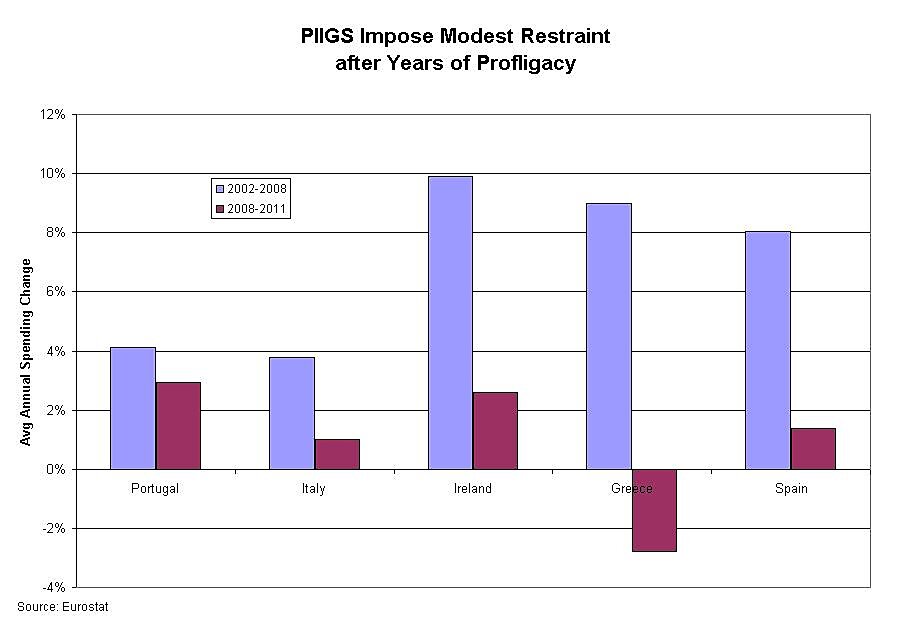
Now let’s briefly touch on the underlying policy debate. Keynesians such as Krugman assert that there have been too many spending cuts in Europe. The “austerity” crowd, by contrast, argues that strong steps are needed to deal with deficits and debt, though they are agnostic about whether to rely on spending reforms or tax increases.
I’ve repeatedly explained that Europe’s real problem is an excessive burden of government spending. I want politicians to cut spending (or at least make sure it grows slower than the productive sector of the economy). And rather than increasing the tax burden, I want them to lower rates and reform punitive tax systems.
The bad news is that Europeans have raised taxes. A lot. The semi-good news is that spending no longer is growing as fast as it was before the fiscal crisis.
In the grand scheme of things, however, I think Europe is still headed down the wrong path. Here’s what I wrote back in January and it’s still true today.
I don’t sense any commitment to smaller government. I fear governments will let the spending genie out of the bottle at the first opportunity. And we’re talking about a scary genie, not Barbara Eden. And to make matters worse, Europe faces a demographic nightmare. These charts, reproduced from a Bank for International Settlements study, show that even the supposedly responsible nations in Europe face a tsunami of spending and debt over the next 25-plus years. So you can understand why I don’t express a lot of optimism about European economic policy.
By the way, I’m not optimistic about the long-term fiscal outlook for the United States either. In the absence of genuine entitlement reform, we’ll sooner or later have our own fiscal crisis.
Related Tags
The Framers and Love
As some of you are aware, I recently got married, right here on Cato’s roofdeck, overseen by the eagle of liberty. I’ll spare you the details — there were plenty of “constitutional moments,” including personalized pocket constitutions as one of our wedding favors — other than to highlight my sometime co-author Josh Blackman’s excellent reading on the Framers and love:
We can look to the same patriots that gave us our Constitution to glean some lessons about love, liberty, and forming more perfect unions.
A successful marriage is not that much different from a successful republic. Both require the union of different parties to utilize their comparative advantages more efficiently. Both require a federalist system that structures powers and rights. And most importantly, both must aspire to a higher charter to bond them into one. For the United States it is our Constitution. For Kristin and Ilya, it is their vows.
First, we look to Federalist 51, Ilya’s favorite, where Madison wrote that if men were angels, we would not need government. Alas, neither husband nor wife is always an angel, so both Kristin and Ilya will need to structure a government for themselves to promote their happiness.
Second, to avoid any strife, we should heed Jefferson’s words in the Declaration of Independence, for mere “light and transient” causes are not enough. They must maintain tranquility, as they “mutually pledge to each other their Lives, their Fortunes and their sacred Honor.”
Third, we turn to the father of our country, General George Washington, whose eternal love for his wife Martha carried him towards victory. In one of the rare letters, which Martha did not burn at George’s death, the General wrote to her, “I retain an unalterable affection for you, which neither time nor distance can change.” May the two of you always be in such love, no matter where you are.
May the passion our framers had for our Constitution and Republic, mirror the love you have for each other. And as the history of our nation has witnessed, despite the dividing difficulties, insurmountable challenges, and specters of oppression, the union shall always prevail. As you pursue happiness together, may Kristin and Ilya always cherish their life, and liberty–and hopefully accumulate vast amounts of property, both personal and real. And that way, they can “secure the Blessings of Liberty to their many Posterity.”
If you’re curious about the rest of the ceremony, including Josh’s presentation, you can view it here (the audio is patchy at first, but kicks in before the vows). Yes, I got permission from my wife to post that and, yes, we’ll be going on honeymoon soon — but, like most couples, we’re waiting for the end of the Supreme Court term before getting away.
A Reply to Epstein & Pilon on NSA’s Metadata Program
Last week, my colleague Roger Pilon and Prof. Richard Epstein co-wrote a Chicago Tribune op-ed defending the National Security Agency’s bulk metadata collection program. I had not, initially, intended to respond directly: Cato scholars often disagree among themselves—as Roger and I long have in this area—and normally it suffices for us each to state our own affirmative arguments and let readers decide for themselves which is most convincing. However, as I now see that some observers—and in particular, a significant number of libertarians—have mistakenly taken this to mean that “Cato” supports the NSA program, which continues to dominate the news, I feel it’s necessary to say something here about why I (and, as I believe, the majority of my colleagues) reject that view.
In an area where so much remains secret, it is impossible to have a sensible debate unless we are at least clear on the public facts. So before I address their broader arguments, it is necessary to correct a few important factual errors in the Tribune piece. Pilon and Epstein write:
The names linked to the phone numbers are not available to the government before a court grants a warrant on proof of probable cause, just as the Fourth Amendment requires.
This is incorrect. Nothing in the law would require a warrant to get the name associated with a number, and the public statements of FBI Director Robert Mueller directly contradict this claim.
At the risk of stating the obvious: phone numbers can often be associated with names by a simple Google search, and the NSA and FBI have access to far larger databases that would likely make such an association trivial.
But even if that weren’t the case, 18 USC §2709 allows names, addresses, and other “basic subscriber information” associated with a number to be obtained via a National Security Letter based on a certification of “relevance” to an investigation, with no need for judicial approval. As Director Mueller explained at a recent hearing, this is precisely how such information would be obtained here, assuming it were not already available.
Indeed, once that warrant is granted to examine content, the content can be used only for national security issues, not even ordinary police work.
This is also incorrect. Under 50 USC §1801, the minimization procedures governing information acquired from electronic surveillance shall “allow for the retention and dissemination of information that is evidence of a crime which has been, is being, or is about to be committed and that is to be retained or disseminated for law enforcement purposes.” As the FISA House Report makes clear, this does not refer to terrorism or espionage related crimes, which can already be retained and disseminated as “foreign intelligence information,” but rather to information about crimes “totally unrelated to intelligence matters.”
As the Eighth Circuit explained in one case where information from FISA intercepts was used in criminal prosecution, U.S. v. Isa:
[FISA] specifically authorizes the retention of information that is “evidence of a crime,” and provides procedures for the retention and dissemination of such information. There is no requirement that the “crime” be related to foreign intelligence. Indeed, the legislative history of Section 1801(h)(3) suggests the contrary.
This may well be appropriate in certain circumstances, but the breadth of FISA surveillance and the sheer volume of crimes on the books make it a significant loophole. In any event, appropriate or not, Epstein and Pilon misstated the relevant law.
They next suggest that the metadata program was used to“discern the pattern that let it thwart the 2009 New York subway bombing plot by Colorado airport shuttle driver Najibullah Zazi.” While the full facts here remain unclear, this conflicts with what is publicly understood about that investigation. House Intelligence Committee Chairman Mike Rogers has claimed that the program “was used” in the Zazi case, but the public record indicates that Zazi was identified, not via some sophisticated pattern analysis, but from his correspondence with an Al Qaeda e‑mail account that was being directly monitored after being located on another terrorists’ laptop.
Conceivably this account is a cover story designed to protect a predictive data mining program, but any such assertion would be pure speculation at this stage. Whatever subsequent role the NSA metadata program may have played in keeping tabs on Zazi, it is unclear the same could not have been accomplished using traditional, particularized pen register and records orders. In any event, again, there is as yet no public evidence for Pilon and Epstein’s assertion.
Finally, they write:
The critics would be more credible if they could identify a pattern of government abuses. But after 12 years of continuous practice, they can’t cite even a single case.
If Epstein and Pilon refer here specifically to this phone records program, the objection is merely rather strange: This is a program so highly classified that even passing allusions to it have been redacted from published Inspector General audits of §215. What possible record exists to cite? The rampant abuses uncovered by the Church Committee, recall, had in many instances gone undisclosed to the public for decades. This is for the unsurprising reason that when government officials illegally misuse information obtained in secret surveillance programs, they tend not to send out press releases about it, but rather make covert and indirect use of the information—as via targeted leaks—and conceal their actions as far as possible, which the shroud of secrecy facilitates.
However, if they refer more generally to government acquisition of phone records under the Patriot Act, the claim is again simply incorrect. “Abuse” is, to some extent, subjective: I would regard the bulk acquisition of all Americans phone logs under an authority to obtain records “relevant to an investigation” as itself abusive. But surely, at minimum, we must count instances explicitly characterized as “abuses” by the Justice Department Inspector General, who in a series of reports on FBI practices found “widespread and serious” misuse of call records authorities. These included systematic disregard for the required procedures for demanding records, false statements in affidavits to both telecommunications companies and the FISA Court, improper acquisition of journalists’ phone records, use of national security authorities in cases unrelated to national security, and attempts by superiors to retroactively conceal these improprieties when they were discovered internally after several years. The IG also noted a pattern of failure to report potential violations to the proper oversight board.
I have, incidentally, referenced these reports on occasion here on the Cato blog. Pilon and Epstein are free to disagree with the IG about the seriousness of these infractions, but again, it is simply inaccurate to say that critics of these authorities have never been able to cite any.
That covers the major strictly factual problems. Now to the more interesting points of legal and policy disagreement. Pilon and Epstein write:
Legally, the president is on secure footing under the Patriot Act, which Congress passed shortly after 9/11and has since reauthorized by large bipartisan majorities.
“Secure footing” seems awfully ambitious: At the very most, one can argue that this program may fall within the bounds of an interpretation that strains §215 to its absolute limit. But many, including one of the authors of the Patriot Act, James Sensenbrenner, argue vehemently that it does not. As Sensenbrenner writes:
Congress intended to allow the intelligence communities to access targeted information for specific investigations. How can every call that every American makes or receives be relevant to a specific investigation?
The theory used to justify this, as summarized by FBI Director Mueller, is that the entire body of phone records is “relevant to an investigation” because it plausibly contains records that will be relevant to some investigation at some point in the future. Former Justice Department lawyer Mark Eckenwiler—who is, shall we say, not exactly an ACLU type—describes this interpretation as “highly questionable,” which I’d call an understatement. By contrast, the Heritage Foundation’s Paul Rosenzweig argues that the program is legal under §215, though he adds that “whatever its legality, the entire order is remarkably overbroad and quite likely unwise.” At the very least, however, I think we can say that this is not what the “large bipartisan majorities” who approved the provision believed they were authorizing.
On, then, to the constitutional question. Pilon and Epstein write:
The text of the Fourth Amendment grasps that essential trade-off [between security and liberty] by allowing searches, but not “unreasonable” ones
This is true as far as it goes, but it’s important here to understand how this phrase was understood at the time of the Founding. There is no free-floating “reasonableness” standard found in the common law of search and seizure in the Founding Era. Rather, the phrase “unreasonable searches” enters the American lexicon through the provision of the Massachusetts Constitution that served as a template for the Fourth Amendment.
That was penned by John Adams, who scholars believe was invoking the language of his great mentor James Otis, who had famously insisted that any statute authorizing general, non-particularized searches was “against common right and reason” and therefore “void.” In other words, “unreasonableness” was not meant to invite the kind of “balancing test” so beloved by the modern Supreme Court—though as technology presents novel problems, some amount of that is, perhaps, inevitable. Rather, “unreasonableness” was specifically associated with the absence of particularity—of the kind exhibited by, for instance, an authority to indiscriminately collect all Americans’ phone records.
Of course, as Pilon and Epstein note, the courts do not simply engage in a kind of utilitarian balancing calculus every time the Fourth Amendment must be applied, but have crafted rules defining a “search” and laying out the circumstances in which it is justified:
In 1979, in Smith v. Maryland, the U.S. Supreme Court addressed that balance when it held that using a pen register to track telephone numbers did not count as an invasion of privacy, even in ordinary criminal cases. That’s just what the government is doing here on a grand scale.
Two points here. First, while Smith v. Maryland and the “third party doctrine” it spawned remain operative, that decision has long been widely condemned as mistaken and incoherent by legal scholars, and it is especially strange to see it favorably invoked by two libertarians. As I outline in a recent Bloomberg piece, and as Prof. Christopher Slobogin details at greater length in his excellent paper “Subpoenas and Privacy,” the early roots of that decision lie in a series of early 20th century cases that represent precisely the type of results-oriented jurisprudence Pilon normally decries: In a reversal of earlier precedents, the Court ruled that the government could compel the production of business records without meeting Fourth Amendment standards, not because the Framers had expected businesses to be denied protection—they rather clearly had—but because to hold otherwise would “practically nullify” the plethora of new federal business regulations Congress was passing.
Smith extended that logic to corporate records of personal information—conflating, incidentally, two lines of not-obviously-applicable cases involving undercover informants and tax records being prepared specifically for submission to the government—on the theory that persons waived their “reasonable expectation of privacy” by disclosing that information to a business, regardless of any contractual guarantees of confidentiality. The Court, in effect, obliterated the distinction between voluntary sharing of information with a particular private entity—for limited and contractually defined purposes—and the compulsory production of that information by government for its own purposes. This is not a line of reasoning one normally expects to see endorsed by libertarians.
The second point to make here is that, even if we wish to accept the shoddy reasoning of Smith, it makes a difference when the acquisition is on a “grand scale.” In a 1983 ruling that found no Fourth Amendment violation in the short-term tracking of a single automobile, Justice Rehnquist acknowledged in passing that “dragnet-type law enforcement practices” involving mass tracking might require the Court “to determine whether different constitutional principles may be applicable.”
In the far more recent case of United States v. Jones, the court unanimously rejected long term tracking of a vehicle using a GPS device, though on a variety of grounds. Justice Alito’s concurrence—whose reasoning was explicitly endorsed by five justices—observed that while short term observation of a vehicle’s public travel violated no expectation of privacy, “society’s expectation has been that law enforcement agents and others would not—and indeed, in the main, simply could not—secretly monitor and catalogue every single movement of an individual’s car for a very long period.” Alito suggests that the Court’s guiding principle should be the “preservation of that degree of privacy against government that existed when the Fourth Amendment was adopted”—noting that while short term visual tailing and surveillance was surely possible at the time of the Founding, 24-hour monitoring for weeks at a time would not have been. It should go without saying that what would have been impossible at an individual level was simply inconceivable at the level of society as a whole.
This more structural approach, which focuses on preserving an overall balance between state control and citizen autonomy, seems to me more appropriate for evaluating mass surveillance programs such as the NSA’s. As I argue in another recent article, while there are good reasons to question whether the intrusion involved in obtaining communications logs is really as “trivial” as Epstein and Pilon suggest, the crucial question is not really whether the short term-benefit of a particular government search outweighs its immediate harm or inconvenience—though I note that the marginal benefit of the NSA program over narrower methods remains as yet asserted rather than demonstrated. By that standard, surely many warrantless searches would pass muster, and the Supreme Court’s 7–2 ruling, in Bond v. United States, that the Fourth Amendment prohibits even the squeezing of luggage would be entirely baffling.
Rather, the appropriate question is whether the creation of a system of surveillance perilously alters that balance too far in the direction of government control, whether or not we have problems with the current use of that system. We might imagine a system of compulsory cameras installed in homes, activated only by warrant, being used with scrupulous respect for the law over many years. The problem is that such an architecture of surveillance, once established, would be difficult to dismantle, and prove too potent a tool of control if it ever fell into the hands of people who—whether through panic, malice, or a misguided confidence in their own ability to secretly judge the public good—would seek to use it against us.
While I hold much of Epstein’s and Pilon’s work in high regard, I believe both their research and their reasoning in this case to be faulty, and hope they will reconsider their position on this important issue. If they remain unpersuaded, then I at least hope that readers who look to Cato for guidance on these questions will recognize that theirs is not the position held by all—or, indeed, most—Cato scholars.