Bill Niskanen did most of his thinking and analysis on paper, in his many books and articles. He didn’t seek out television appearances, though he certainly made a few during his years with Cato. But one television appearance stands out in my mind, when he debated Rep. Richard Gephardt on PBS’s NewsHour about Gephardt’s bill that would have required economic retaliation against countries that have huge trade surpluses with the United States. Alas, I can’t find the exact date for this pre-Internet appearance — possibly 1988, when Gephardt ran for president and made protectionism a big part of his campaign — and I have only a clip of one of Bill’s answers. But it confirms the “Blunt Libertarian Economist” headline that the New York Times used on its obituary:
Cato at Liberty
Cato at Liberty
I first met Bill when I went to the Council of Economic Advisers in mid-1982. Bill had come to the CEA in the spring of 1981 as one of the early appointees of the incoming Reagan administration. He had known the president and worked with him when he was governor of California.
Bill and I quickly became good friends. Whenever we were both in Washington, we would usually start the day with 20 minutes of chewing over what was going on in the economy and in public policy. Part of the bond that developed between us was a consequence of the unrelenting infighting within the administration. The infighting sometimes involved the CEA but Bill and I, most of the time, were able to stand clear and remain in neutral territory.
Of course, Bill understood how bureaucracies work, or failed to work, from both his research and his experience at Rand, Ford, OMB and, yes, at UCLA and Berkeley. His insights were a staple of our conversations both at the CEA and later. Very few scholars have such first-hand experience in these various sectors of the economy. That fact often shows in the work of academics who have policy ideas that are simply untenable in the context of how organizations and the political system actually work.
A wonderful sense of humor lubricated Bill’s interactions with others. Well, most of the time anyway. During the administration’s work that culminated in the Tax Reform Act of 1986, Bill cracked along the way that the Treasury proposal was one that Walter Mondale would be proud of. I had left the CEA and returned to Brown University by that time, but Bill’s crack so angered Treasury Secretary Don Regan (who was not renowned for a sense of humor) that Regan vetoed Bill’s path to become chairman of the CEA. He served as acting chairman for a short time and then joined Cato.
Bill was the most widely read person I have known. That, plus the breadth of his personal experience, made him a delightful conversationalist on almost any topic in almost any group.
Although it was a big loss to the Reagan administration for Bill to depart, it was a huge gain for Cato and for the nation for him to join Cato. His leadership there, working closely with Ed Crane, built Cato to what it is today—the premier libertarian think tank in the world. Bill’s scholarly work will influence future generations; so also, in equal or greater measure, will the Cato Institute that he helped to build.
Related Tags
I have sometimes wondered whether it is accurate to say that Republicans are the “Stupid Party.”
We’ll soon know the answer to that question. As part of the debt limit agreement, the politicians agreed to set up a “Supercommittee” comprised of six Republicans and six Democrats that was responsible for producing at least $1.2 trillion of supposed deficit reduction.
But the Democrats appointed a group of hardcore leftists to the Supercommittee, which means that it is virtually impossible to get the necessary seven votes for a good agreement. Indeed, the more relevant question is whether one or more of the Republicans surrenders to a big tax hike.
Fortunately, there is an alternative. The law says that there will be automatic spending reductions if the Supercommittee does not reach an agreement. The political establishment in Washington thinks that this outcome—known as sequestration—would be horrible.
They tell as that a sequester would mean “savage” and “draconian” budget cuts. The only “responsible” approach, we are told, is to go along with a tax increase.
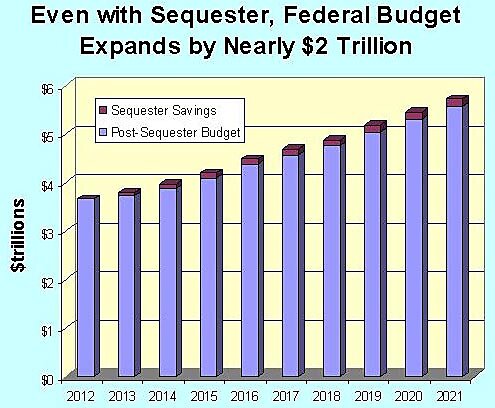
This is hogwash. The automatic spending cuts are only “cuts” using Washington’s dishonest budget math. Here’s a chart showing how much spending will grow over the next 10 years, and the relatively tiny reduction in budgetary growth that will be caused if there is a sequester.
We’ve actually been down this path before. There was a small sequester back in the mid-1980s, shortly after the Gramm-Rudman-Hollings law was enacted. There was much wailing and gnashing of teeth, but the sequestration helped restrain the growth of spending and helped bring about a record amount of deficit reduction in 1987.
There was a similar (unsuccessful) fight in 1989. Here’s what then-Senator Bob Packwood of Oregon wrote in 1989.
…the sequester has become the focus of partisan debate . Each side accuses the other of being responsible for “deep and arbitrary” budget cuts . Some legislators say we should do whatever it takes to cancel the sequester, even if it means higher taxes. While a sequester is certainly not the ideal way to resolve this year’s budget dispute, there are reasons to believe that the fiscal discipline of a sequester is the medicine we need to cure the budget process. For all its drawbacks, a sequester is real deficit reduction . Instead of budget gimmicks, accounting tricks, phony cuts, and “revenue enhancements,” a sequester would reduce spending levels by a fixed percentage in eligible spending programs . In other words, unlike most deficit reduction packages, sequestration would actually reduce the deficit.
The only argument against a sequester, at least among conservatives, is that a sequester would impose too much of a burden on the defense budget. But I’ve already explained in this post that the defense budget will climb by about $100 billion under sequestration.
I don’t know whether Republicans are the stupid party, but I know they will be very stupid if they don’t take the sequester and declare victory.
Related Tags
There’s an interesting new NBER working paper out this week on the impacts of Fannie Mae and Freddie Mac on the mortgage market and the overall economy. I have to admit I’m still working through some of it (my matrix algebra is a little rusty).
To summarize the paper’s findings:
First, comparing stationary equilibria with and without the policy, a tax-financed interest rate subsidy of 40 basis points leads to a significant increase in mortgage origination, but has little effect on investment in housing assets or in the equilibrium construction of real estate. The mortgage subsidy does not significantly change the share of households with positive holdings of real estate, because on one hand the subsidy makes real estate ownership more attractive, but on the other hand the higher required taxes lower net of tax income and thus discourage homeownership for low-income and low-asset households. However, the subsidy does significantly affect the distribution of leverage in the economy by increasing both the fraction of households that have positive mortgage debt and the level of leverage. This suggests that the GSE’s may have led to over-investment in mortgages and excess household leverage, which may have exacerbated the response to the recent drop in house prices.
Using a steady state utilitarian social welfare functional we find that the aggregate welfare implications of the subsidy are negative, in the order of 0f 0.8% of consumption equivalent variation. However, since households are heterogeneous, there is disagreement over the desirability of the subsidy. Low-wealth households prefer to live in a world without the subsidy, whereas high wealth households prefer to live in a world with the subsidy. This can be explained by the fact that low-wealth households hold little or no housing, and thus do not benefit from the subsidy, as compared to high wealth households that have large homes and mortgages.
Of course you can always read the paper and decide for yourself. I didn’t need to work out all the equations to prove that Fannie and Freddie have been a massive regressive theft from all of us to a narrow segment of higher-income homeowners (and bankers).
Last week on The Tonight Show with Jay Leno, President Obama discussed the withdrawal of U.S. troops from Iraq, the 2012 Republican presidential field, and ubiquitous Hollywood socialite, Kim Kardashian. But the conversation got really interesting when it veered to the recent intervention in Libya.
Obama said that with the arrival of the Arab Spring, the late Libyan leader Moammar Qaddafi had an opportunity “to finally loosen his grip on power and peacefully transition to democracy. We gave him ample opportunity and he wouldn’t do it.” On the former leader’s killing, Obama said, “There’s a reason after [Osama] bin Laden was killed, for example, we didn’t release the photograph. I think that there’s a certain decorum with which you treat the dead even if it’s somebody who’s done terrible things.”
Hmmm, decorum. To some in the Beltway it may seem tired and trite to hear that U.S. foreign policy is flagrantly hypocritical when it comes to the subject of human rights. But it’s nonetheless noteworthy to hear prominent American leaders openly advocate intervening abroad in places like Libya in advance of the universal human aspiration to be free while continuing to support Middle East client states that repress their own people. Sadly, President Obama and other American leaders, especially in the wake of the momentous Arab Spring, are often perceived as liberty’s worst emissaries.
For numerous strategic and historical reasons, no American government has intervened militarily in countries such as Algeria, Jordan, or Yemen in defense of human rights. In Saudi Arabia, a long-time U.S. partner, homosexuals, apostates, and drug smugglers can be sentenced to execution, sometimes by beheading. In extreme cases, the convict’s body is crucified in public. And yet, the same U.S. government that offers unflinching support to the Saudi Kingdom led from behind for an intervention in Libya to stop an alleged massacre in Benghazi. In neighboring Egypt, meanwhile, for 29 years the U.S. government showered former President Hosni Mubarak with praise, despite his widespread use of torture and systematic repression of political prisoners. Washington also continues to support and arm the regime in Bahrain, which deliberately kills unarmed protesters and oppresses its people.
To promote human rights in Libya while supporting some of the world’s most heinous tyrannies may reflect America’s geopolitical preferences, but it makes a mockery of human rights and reveals an enormous discrepancy between what America claims to be doing and what it actually does. As much as Obama and his defenders want to strut around and promote their triumph over Moammar Qaddafi, people in the Middle East and around the world are well aware of this discrepancy. Such policies are not only abhorrent but also detrimental to America’s long-term interests. Advancing liberty is a painful and arduous process, but it can be done, and often independent of U.S. government efforts.
Related Tags
The expression, “runaway grand jury,” is typically used to disparage a grand jury that has turned its attention toward officialdom. That’s happening in Texas where a grand jury is looking at a district attorney’s office and its use of controversial evidence in DWI cases.
For additional background on the grand jury, go here.
The president has relentlessly called for a more extensive—and expensive—federal role in education. Here’s just one example:
The human mind is our fundamental resource. A balanced Federal program must go well beyond incentives for investment in plant and equipment. It must include equally determined measures to invest in human beings—both in their basic education and training and in their more advanced preparation.… Without such measures, the Federal Government will not be carrying out its responsibilities for expanding the base of our economic… strength.
And if we spend all those new federal dollars on k‑12 education, the president promised that “it will pay rich dividends in the years ahead.”
But here’s the strange part: in that same speech, the president made this seemingly ridiculous claim:
Our progress in education over the last generation has been substantial. We are educating a greater proportion of our youth to a higher degree of competency than any other country on earth.
It’s actually not so ridiculous when you learn that the president who said it was John F. Kennedy, in February of 1961. Back then, we really had been making educational progress.
Aside from the ill-fated National Defense Education Act of 1958, the federal government had made no attempt to improve k‑12 academic achievement or attainment in the four decades before JFK… and yet, as he noted, American education did in fact improve during that period.
But within a couple of years of JFK’s assassination, Congress passed the Elementary and Secondary Education Act, now known as the No Child Left Behind Act. And in the four plus decades since, the feds have spent roughly $2 trillion trying to improve outcomes and attainment. Over that course of years, both graduation rates and academic achievement at the end of high school have been flat or declining.
Perhaps it could be argued that JFK couldn’t have known better. There was no history showing him what an expensive failure U.S. federal education spending would turn out to be. But the same cannot be said of President Obama, or of those in Congress who continue to tell the public, and presumably themselves, that fed ed. spending is a useful “investment.”
Today, we can look back at a half-century of failed federal education programs. We can think about how much better off the U.S. economy and our children would be if we hadn’t thrown $2 trillion at a calcified school monopoly that cannot spend money efficiently.
And reflecting on that history, perhaps we’ll find the wisdom not to repeat it.