If U.S. education secretary Arne Duncan is going to talk as if he’s from an alternate universe, shouldn’t he have to grow a beard like Spock from the classic Star Trek episode “Mirror, Mirror”?
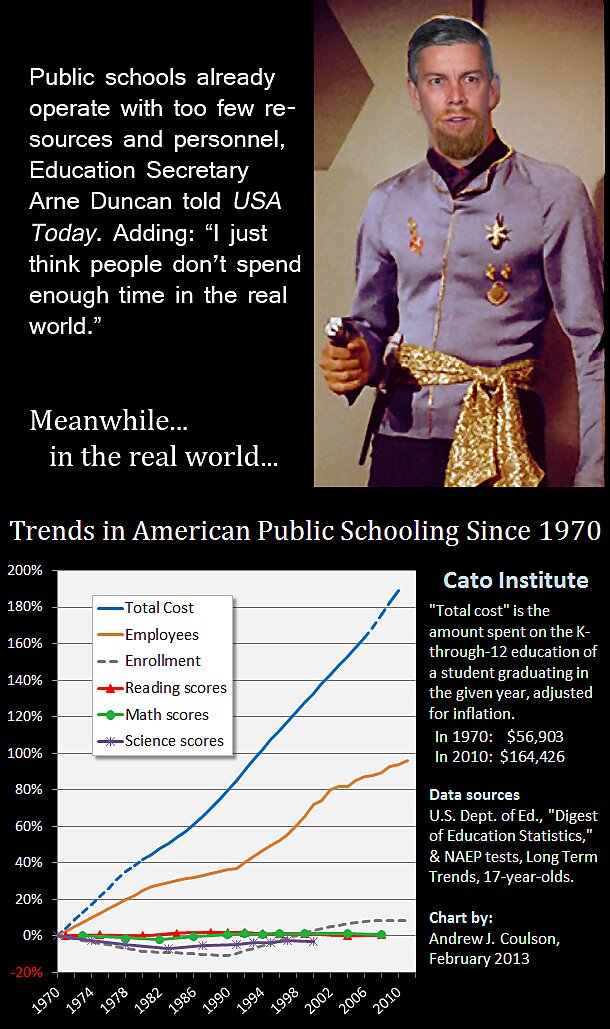
If U.S. education secretary Arne Duncan is going to talk as if he’s from an alternate universe, shouldn’t he have to grow a beard like Spock from the classic Star Trek episode “Mirror, Mirror”?
I was surprised but pleased to see that a blog post I wrote in 2009 started getting some attention yesterday. The post, which emerged from a paper I gave at the 2010 APSA, argued that there is a big gap between the views of U.S. grand strategy in the international relations academy versus the view in the foreign policy community (FPC), and that this gap is caused by domestic politics. In short, academics tend to think American strategy is unduly grandiose and FPC types think it’s great. Dan Drezner has a post up wondering whether this is generally true, or unique to the Iraq period.
To begin, I’m not sure why Drezner thinks that in order for my argument to be correct, “the foreign policy community should be united in dispatching military force at every opportunity since Iraq.” Neither the blog post nor the paper on which it was based argued that the foreign policy community should unanimously support every potential war, but rather that they were united around an activist strategy that produced Iraq.
That’s what made the recent article by Stephen Brooks, John Ikenberry, and Bill Wohlforth so edifying. It was the first defense of American grand strategy I can recall reading that was sophisticated enough to be published in a journal like International Security. And the reason they wrote it? Because according to “many of the most prominent security studies scholars—and indeed most scholars who write on the future of U.S. grand strategy” retrenchment’s time has come.
It’s worth noting that a disproportionate number of academics writing about grand strategy are realists, so that’s coloring the ideological content of what the academics are producing. Drezner has complained about realist victimhood before, but grand strategy is an elite sport, and even he admits that “America’s foreign policy elites are more hostile to realpolitik — though even here, things can be exaggerated.” Drezner then points to Henry Kissinger and Brent Scowcroft as bearers of the realist flag, but even if you would lump Kissinger and Scowcroft in with Posen and Walt (I wouldn’t), both men are in their late 80s. There is no realist faction in the FPC, if by “realist” we mean “person whose views on strategy comport with leading academic realists.”
Think about members of the FPC who work on strategy and scholars in the academy who do so. Is a potential strategy debate between, say, a Democrat like Anne-Marie Slaughter and a Republican like Robert Kagan very interesting? I don’t think so. It’s fought between the seven and nine-yard lines at the primacy end of the field. Then consider a debate between, say, Barry Posen or John Mearsheimer, on the one hand, and Kagan or Slaughter on the other. Pass the popcorn.
You can reconcile this one of two ways. One, you can say that there’s a problem in the academy. Primacy is so obviously the optimal grand strategy for the United States that it reflects poorly on the ivory tower that so many strategists there don’t get it. Two, you can conclude that the strategy is not self-evidently optimal, so there’s something wrong with the consensus in Washington.
While we’re here, though, let’s take Drezner’s question about whether the disagreement over Iraq was an aberration. Let’s look at two of the biggest strategic questions facing Washington over the last five and next five years: Afghanistan and Iran.
Afghanistan — I had a fairly easy time pulling together signatures from academics for the Coalition for a Realistic Foreign Policy’s letter to President Obama urging him not to surge into Afghanistan in 2009. Signatures from Beltway types were hard to come by. For his part, Columbia’s Jack Snyder characterized the view from the academy this way:
Pretty much everyone thinks that the conditions in Afghanistan are terrible, that the political situation is terrible, and thus that the conditions for successful counterinsurgency and state-building are inauspicious,” says Snyder, warning that the current war strategy “would be costly, would take a really long time, and might not work.
As always, more/better data would be better, but other than Stephen Biddle, I don’t know a lot of academics who thought Surge Part II was a movie worth seeing.
Iran — An awful lot of academics and others are saying we could live with a nuclear Iran without too much difficulty. The most recent TRIPs survey of IR academics had the “bomb Iran/live with a nuclear Iran” count at 20 percent to 80 percent. That’s not the order of battle in the FPC. Not in public, or in the political debate, anyway. For example, in a recent “national security insiders” poll from National Journal, a narrow majority of insiders did say—implicitly—that living with a nuclear Iran would be better than a war. But, importantly, those answers were given anonymously. And half of the public Beltway commentary over what to do about Iran does not say we could live with a nuclear Iran, which again points to the incentives facing defense intellectuals in Washington. People who appear to believe we could live with a nuclear Iran aren’t saying so forcefully, despite the important consequences. Why not?
The paper argues that domestic political factors are at work. I just uploaded the final edited version at SSRN, so give it a look and, as Drezner might ask, tell me what I’m missing.
The scheduled implementation of the sequestration spending cuts is a little more than a week away, which has Republicans, Democrats, bureaucrats, special interests, and the media warning that the apocalypse is nigh. Sequestration isn’t the ideal way to cut spending, but it would be a start. And despite all the wailing and gnashing of teeth, the areas of federal spending targeted by sequestration should be cut.
Many of these areas have been covered by Cato’s Downsizing Government website. The following is a “guide” for those who are interested in alternative points of view (and who haven’t already sought refuge in a bunker):
Downsizing discusses other agencies and programs that would be cut (and more), but those are some of the more prominent areas that are being discussed.
The Current Wisdom is a series of monthly articles in which Patrick J. Michaels, director of the Center for the Study of Science, reviews interesting items on global warming in the scientific literature that may not have received the media attention that they deserved, or have been misinterpreted in the popular press.
Have climate models, which are claimed by our friends like Ben Santer, to accurately represent the climate of the 20th century gotten things right for the wrong reasons? New research on the role of carbon aerosols suggests that this may be the case. If it is, it does not bode well for the accuracy of forward projections made by the same climate models.
This would represent a classic case of “overfitting”— building a model with bells and whistles added and tuned so as to match the data at hand, but which then breaks down when trying to predict out-of-sample observations. This occurs because the overfitted model has been polished up to give the appearance of capturing the underlying behaviors driving the system—an appearance that is often good enough to fool even the model builders—but, in fact, the appearance is only skin deep, and the mechanisms driving things in the real world differ from those from which the model was built.
A recent paper by Dr. Tami Bond and colleagues finds that carbon aerosols—particulates released into that atmosphere from a variety of human activities including diesel engines, open cook stoves, poorly filtered coal burning, and open burning, etc.—have played a much larger role in impacting the climate than has been previously recognized (and included in climate models).
For instance, Bond et al. report that black carbon aerosol, or soot, is second only to carbon dioxide as the substance emitted by human activity that has the greatest warming influence on the climate—contributing a quarter (or perhaps even a bit more) to the current overall anthropogenic warming effect. Bond et al. find that the total warming impact from black carbon emissions is about 70% as large as that from carbon dioxide emissions.
These finding are similar to those reported a few years ago by Ramanathan and Carmichael but grossly dissimilar to those from the U.N.’s Intergovernmental Panel on Climate Change (IPCC), which says that black carbon is responsible for only about 10% of the total anthropogenic warming influence.
Apparently, climate models incorporate even less of an influence from black carbon. According to Bond et al. “global atmospheric absorption attributable to black carbon is too low in many models, and should be increased by a factor of almost three.”
There are several interesting implications.
When divvying up the causes of the observed global warming over the past 50 years, a much larger percentage is now recognized to result from something other than carbon dioxide and other greenhouse gases.
Figure 1 shows our tally, based on the IPCC’s latest climate compendium, and the results from Bond et al.
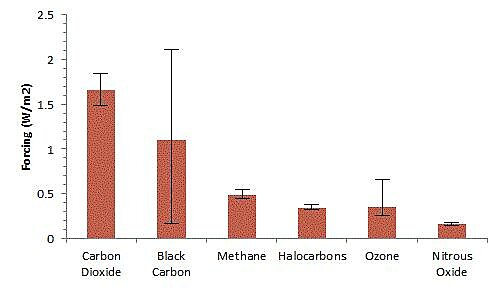
Figure 1. Relative warming influence of the major anthropogenic emissions (whiskers are the 90% uncertainly bounds).
If you combine the results in Figure 1 with those recently reported concerning other (non ‑greenhouse gas) influences on the observed temperature history, you must conclude that carbon dioxide was responsible for less than one-third of the observed warming since the mid-20th century reported in the IPCC’s Fourth Assessment Report. Further, the warming from all greenhouse gases amounts to something less than 60% of the total.
There seems a disproportionate amount of handwringing about the climate influence of carbon dioxide, when the climate influence on black carbon is nearly as great. And, of course, soot doesn’t come with the plant fertilization benefits that carbon dioxide emissions provide (see here for example).
Another eye-opening consequence of the Bond et al. finding is that the modeled climate change “fingerprints” are missing the influence of black carbon—which is now much larger (and consequently much more important) than has been recognized.
That “fingerprint” studies have proclaimed success at matching observed patterns of climate change with those projected by climate models run with anthropogenic atmospheric inputs—yet which omit black carbon—can only be a sign of overfitting.
All else being equal, if the black carbon absorption in climate models were to be increased by a factor of almost three (to better match the findings of Bond et al.), they would certainly predict far too much warming to have already occurred. But these models have already accomplished this without black carbon!
One potential reason is that “all else is not equal.” When black carbon is emitted, so is all sorts of other stuff, like sulfur dioxide and organic carbon. These tend to have a cooling impact on the climate, as they generally act to increase the amount of solar energy that is reflected back into space.
According to Bond et al., although the amount of (warming) black carbon emitted into the atmosphere has been underestimated, so too has the amount of the (cooling) co-emissions. When everything is tallied up in net, the effect turns out to be very near zero.
One might argue that if the net impact is zero, it doesn’t matter that the climate models have the wrong amount of black carbon (and co-emissions) in them.
But this would be a far too generous and simplistic. The historical (in both time and space) characteristics of black carbon emissions, although not well known, are almost certainly different from the characteristics of historical emissions of greenhouse gases (and sulfate aerosols). The difference arises because the sources of the different types of emissions are, to an important degree, not the same.
Which means the behavior of the true climate system is different from the behavior of the (overfitted) model climate system.
Until you have a pretty good handle on the sources, and how they have changed over time (in magnitude and space), there is no way to way to get an accurate handle on projections, either in the past or the future.
So “fingerprint” studies which claim to find close correspondence between climate model projections and actual observations during the past 50 to 100 years are confused as to both causes and effects.
The bottom line of the Bond et al. study is that the relative impact of anthropogenic carbon dioxide emissions is much less than widely thought, the relative impact of black carbon is greater than thought, and climate models’ views of the past and projections of the future must therefore be tainted.
Tainted and confused models are the last thing we need for producing science-based policy.
Reference:
Bond, T.C., et al., 2013. Bounding the role of black carbon in the climate system: A scientific assessment. Journal of Geophysical Research, in press, http://onlinelibrary.wiley.com/doi/10.1002/jgrd.50171/abstract
Ramanathan V., and G. Carmichael, 2009. Global and regional climate changes due to black carbon. Nature GeoScience, 1, 221–227.
Wigley, T.M.L., and B.D. Santer, 2012. A probabilistic quantification of the anthropogenic component of twentieth century global warming. Climate Dynamics, doi: 10.1007/s00382-012‑1585‑8
Tonight at 9 pm on the Fox Business Network, John Stossel interviews a vast array of characters — Gov. Gary Johnson, Rep. Justin Amash, Rep. Dennis Kucinich, Cato Media Fellow Radley Balko, John Bolton, Ann Coulter, and even me — in front of a cast of thousands. Literally. Some 1400 attendees at the Students for Liberty conference joined in asking the questions. As Stossel’s website says,
This week, Stossel does a special show at the 6th annual “Students for Liberty” conference in Washington.…
Fireworks fly when Stossel and the mostly libertarian crowd spar with Ann Coulter about gay marriage and drug laws. Coulter is in rare form, passionately denouncing libertarians, and at one point calling Stossel and the crowd out for focusing on drug laws and gay marriage.
It may not make it into the final version, but Coulter said libertarians should stop spending time on, you know, issues of personal freedom and equality under the law and focus on more important issues. Like privatizing the New York City subways. I kid you not.
9 pm ET tonight. Be there.
The following is cross-posted from the National Journal’s Education Experts blog:
This week’s introduction says that, when it comes to President Obama’s preschool proposal, “the only problem, as always, is that these investments cost money.” These proposals certainly would cost money – dollars Washington doesn’t have – but even discussing cost is seriously jumping the gun. The fact is that right now, regardless of cost, there is almost no meaningful evidence to support massive expansion of federal pre-school efforts. Indeed, the evidence calls much more loudly for the opposite.
Start with the biggest federal pre‑K initiative, Head Start. It costs about $8 billion per year, and what are its lasting effects? According to the latest random-assignment, federal assessments, there essentially aren’t any. The program has demonstrated no meaningful, lasting benefits, and is therefore a failure.
How about Early Head Start, which involves children ages 0 to 3? It is a much newer program than its big brother, but it, too, provides no evidence of overall, lasting benefits. As a 2010 random-assignment, federal study concludes:
The impact analyses show that for the overall sample, the positive effects of Early Head Start for children and parents did not continue when children were in fifth grade…. It appears that the modest impacts across multiple domains that were observed in earlier waves of follow-up did not persist by the time children were in fifth grade.
There were, to be fair, some lasting positive effects found for some subgroups, but there were also negative effects. And for the “highest-risk” children – the ones the program is most supposed to help – the outcomes were awful:
Finally, for children in the highest-risk group, six impacts were statistically significant, all of which were at the child level and all of which favored the control group. Children in the program group scored significantly lower than children in the control group on the PPVT-III (ES = −0.21, p < .10) and the mathematics test (ES = −0.33, p < .05) and had lower scores on the academic success index (ES = −0.29, p< .05). Parents reports indicated that chronic absenteeism was higher in the program group than the control group (ES = 0.37, p < .10). Children in the program group also scored higher on the cumulative risk index (ES = 0.35, p < .10) and lower on the cumulative success index (ES = −0.31, p < .05) than children in the control group. There were no significant impacts on parenting and family-level outcomes in the highest-risk group.
The federal government, quite simply, has demonstrated no ability to scale-up pre‑k programs and achieve positive, lasting effects. Knowing that, it is impossible to convincingly argue that the current efforts should even be maintained, much less greatly expanded.
What about state programs? The evidence is hardly conclusive that even highly-touted programs such as those in Oklahoma or New Jersey are effective. The quality of the research – which is rarely random-assignment – isn’t what it needs to be to confidently conclude that the programs work. Indeed, pre‑K advocate James Heckman said that in a Washington Post interview:
Dylan Matthews: The Abecedarian and Perry experiments provide pretty definitive evidence that individual preschool programs have strong effects, but Obama’s been touting certain statewide programs like Oklahoma’s. What’s the evidence for those like?
James Heckman: I would be cautious. I’m instinctively cautious because I’m an academic. The Perry and ABC (Abecedarian) and some others, the nurse-family partnership, have not only had randomized trials, but have also followed people up for decades. The Perry people are now 50 years old. The ABC people, now they’re close to 40. We actually can follow them in a way that the other programs don’t follow their participants. The state programs have relatively short-term evaluation plans. And I think, you’re right, they’re not randomized controlled trials, so I’m a little cautious. I don’t find them as convincing. As far as I know they’re not of the same quality. I have not personally relied on them. That’s not to say they’re bad programs, they just haven’t been evaluated as thoroughly.
So state programs haven’t been adequately evaluated to demonstrate their effectiveness, yet some act like it is obvious that the federal government – which has demonstrated an inability to run effective pre‑K programs – should scale all this up. Illogical. What they should be insisting is that Washington follow the Constitution and stay out of this, letting states experiment to see what works and what doesn’t, and replicate programs on their own – or do nothing – if they think the evidence justifies it.
When you get down to it, there are only two or three pre‑K programs that have solid enough research bases that advocates can confidently say they had lasting, positive effects. As Dylan Matthews’ question makes clear, the two most prominent are the Abecedarian and Perry Preschool programs. But here’s what you need to know: Both were hyper-intensive programs with very dedicated staff. Indeed, Abecedarian treated just 57 children at a price of about $17,700 per child, and Perry worked with 58 kids at roughly $12,500 per child. For all intents and purposes there is no way any government is going to scale those up and get the same effects, much less the bloated, ineffectual federal government.
It is much too early to say the only reason not to expand federal per‑K is the lack of funds. Before anyone gets even close to that, they need to address the huge dearth of evidence that big pre‑K – especially federal – would be anything other than a failure.
Word is that Florida Gov. Rick Scott (R) has decided to throw his support behind, or at least drop his opposition to, ObamaCare’s Medicaid expansion. His formal announcement, which may come tomorrow, will receive much attention. Scott was an early opponent of ObamaCare. He parlayed that opposition into a bid for governor in 2010, and rode the anti-ObamaCare wave into office. Shortly after becoming governor, he announced he would not lift a finger to help the federal government implement the law. I followed all this pretty closely. I served on Scott’s gubernatorial transition team, at his invitation.
Now, it appears Scott doesn’t see the point in opposing the Medicaid expansion. Never mind that — according to my colleague Jagadeesh Gokhale, whom the Social Security Administration consults when making these types of projections — the expansion will cost Florida $20 billion over the first 10 years, and add 3 million Floridians to the Medicaid rolls. Never mind that many of those Floridians currently have private health insurance. Never mind that Medicaid will provide them inferior access to care. Never mind that expanding Medicaid would make those millions of voters dependent on government for their health care, and thus would expand the constituency for more government spending and higher taxes.
There is speculation that Scott made a deal with the Obama administration: he would drop his opposition to the Medicaid expansion in exchange for HHS approving Florida’s plan to put its Medicaid enrollees in managed care plans. HHS approved Florida’s plan today. But economists have shown that moving Medicaid enrollees into managed care increases state and federal spending because it lures more people into the program. So it appears that Scott supported ObamaCare’s Medicaid expansion so that the Obama administration would support his.
Scott says he still opposes having Florida create a health insurance Exchange. Then again, he said the same thing about the Medicaid expansion. So in addition to whatever other damage his flip-flop does, he has squandered his credibility as an opponent of ObamaCare.
To reclaim any credibility on this issue, Scott would have to file an Oklahoma-style lawsuit to block the illegal taxes that the Obama administration is trying to impose on employers in Florida and the other 33 states that have opted for a federal Exchange. Or will he sell out Florida’s job creators too?