Thank you for making this point. But two wrongs don’t make a right.
Respectfully,
Justin Logan
Thank you for making this point. But two wrongs don’t make a right.
Respectfully,
Justin Logan
HHS secretary-nominee and former U.S. Senate majority leader Tom Daschle owed the IRS more than $140,000 in back taxes and interest. One contributing factor: a spokeswoman says Daschle “naively” believed that the Cadillac and driver provided gratis by a business partner was “nothing more than a generous offer from a friend.”
A former Daschle aide reassures us, “He’s the gold standard for integrity in government.” (Precisely the problem, isn’t it?)
The Washington Post reports that none of this is likely to derail Daschle’s confirmation by his former Senate colleagues. “Senators also cited their personal knowledge of Daschle in justifying their willingness to dismiss the tax issue,” writes the Post. “He and his wife, Linda Hall Daschle, donated over the past two years to at least 14 senators who will be tasked with voting on his confirmation.”
Once a grim statistic gets some play in the media, it keeps getting repeated even if it is completely erroneous.
On the Washington Post front page Saturday: “In soup kitchens, food pantries and universities across the country, activists are planting the seeds for an overhaul of the way America feeds its more than 35 million hungry people.…”
Doesn’t 35 million seem kinda high to you? It did to me, and so I looked up the official data. As I noted in prior blog posts (and here), the the actual number of Americans going hungry is about 11 million, according to U.S. Department of Agriculture data.
Reporters seem to grab data from past stories, or get data from lobby groups, without going to the original government sources to check the accuracy. Hunger is a serious problem in America, but so is sloppy and biased newspaper reporting.
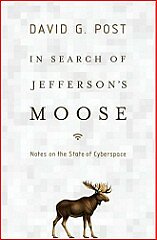
Reminder: Next Wednesday, February 4th, the Cato Institute will host a book forum on David Post’s new book, In Search of Jefferson’s Moose: Notes on the State of Cyberspace.
Comments will come from Clive Crook, chief Washington commentator of the Financial Times and senior editor of The Atlantic Monthly; and Jeffrey Rosen, professor of law at The George Washington University and legal affairs editor of The New Republic.
It’s a very interesting book, and the commentators are second to none.
The forum is at noon next Wednesday, February 4. Register here.
And here’s Cato alum Adam Thierer’s review of the book.
Honestly, a 900-word Politico article on “the Power of Obama’s Hand”? It’s going to be a long four-to-eight years. (Hat tip: Dave Weigel).
Path dependence plays a huge role in shaping nations’ health care sectors. Path dependence is also why we want health care reform to nudge America toward freer markets.
Government exacerbates path dependence. Government gives the old order the power to block the new. The larger the role government plays in health care (or anything else), the harder it is to make incremental changes that would yield greater benefits than existing arrangements.
That’s why, as Gawande observes, Medicare does a lousy job of improving quality. (Or containing costs, for that matter.) Medicare and other government interventions are also why we don’t see enough innovation in the private sector, either.
So if you want tomorrow’s health care sector to have the same problems with cost, quality, and access as today’s, then by all means expand Medicare. Or create a government-run “exchange” like the Federal Employees Health Benefits Program. Or expand the Veterans’ Health Administration. Or expand Medicaid and SCHIP.
But if you’d rather a health care sector that constantly makes improvements in cost and quality, you need to let seniors and non-seniors alike control their health care dollars and choose their own health plan.
On the campaign trail, then-candidate Obama spoke against policies that give companies tax breaks after shipping jobs overseas.
“I will stop giving tax breaks to corporations that ship jobs overseas, and I will start giving them to companies that create good jobs right here in America,” Obama said.
Now as president, there’s little doubt he will put those promises into action.
In today’s Cato Daily Podcast, Dan Griswold, director of Cato’s Center for Trade Policy Studies, explains why singling out those companies now for tax hikes can have a particularly painful negative side effect.
“When they talk about shipping jobs overseas what do they mean exactly? Well, if they mean U.S. companies investing in operations abroad then you’re indicting pretty much all of corporate America,” Griswold says.