- A libertarian primer on the real meaning of the phrase “campaign finance reform.” For more, read John Samples’ book, The Fallacy of Campaign Finance Reform.
- New report shows that Head Start, a sacrosanct (and very expensive) federal education program, doesn’t work. So what should we do about it? Give it more money of course!
- “In his State of the Union address, President Obama proposed spending another $4 billion annually on K–12 public education. He did not mention that state, local, and federal governments already spend well over twice what they did in 1980, or that there has been no discernible improvement in student achievement during that period.” Just sayin’.
- Michael Tanner on Obama’s faith-based boondoggle: “The faith-based initiative was a typical example of Bush-style “big-government” conservatism. It has been co-opted by the Obama administration as another weapon for social engineering.”
Cato at Liberty
Cato at Liberty
General
In a recent Cato study, “The Libertarian Vote in the Age of Obama,” authors David Boaz and David Kirby found that libertarian voters, who make up about 14 percent of the electorate, are a leading indicator of how independents will cast their ballots.
Appearing on Freedom Watch earlier this week, Boaz explained the results of the study, and what it means for the next election. Watch:
Related Tags

In response to my Los Angeles Times op-ed on the movie “Avatar,” in which I claim that conservative critics missed the central conflict over property rights, I’ve received some emails arguing that the Na’vi in the film lacked “well-defined property rights” or simply that a collective group cannot have rights to the property they live on.
So I went to some smarter guys to ask them what they thought about “collective property rights.” The political philosopher Tom G. Palmer (best known as an activist and traveling troubadour of liberty [see pictures in this very large pdf] but also a deep thinker about liberty, as seen in his new book Realizing Freedom) says:
Just because people did not have English freehold property rights is no reason to chase them off land to which they held a clear customary right. Some people seem to assume that only English freehold counts as property, by which they mean individual property. But there is family property, village property, and many other forms of property, which are defined by the exclusion of others. (Elinor Ostrom has written extensively on how common property arrangements are governed and when they are efficient, and when not.) The critique of “collective property” is certainly not Lockean. In the Second Treatise’s chapter on property (paragraph 28) he writes (not entirely clearly), “We see in commons, which remain so by compact, that it is the taking any part of what is common, and removing it out of the state nature leaves it in, which begins the property; without which the common is of no use.” Then in paragraph 35, he notes, “It is true, in land that is common in England, or any other country, where there is plenty of people under government, who have money and commerce, no one can inclose or appropriate any part, without the consent of all his fellow-commoners; because this is left common by compact, i. e. by the law of the land, which is not to be violated. And though it be common, in respect of some men, it is not so to all mankind; but is the joint property of this country, or this parish.”
Thus Locke would say that the Na’vi, even if they do not have any separate plots, have a joint property in the land, “And though it be common, in respect of some men, it is not so to all mankind; but is the joint property of this country, or this parish.”
David Henderson, editor of the Concise Encylopedia of Economics, discussed this point about “collective property” in his own essay on “Avatar”:
Now, [Ed] Hudgins could argue that the analogy with the Kelo decision doesn’t make sense because this is tribal property, not individual property. OK. So imagine that some civilization more technologically advanced than ours discovers that there’s a rare mineral below the hills and mountains of Yosemite, which, in a sense, is tribal property. Our government has refused to sell. To get at the mineral, this other “civilization” must blast and bulldoze Yosemite down to nothing. If that more advanced group comes in and uses violence to grab Yosemite, would Hudgins say that was fine? I think not.
As I noted originally, “At least for human beings, private property rights are a much better way to secure property and prosperity. Nevertheless, it’s pretty clear that the land belongs to the Na’vi, not the Sky People.”
P.S. For a French version of my article, click here. At UnMondeLibre you’ll find many more ideas about liberty, too.
Related Tags
- Cato experts give Obama’s State of the Union a video fisking.
- Are we watching the History Channel or something? Because this new president sure does sound a lot like the old one.
- Time for the SOTU fact check: Cato experts put some of President Obama’s core State of the Union claims to the test. Here’s what they found.
- Flashback to February 2009: Gene Healy on how “the president talks too much.”
- During this year’s SOTU, President Obama criticized the Supreme Court decision in the Citizens United case. Today’s podcast examines the Court’s ruling.
Related Tags
In his State of the Union speech, President Obama vowed to double U.S. exports in five years to (all together now) “create jobs.”
Exports are dandy, and they do support higher-paying jobs, but the president’s pledge was unrealistic and raises false hopes that it will make any dent in the unemployment rate.
U.S. exports have not doubled in dollar terms during a five-year period since the inflation-plagued 1970s, not exactly a golden era for the U.S. economy. In real terms, according to the U.S. Bureau of Economic Analysis, exports have not come close to doubling during any five-year stretch in the past 40 years. The fastest growth in inflation-adjusted exports came in the second half of the 1980s, when they grew by two-thirds from 1985 to 1990. Other periods of robust growth were the mid-1990s, and during the second term of George W. Bush, when five-year export growth approached 50 percent.
Export growth is certainly enhanced by a weaker dollar and lower trade barriers abroad, but the primary driver of export growth is rising GDP and demand abroad, and that is something outside even this president’s direct control. The key to reducing U.S. unemployment is not primarily selling more to growing markets abroad, but selling more in a robustly growing market at home.
Other Obama policies will actually make it more difficult to achieve his export pledge. The president renewed his misguided pledge last night to raise taxes on U.S. multinational companies that “ship jobs overseas.” Yet, as I pointed out in a Free Trade Bulletin last year, U.S.-owned affiliates in other countries sold $4 trillion worth of U.S. branded goods and services in 2006. A large chunk of our exports go to those affiliates to help them make their final products for sale. Forcing U.S. firms to cut back their foreign operations will douse an important source of demand for U.S. exports.
The only major foreign market that has recently doubled its demand for U.S. exports in a five-year span is China. Yet President Obama has needlessly antagonized potential customers in our fourth-largest export market by imposing tariffs on Chinese tire imports and threatening other trade-reducing actions.
We can best promote more open markets abroad by setting a good example ourselves.
Yesterday, the president proposed yet another big increase in federal education spending. The Washington Post quoted “senior White House officials” as saying that the spending would boost “the nation’s long-term economic health.”
I sent the story’s authors a blog post laying out the evidence that higher government spending hasn’t raised student achievement, and that if you don’t boost achievement, you don’t accelerate economic growth.
Today, there is an updated version of the original WaPo story. It no longer mentions the stated goal of the spending increase. It doesn’t mention that boosting gov’t spending has failed to raise achievement, and so will fail to help the economy.
But it does cite a single non-government source for comment on the president’s plan: the Committee for Education Funding. The Committee is described by the Post as “prominent education advocates,” and as an organization that “represents dozens of education groups.”
Here’s how the CEF itself measures its accomplishments: “The… Committee [has] been very successful in championing the cause of increasing federal educational investment. Through strong advocacy… [it has] won bipartisan support for over $100 billion in increased federal education investment over the last five years.” Its members, if you haven’t guessed already, include virtually every public school employee organization you can name, including, of course, the national teachers unions.
That’s the source, the one source, the Washington Post asked to weigh in on a new federal education spending gambit.
I asked the author of the revised version of the story to comment for this blog post. At the time of this writing, I’ve received no response.
Related Tags
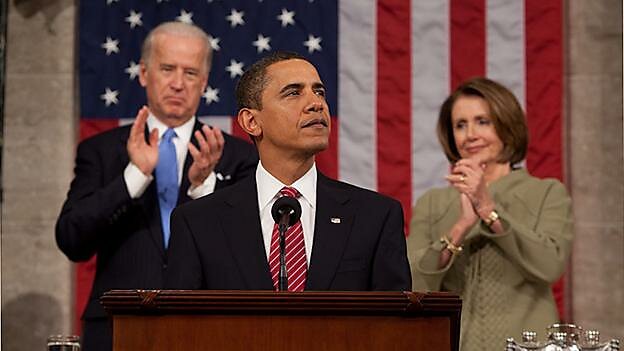
Cato experts put some of President Obama’s core State of the Union claims to the test. Here’s what they found.
THE STIMULUS
Obama’s claim:
The plan that has made all of this possible, from the tax cuts to the jobs, is the Recovery Act. That’s right — the Recovery Act, also known as the Stimulus Bill. Economists on the left and the right say that this bill has helped saved jobs and avert disaster.
Back in reality: At the outset of the economic downturn, Cato ran an ad in the nation’s largest newspapers in which more than 300 economists (Nobel laureates among them) signed a statement saying a massive government spending package was among the worst available options. Since then, Cato economists have published dozens of op-eds in major news outlets poking holes in big-government solutions to both the financial system crisis and the flagging economy.
CUTTING TAXES
Obama’s claim:
Let me repeat: we cut taxes. We cut taxes for 95 percent of working families. We cut taxes for small businesses. We cut taxes for first-time homebuyers. We cut taxes for parents trying to care for their children. We cut taxes for 8 million Americans paying for college. As a result, millions of Americans had more to spend on gas, and food, and other necessities, all of which helped businesses keep more workers.
Back in reality: Cato Director of Tax Policy Studies Chris Edwards: “When the president says that he has ‘cut taxes’ for 95 percent of Americans, he fails to note that more than 40 percent of Americans pay no federal incomes taxes and the administration has simply increased subsidy checks to this group. Obama’s refundable tax credits are unearned subsidies, not tax cuts.”
Visit Cato’s Tax Policy Page for much more on this.
SPENDING FREEZE
Obama’s claim:
Starting in 2011, we are prepared to freeze government spending for three years.
Back in reality: Edwards: “The president’s proposed spending freeze covers just 13 percent of the total federal budget, and indeed doesn’t limit the fastest growing components such as Medicare.
“A better idea is to cap growth in the entire federal budget including entitlement programs, which was essentially the idea behind the 1980s bipartisan Gramm-Rudman-Hollings law. The freeze also doesn’t cover the massive spending under the stimulus bill, most of which hasn’t occurred yet. Now that the economy is returning to growth, the president should both freeze spending and rescind the remainder of the planned stimulus.”
Plus, here’s why these promised freezes have never worked in the past and a chart illustrating the fallacy of Obama’s spending claims.
JOB CREATION
Obama’s claim:
Because of the steps we took, there are about two million Americans working right now who would otherwise be unemployed. 200,000 work in construction and clean energy. 300,000 are teachers and other education workers. Tens of thousands are cops, firefighters, correctional officers, and first responders. And we are on track to add another one and a half million jobs to this total by the end of the year.
Back in reality: Cato Policy Analyst Tad Dehaven: “Actually, the U.S. economy has lost 2.7 million jobs since the stimulus passed and 3.4 million total since Obama was elected. How he attributes any jobs gains to the stimulus is the fuzziest of fuzzy math. ‘Nuff said.”