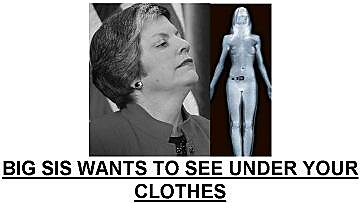
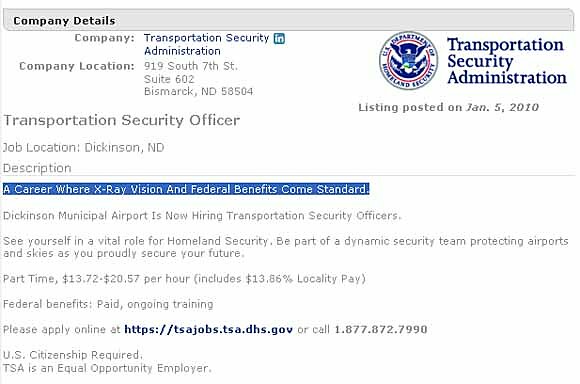
That’s the slogan the Transportation Security Administration is apparently using to entice people to apply for jobs as airport screeners. Now that they’re preparing to expand the use of whole body imaging scanners, which can produce moderately detailed nude images of travelers, maybe they should consider a tagline that doesn’t sound like it’s designed to recruit voyeurs.
Cato at Liberty
Cato at Liberty
Topics
Defense and Foreign Policy
So Much for That Argument for War!
Remember when President George W. Bush was pushing war for democracy? Excited neoconservatives promised that a new wave of democratization was about to roll through the Middle East, sweeping out authoritarian and anti-American regimes.
Oops.
The most significant finding of the latest report is the decline in freedom in the Middle East, [Arch Puddington] said.
Three countries — Jordan, Yemen and Bahrain — were reclassified from “partly free” to “not free,” and freedoms declined in Morocco and Iran.
“Freedom House saw the region as a whole as headed slightly in the right direction after 9/11,” he said. “But that has changed.”
Not only are countries moving backwards, but America’s friends and allies are leading the parade: Jordan, Morocco, Bahrain.
So much for that justification for invading and bombing other lands.
Related Tags
“Risk of Accidents Ameliorated!” Doesn’t Sell Papers
What a headline on the Washington Examiner today! It’s a good illustration of the propensity of media to overplay terrorism.
“Terror threat to city water,” the headline blares in large type. “Chlorine changed to protect D.C., Va. supply.”
The actual story is about the Army Corps of Engineers’ switch from chlorine gas to a liquid form of chlorine called sodium hypochlorite. Gaseous chlorine is relatively more dangerous and difficult to contain if it’s released, so the change is a prudent safety step.
It has as much to do with protecting against accidental release as any terror threat. And an accidental release is not a threat to the water supply; it’s a threat to people near the facilities or transportation corridors where cholrine gas could be released.
The idea of terrorism may have gotten the Corps moving forward, but nothing in the story says there was any specific threat by anyone to attack the D.C. water treatment infrastructure.
This is a story about risks being ameliorated, and it’s pretty boring—except for the headline!!
Related Tags
Al Qaeda Wants You to Panic
If you read just one thing on al Qaeda’s failed Christmas Day bombing, read Fareed Zakaria’s column in today’s Washington Post.
If you’re hungry for more, Peter Beinart in Time and this article in the Wall Street Journal also get it right.
And if you’re convinced, or even modestly intrigued, by the suggestion that one of the key goals of terrorism is to terrorize, and the appropriate response is to not be, then listen to or watch this event on Wednesday.
Related Tags
The Department of Sneak-a-Peek
The Drudge Report’s provocative banner this afternoon combines with other news to suggest a homeland security trend: sneakin’ a peek.
The other story is the question whether the nominee to head the Transportation Security Admnistration violated federal privacy laws as an FBI agent, then omitted key information in reporting it to Congress. Robert O’Harrow of the Washington Post (returning to the privacy beat!) reports that Erroll Southers, a former FBI agent, made inconsistent statements to Congress about wrongly accessing confidential criminal records about his estranged wife’s new boyfriend. (More here.)
That was 20 years ago. Being fully transparent about it today would almost certainly have prevented it from being disqualifying. But over the last 20 years, data collection has grown massively, and federal access to personal data has grown — including access by the TSA. Data about the appearance of your naked body may be on the very near horizon.
Southers’ problem with sneaking a peek at confidential records — and whatever cover-up or oversight in his reporting of it to Congress — signal precisely the wrong thing at a time when people rightly want their security not to be the undoing of privacy.
Related Tags
George Clooney’s Docile Body
Running the airport maze to board my flight from Madrid back to the U.S. last week, I found myself thinking, with no small measure of envy, about Ryan Bingham, George Clooney’s character from Up in the Air. The ultimate frequent flier, Bingham slides shoes and belt off, flips laptop from case, and aligns them neatly on the x‑ray conveyor in a seamless, fluid display of security Tai Chi. He navigates from curb to gate and back with crisp efficiency, every motion practiced and automatic.
My envy was tempered somewhat as I reread Discipline and Punish on the trip back. Bingham’s military precision, it struck me, was the product of a form of training implicit in the security process. As a corrective brace “teaches” the proper posture just by making it the only comfortable one, the screening procedures embed a set of tacit instructions, consisting of the optimal set of motions required to pass through smoothly. And of course, it teaches more than bodily motions: Bigham knows you don’t stand behind the Arabs in the screening line!
That’s not to say airport security is some kind of insidious brainwashing program, but there’s a dimension of privacy here that it seems to me we don’t talk about nearly enough. Our paradigms of privacy harms are invasion (the jackboot at the door, in the extreme case) and exposure (the intimate detail revealed). We generally think of these as exceptions — as what happens when surveillance goes wrong, either because it gets the wrong target or, when the surveillance is universal by design, because information that’s supposed to remain protected falls into the wrong hands or is otherwise misused. Invasion and exposure may be serious problems, but they are fundamentally mistakes — hiccups in the system we can seek to fix.
Discipline, by contrast, is what inevitably happens when the system functions as intended, at least to the extent people are conscious of being (actual or potential) targets of surveillance. It is probably not as serious a harm as invasion or exposure most of the time, but it’s also by far the most pervasive and ineradicable effect of surveillance. It would be nice if our debates about surveillance included not just the question “What will be exposed?” but also “How — and for what — are we training ourselves?”
Fly the Perfectly Safe Skies!
Do you insist on flying risk-free, at all costs? Satirist/animator Mark Fiore has just the airline for you.