One story lost in all the Obamacare coverage last week, was the new law concerning jury nullification in New Hampshire. In a post over at our police misconduct site, I try to explain what impact that new law will have in the New Hampshire courts.
Live Now
Cato at Liberty
Cato at Liberty
Cato at Liberty
Cato at Liberty
Topics
Constitutional Law
July 2, 2012 12:20PM
An ObamaCare Silver Lining?
Today POLITICO Arena asks:
Was the health care ruling actually a long-term victory for conservative jurisprudence?
My response:
It will take some time to fully digest the Court’s massive and often opaque split decision on ObamaCare, but whether the ruling will eventually lead to a victory for conservative jurisprudence will now be in the hands of the voters. If the reaction to this decision brings the majority of citizens who’ve consistently opposed ObamaCare to the polls, not only might ObamaCare be repealed, but the Court itself may eventually change in the direction the dissent marked out, and that would be good.
To be sure, some have suggested that this decision is not as bad as it seemed at first, but here are just a few responses to that contention: (1) the Commerce Clause “victory” is extremely limited; Congress cannot compel people to engage in commerce so it can then regulate that commerce, but this is the first time Congress has ever tried such a thing, so it’s not an everyday affair; (2) the vast post-New Deal regulatory power that Congress has practiced remains untouched by this decision; (3) a good case can be made that this Commerce Clause “victory” will be read as dicta and hence will not be binding in future cases; and finally, (4) Congress can now do the same thing under its taxing power, so as a practical matter there was no change.
Yes, that last point puts the matter “on budget,” and that’s no small matter, politically. But it will take a political reaction and then a change on the Court before this decision can be read, doubtless by historians, as having precipitated a victory, not so much for “conservative jurisprudence,” which is not of a piece, but for the Constitution.
July 2, 2012 11:46AM
“Conservatives’ Last Legal Option to Invalidate Obamacare”
The New Republic reports on an issue that Jonathan Adler and I have been highlighting: an IRS rule that will tax employers and subsidize private health insurance companies without congressional authorization. Why would the IRS issue such a rule? Perhaps because ObamaCare could collapse without it.
The post quotes another law professor who acknowledges the Obama administration faces a serious problem:
“It’s fairly decent textual case,” says Kevin Outterson, a professor at Boston University Law School, and health care blogger for The Incidental Economist. And if it stood, he says, the consequences could be disastrous.
Disastrous for ObamaCare, that is. But as Adler and I have written previously, if saving ObamaCare means letting the IRS tax employers without congressional authorization, then ObamaCare is not worth saving.
July 2, 2012 10:18AM
It’s “Declaration of Internet Freedom” Day!
… or at least I should have said so back on March 4th.
That was the anniversary of the day that Congress proposed to append a Bill of Rights to our Constitution. With a lovely preamble that went a little somethin’ like this:
THE Conventions of a number of the States, having at the time of their adopting the Constitution, expressed a desire, in order to prevent misconstruction or abuse of its powers, that further declaratory and restrictive clauses should be added: And as extending the ground of public confidence in the Government, will best ensure the beneficent ends of its institution.
The Bill of Rights contains gems like “Congress shall make no law … abridging the freedom of speech, or of the press,” (Amendment 1) and, “The right of the people to be secure in their persons, houses, papers, and effects, against unreasonable searches and seizures, shall not be violated” (Amendment 4).
I think this original Declaration of Internet Freedom is the bee’s knees. Yes, it’s taking some work to apply its strictures to the modern communications environment, but that’s a much more contained problem than starting over.
Starting over. That’s what a collection of really lovely groups–some highly pro-regulation, others handmaidens of government growth–are doing. They’ve come up with a “Declaration of Internet Freedom” whose principal virtue is a pretty cool graphic. The actual “principles” in it are so weasel‑y that I wouldn’t trust ‘em as far as I could throw ‘em.
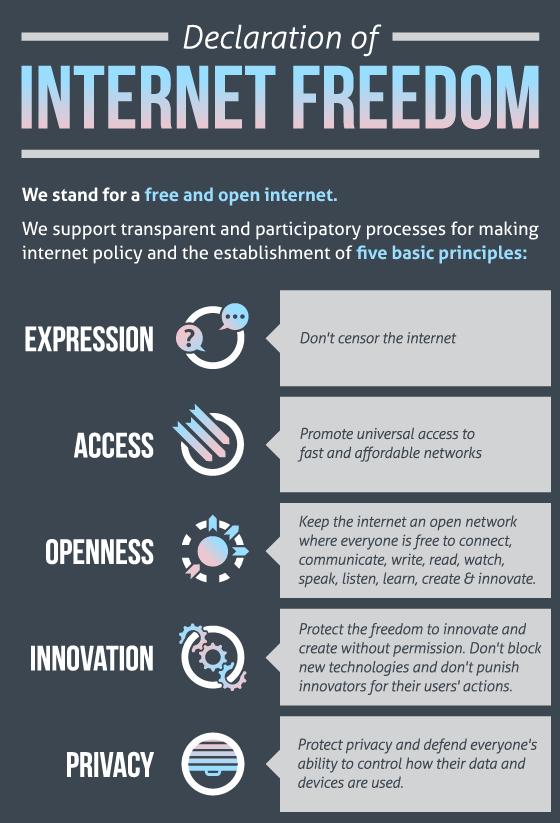
When you’re done pondering how one could “throw” a principle, consider an alternative to the “mainstream” declaration put out by our friends at TechFreedom. Their Declaration of Internet Freedom has a bunch of principles like “Humility” and “Rule of Law.”
Their thing on “Free Expression” cites the First Amendment. Remember that one? That’s the “Congress shall make no law” one. So that’s pretty good.
But I’m really hoping that nobody living today gets to define the basic principles by which the Internet is ruled. We’ve got that. It’s a neato collection of negative rights, preventing the government from interfering with society’s development, whether that development occurs online or off.
So happy Declaration of Internet Freedom day! I’ll be celebrating the real one.
In case you’ve gotten confused in all the jostling around, the real one is the Bill of Rights.
June 30, 2012 12:50PM
‘The IRS Overstepped Its Bounds and Lacked the Power to Rewrite the Law’
Of course, that is just Reuters paraphrasing me:
Under the new healthcare law, individuals can shop and purchase health insurance through government-created exchanges. If a state refuses to set up its own exchange, the law allows the federal government to set one up instead. Due to a glitch in the original statute, individuals are only eligible for a tax credit if they buy insurance through a state exchange, not a federal one. That allows states to disrupt the system by refusing to set up their own exchanges. To fix this technical problem, the Internal Revenue Service issued a new rule, making the tax credit available for people who purchase insurance on federal exchanges. Conservative watchdogs, including Michael Cannon of the Cato Institute, say the IRS overstepped its bounds and lacked the power to rewrite the law. While no lawsuit has been filed yet, “we’re watching the whole exchange issue now,” said Diane Cohen of the Goldwater Institute.
One addition and three corrections.
- By spending that money illegally and issuing those illegal tax credits, the IRS is also triggering an illegal tax against employers (i.e., ObamaCare’s employer mandate).
- It’s not a “glitch.” It is a deliberate design feature.
- When the IRS lacks statutory authority to tax people or spend taxpayer dollars, but does both anyway, that lack of authority is not “technical problem.” It is called “taxation without representation.” And it is a very bad thing.
- I am not a conservative.
June 29, 2012 4:43PM
The ADA and the Internet
Law professor Eric Goldman points to a “really terrible” ruling in a case called National Association of the Deaf v. Netflix that “has potentially ripped open a huge hole in Internet law” by concluding that Internet sites are “places of public accommodation” for the purposes of the Americans with Disabilities Act, simply ignoring a boatload of precedent concluding just the opposite. As Goldman explains, this is apt to unleash a costly and innovation-stifling flood of litigation:
Could YouTube be obligated to close-caption videos on the site? (This case seems to leave that door open.) Could every website using Flash have to redesign their sites for browsers that read the screen? I’m not creative enough to think of all the implications, but I can assure you that ADA plaintiffs’ lawyers will have a long checklist of items worth suing over. Big companies may be able to afford the compliance and litigation costs, but the entry costs for new market participants could easily reach prohibitive levels.
And then there’s linkages with other civil rights statutes, such as Title II of the Civil Rights Act of 1964 (an anti-discrimination law) and state laws, that use similar language as the language interpreted in this ruling. If all of those statutes are back in play too, the range of obligations imposed on websites–and the opportunities for aggressive plaintiffs’ lawyers–expand exponentially. Expect lots of consumer claims that a website discriminated against them based on an impermissible criterion. It’s safe to say that the legal rules at issue in this case could have billions of dollars of impact between the web coding obligations and the potential litigation frenzies.
That wouldn’t be terribly surprising: The ADA has certainly led to its share of costly unintended consequences in the physical realm. But there are a few reasons why the statute seems particularly ill-suited for application to the Web.
At the risk of belaboring the obvious: Web sites are not “places” at all, except in a metaphorical sense: They are streams of information transmitted to users. (There is, of course, some physical place where the server is located, but that place is typically not physically open to the public.) The court treats this as a kind of trivial semantic distinction rendered moot by the advance of technology, even suggesting that it would be “absurd” to exempt Netflix and Amazon from the rules written for the local cineplex and bookshop. But there are actually quite a few crucial distinctions between Internet sites and traditional brick-and-mortar businesses, which make it a rather surprising leap to insist that a statute designed for literal “places” naturally extends to the metaphorical digital “sites” that serve similar functions.
First, information streams, unlike actual places, are intrinsically made of speech. That certainly doesn’t mean the First Amendment is some kind of blanket get-out-of-regulation-free card for businesses engaged in online commerce, but it does mean that expressive rights will often be implicated when changes to the virtual “place” or “service” are demanded, in a way they are typically not when a shop is required to install a wheelchair ramp. Online, the boundary between being compelled to act and being compelled to speak is especially porous. Again, that’s not an absolute bar to regulation, but it seems odd to assume that Congress must have intended to create such broad causes of action against what are essentially publishers of information, when the examples used to define “public accommodation” very conspicuously don’t include any producers of content. “Places of exhibition entertainment” are covered, but not the content of the entertainment itself—which is why the ADA doesn’t require DVD makers to provide caption tracks (though most do) or books and periodicals to run large-print editions. As the court observes, Congress probably could not have anticipated Netflix or Amazon when it passed the ADA in 1990—yet it presumably had at least a passing familiarity with the concept of magazines and videotapes. It does not seem terribly mysterious that Congress nevertheless declined to invite the routine conflict with expressive rights that would predictably result from shoehorning publishers of information under the same regulatory rubric as physical businesses.
Second, physical businesses and their customers—disabled customers in particular—are inherently constrained by distance and the costs of transit in a way virtual “places” are not, which importantly changes the cost-benefit calculus for all concerned. Outside major metropolitan areas, there may be only one or two businesses of a particular type local to some disabled persons, which for practical purposes means they must be able to access that facility if they are to avail themselves of the relevant class of goods or services at all. Conversely, since physical businesses are generally competing only for the patronage of the local population, owners may be more likely to conclude that it doesn’t make economic sense to invest in accessibility aids that will only be needed by a handful of customers.
Things are obviously quite different online. As a general rule, any site on the Web is accessible from anyplace else, which means the inaccessibility of any particular site is less likely to represent a significant practical reduction of the choice set of any individual disabled user. One common argument for imposing the ADA’s universal obligations on physical businesses is that it may be unrealistic to expect the disabled in particular to simply “go somewhere else” if the nearest business can’t accommodate their needs. That argument has less traction in a landscape without distances. But what if none (or very few) of the businesses in a particular sphere implement some particular desired accommodation? Online, that’s much more likely to be evidence that it would be unduly costly or burdensome to do so—and therefore beyond the ADA’s requirements—because sites are typically competing for a national (if not global) pool of hearing and visually impaired customers.
The suit against Netflix is actually an excellent illustration. The National Association of the Deaf is arguing that Netflix runs afoul of the ADA by failing to provide closed-captioning for all of the movies it makes available to “Watch Instantly” online, among other things. Now, there are something like 35 million hearing impaired people in the United States, and more than a million who are functionally deaf. One can imagine the manager of the lone local theater deciding it’s not worth even a relatively small investment to accommodate a handful of disabled potential patrons. It’s much harder to believe that Netflix is just arbitrarily dragging its heels in making its offerings more appealing to such an enormous potential market: To the extent it’s feasible to do at a reasonable cost, they have ample incentive to be doing it without legal prodding—an incentive magnified by the speed with which Web businesses that get complacent fall to more innovative competitors eager to spot those missed opportunities for improvement. (Anyone remember Altavista and Friendster?)
As Netflix’s attorneys point out, the real holdup isn’t, in fact, a lack of will so much as an inability to act unilaterally: They’re obliged to negotiate with the copyright owners of the movies they stream. The court correctly responds that this specific argument doesn’t affect whether Netflix is classed as a “public accommodation”: Rather, it’s a defense they could raise after that determination is made to show they’re complying with the ADA as far as they’re able. But there are reasons to think there would nearly always be such a defense, because the nature of the online economy should generate far stronger pressure for someone to step in and serve disabled users unless it’s infeasible or prohibitively costly—and for incumbent businesses to preempt any new entrants who’d exploit their failure to do so. Congress judged the ADA necessary based on the history of brick-and-mortar businesses where the constraints of space and distance might be thought to attenuate those pressures. Assuming, without further legislative guidance, that the same regulatory regime is appropriate where those constraints are absent is a bit like applying a statute prohibiting animal cruelty in stables to car manufacturers: Cars and horses may serve many of the same social functions, but they differ in the key respect that provided the rationale for regulation. This may be one reason Congress declined to augment its illustrative list of “public accommodations” to include any purely virtual spaces when it extensively amended the ADA in 2008.
Finally, and perhaps most importantly, users are constrained to take physical spaces more or less as they find them. The owner can make changes in the physical environment; the user or patron cannot. If a theater does not provide wheelchair ramps or wheelchair-friendly viewing spaces, there is not a whole lot a disabled patron can realistically do to change that fact at a reasonable cost. Websites are quite different: How they’re experienced is, in practice, always a collaborative fact determined partially by the code served by the site itself, and partially by the end-user’s browser. If you are experiencing this post as a string of written characters in medium-size on a screen, that is not because of any natural fact about the Cato blog as a “place,” but because you have a computer system configured to interpret the binary stream transmitted by Cato’s servers in that way. Your current browser could easily be reconfigured to display it as much larger text; your operating system probably has an option to deliver that text as a computer-generated audio; and with the right browser and peripherals, you could render it as Braille or a series of odors instead. Even assuming a site’s content is rendered in the statistically “normal” way, the fact that this content is delivered to a highly configurable computing environment under the end-user’s ultimate control means it will usually be vastly simpler for adjustments necessary to compensate for special needs to be made client-side rather than server-side.
This is self-evident for at least some cases: Given the widespread availability of browsers and operating systems that can speak written text out loud—however imperfectly—nobody thinks it would make sense to require every individual Web site to provide a spoken audio file corresponding to each page of text. As of 2012, voice recognition software is not nearly good enough to allow automated on-the-fly rendering of movie captions, but that doesn’t mean provision by the provider of the audio-video stream is the only alternative. There are online repositories like the Internet Movie Script Database and (probably more useful in this context) OpenSubtitles.org, providing crowdsourced, time-synched captions for popular movies—combining a client-side solution with a community-based third party resource.
With physical facilities, it will often be obvious in advance which adaptations for disabilities must be provided by the owners of the facility itself (wheelchair ramps; wheelchair-accessible bathroom stalls) and which are more properly the responsibility of the disabled patron and third-party companies (the wheelchair itself). With Web sites, this will not necessarily be nearly as clear in advance, but there’s ample reason to expect that client-side solutions will often be simpler and less costly. Applying the ADA to the Web effectively locks in a presumption in favor of server-side solutions that is highly unlikely to be optimal. Especially given the speed at which Internet technologies and platforms evolve, it seems far more sensible to stand back and let businesses and online communities determine the most appropriate locus for adaptation as new services and platforms arise.
June 29, 2012 11:41AM
ObamaCare Lost on the Medicaid Mandate & Commerce Power. It May Yet Lose on the Tax Power.
Supporters of the Obama health law are incorrectly reading the Supreme Court’s ruling as a victory.
First, the ruling severely limited the Obama health law’s Medicaid expansion, effectively giving states the green light to refuse to expand their Medicaid programs. Coupled with the fact that the statute already enables states to block the other half-trillion dollars of new entitlement spending, the law is in a very precarious position.
Second, the Court ruled 5–4 that the individual mandate is not a legitimate use of the Commerce Power. That too is a defeat for the government, even if it is of no immediate consequence.
Third, while the Court upheld the individual mandate as a tax, that ruling may be vulnerable to legal challenge.
Chief Justice Roberts wrote, “The Federal Government ‘is acknowledged by all to be one of enumerated powers,’ ” and, “The Constitution’s express conferral of some powersmakes clear that it does not grant others.” So it is interesting that Roberts did not specify exactly what type of constitutionally authorized tax the mandate is.
As Cato chairman Bob Levy wrote in 2011, that’s not an easy thing to do:
Assume, however, the Supreme Court ultimately disagrees and finds that the penalty for not purchasing health insurance is indeed a tax. Nevertheless, say opponents of PPACA, the tax would be unconstitutional. They underscore that taxes are of three types—income, excise, or direct. Each type must meet specified constitutional constraints. Because the mandate penalty under PPACA does not satisfy any of the constraints, it is not a valid tax.
Income taxes, authorized by the Sixteenth Amendment, must (by definition) be triggered by income. Yet the mandate penalty is triggered by the nonpurchase of insurance. Except for an exemption available to low-income families, the amount of the penalty depends on age, family size, geographic location, and smoking status. So the penalty is not an income tax.
Excise taxes are assessed on selected transactions. Because the penalty arises from a nontransaction, perhaps it qualifies as a reverse excise tax. If so, it has to be uniform across the country (U.S. Const., Art. I, sec. 8). But the penalty varies by location, so it cannot be a constitutional excise tax.
Direct taxes are assessed on persons or their property. Because the penalty is imposed on nonownership of property, perhaps it could be classified as a reverse direct tax. But direct taxes must be apportioned among the states by population (U.S. Const., Art. I, sec. 2). The mandate penalty is assessed on individuals without regard to any state’s population. Hence, it is not a lawful direct tax.
On the last point, Roberts agreed: “A tax on going without health insurance does not fall within any recognized category of direct tax.” But then what kind of constitutionally authorized tax is it?
The dissent suggests the Court has given this issue scant attention:
Finally, we must observe that rewriting [the mandate] as a tax in order to sustain its constitutionality would force us to confront a difficult constitutional question: whether this is a direct tax that must be apportioned among the States according to their population. Art. I, §9, cl. 4. Perhaps it is not (we have no need to address the point); but the meaning of the Direct Tax Clause is famously unclear, and its application here is a question of first impression that deserves more thoughtful consideration than the lick-and-a-promise accorded by the Government and its supporters. The Government’s opening brief did not even address the question—perhaps because, until today, no federal court has accepted the implausible argument that [the mandate] is an exercise of the tax power. And once respondents raised the issue, the Government devoted a mere 21 lines of its reply brief to the issue…At oral argument, the most prolonged statement about the issue was just over 50 words…One would expect this Court to demand more than fly-by-night briefing and argument before deciding a difficult constitutional question of first impression.
There is even less discussion about what type of constitutionally authorized tax the mandate is.
I’m not a lawyer. But it seems to me there may be room here for the same individual citizens who brought this case to again file suit against the federal government for trying to impose an unconstitutional tax. It may seem unlikely that Roberts would reverse himself on the Tax Power issue. Then again, since he never specified what type of constitutionally permissible tax the mandate is, perhaps voting to strike the mandate would not be reversing himself.