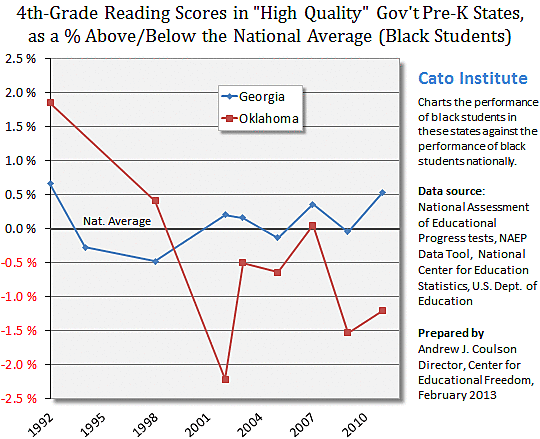
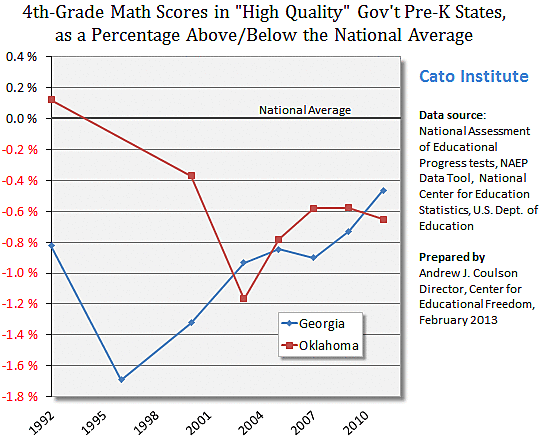
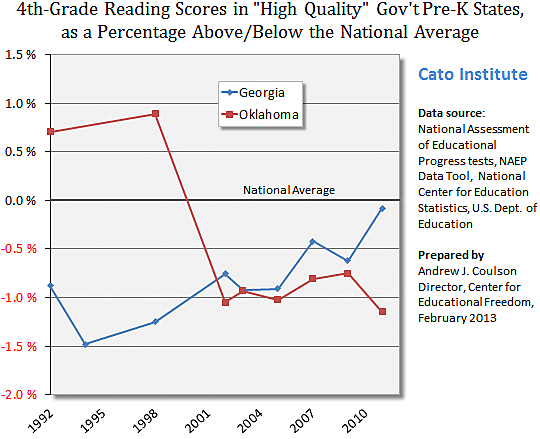
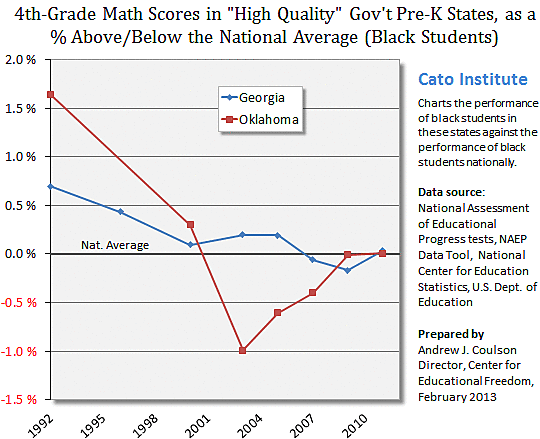
After my previous post showing the lackluster overall achievement trends in states with purportedly “high quality” universal pre‑K programs, one response was that this might miss better results among minority students. Well, I’ve had a chance now to chart the results for African American kids and… they’re slightly worse. See below. Can we now, finally, stop for a moment and reflect before lavishing tens of billions of dollars we don’t have on a federal expansion of such programs?
Cato at Liberty
Cato at Liberty
Topics
Education
“High Quality” Pre‑K States Show Mixed Results
In previous blog posts I’ve pointed out that federal pre‑K programs have proven ineffective for half a century and that the claims of large returns-on-investment due to pre‑K stem almost exclusively from just three small-scale programs—out of hundreds of such programs operating around the nation for decades. Naturally, if we confine ourselves to talking about the tiny minority of programs that appear to have worked, we’ll find, well, that they worked. Pretending that their results are representative is not scientifically-based policymaking, it’s willful self-delusion—particularly when they have never successfully been scaled-up.
Those few among the advocates of universal government preschool who comtemplate such facts usually point, in their defense, to Georgia and Oklahoma. These two states have long had universal state-funded preschool programs deemed, by their advocates, to be “high quality.” Even if we could magically wave our policy wands and ensure that these programs could be faithfully replicated by the U.S. Congress, we might not want to. Here is why, in pictures:
Several things are evident from these charts. First, neither state has seen a very large move in its scores relative to the national average; Second, while Georgia shows improvement Oklahoma shows decline; and Third, Oklahoma’s declines are larger than Georgia’s improvements. These are the results in putatively “high quality” pre‑K states. Would anyone without ulterior political motives see them as an argument for borrowing and spending tens of billions of additional federal tax dollars every year?
If taxpayers in certain states around the country think they can improve upon Georgia’s results and avoid falling prey to Oklahoma’s, more power to them. But there is no empirical basis that could justify a federal government role in preK even if the Constitution allowed it one.
Related Tags
Preschool’s Anvil Chorus
Act 2, scene 1 of Verdi’s opera Il Trovatore is marked by a lot Gypsy blacksmiths wailing away on their anvils. Sensibly enough, this has come to be called the “Anvil Chorus.” There is an equally clamorous chorus calling for universal federally-funded preschooling—one that president Obama may join this evening in his State of the Union address. It should be called the Anvil Chorus, too, because if it is successful it will tie an anvil ’round the neck of early education and American taxpayers.
The trouble with federal-government-funded preschooling is that we have 47 years of experience with it … and it doesn’t work. The federal Head Start pre‑K program was created in 1965, and despite decades of concerted efforts to refine and improve it it has virtually no measurable effects that last to the end of the third grade—or even the first. And of the very few and modest effects that have been found at the end of the third grade, some are actually negative. That is what federal government pre‑K has accomplished with $200 billion and half a century of effort. Is that a sensible basis for expanding federal government pre‑K?
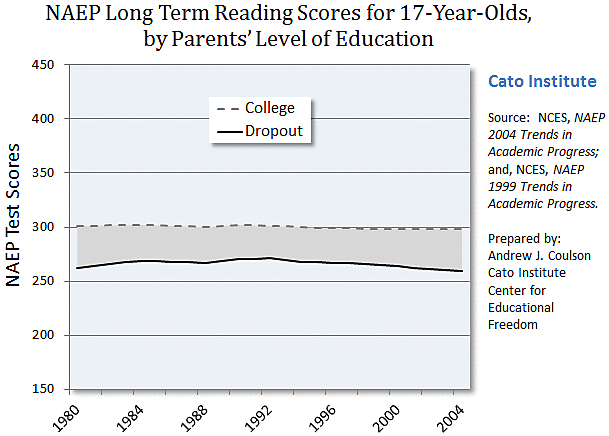
Those large-scale randomized studies of Head Start are not the only indication that federal government spending on pre‑K (and K‑12) programs is ineffective. We can also look at the performance gap, at the end of high school, between the children of high school dropouts and those of college graduates. This is the key gap—between children in advantaged and disadvantaged families—that federal compensatory education programs set out to close in 1965. Below is a chart I prepared just a few years ago, documenting that gap using the reading section of the best national data set available (the “Long Term Trends” series of the National Assessment of Educational Progress). The results are equally disappointing in math and science (see Figure 20.5, here).
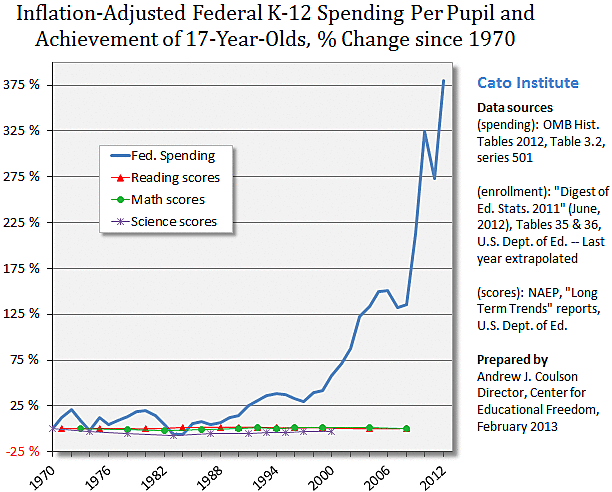
Nor should we be surprised by the failure of federal pre-K-through-12 programs to narrow this gap—they have failed just as badly in their other aim of improving overall student achievement, as the following chart of federal spending and student achievement at the end of high-school reveals.
Overcome by the sound of their own chorus, universal federal pre‑K advocates are deaf to this evidence. For the sake of the children they seek, ineffectually, to help, let’s hope they are unable to fasten their anchor around the necks of current and future generations of taxpayers.
Related Tags
Thanks, but I’d Rather Keep My Money under This Mattress
If his election rhetoric, or stories about tonight’s State of the Union, are any indication, this evening President Obama will talk a lot about “investing” in education. And that sounds nice, doesn’t it? I mean, who doesn’t want to wisely and profitably put money into the American people? The problem is, such federal spending has never been wise or profitable, unless the profit you seek is political points.
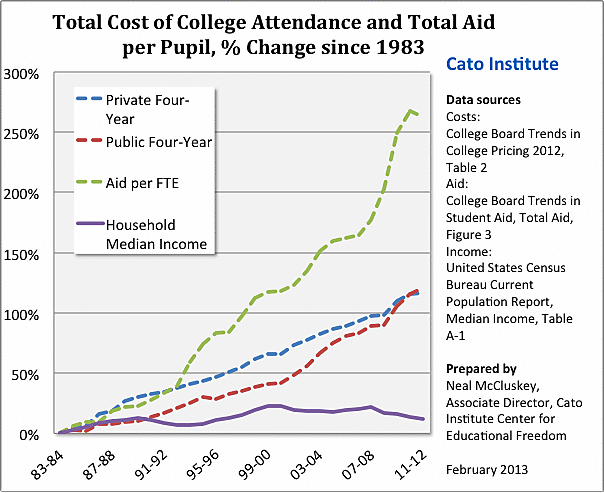
To demonstrate the dangerous folly of federal education spending, I offer the following chart on higher education. And shortly, Andrew Coulson will be delivering a damning graphic on k‑12.
What does this chart show? That inflation-adjusted student aid—the vast majority of which came through the federal government—has exploded over the last thirty years, but probably hasn’t made college more affordable. No, it has fueled a more than doubling of inflation-adjusted college prices, all while median household income has been basically flat. Schools have simply raised their prices to capture the aid.
That’s some investment: students and taxpayers are out bigger and bigger sums of money while colleges—and approval-seeking politicians who want to show how much they “care”—reap the big profits. Probably not the payoff most people had in mind.
Related Tags
Live Blog of the 2013 State of the Union Address and the GOP Response
Please join us at 9:00PM ET on Tuesday, February 12, for live commentary during President Obama’s State of the Union address, the GOP response by Sen. Marco Rubio, and the Tea Party response by Sen. Rand Paul. Here is our panel of policy experts by research area:
General Comment and the Presidency:
- David Boaz, Executive Vice President (@David_Boaz)
- Gene Healy, Vice President (@GeneHealy)
- Aaron Powell, Research Fellow and Editor of Libertarianism.org (@ARossP)
Banking and Financial Regulation:
- Mark Calabria, Director of Financial Regulation Studies (@MarkCalabria)
Infrastructure and Fiscal Policy:
- Chris Edwards, Director of Tax Policy Studies (@CatoEdwards)
- Tad DeHaven, Budget Analyst (@Tad_DeHaven)
- Daniel J. Mitchell, Senior Fellow (@DanielJMitchell)
Law and Civil Liberties:
- Trevor Burrus, Legal Analyst (@TCBurrus)
- Walter Olson, Senior Fellow (@WalterOlson)
Telecom and Information Policy:
- Jim Harper, Director of Information Policy Studies (@Jim_Harper)
Health Care:
- Michael Tanner, Senior Fellow (@MTannerCato)
Immigration:
- Alex Nowrasteh, Immigration Policy Analyst (@AlexNowrasteh)
Education:
- Andrew Coulson, Director — Center for Educational Freedom (@Andrew_Coulson)
- Neal McCluskey, Associate Director — Center for Educational Freedom (@NealMcCluskey)
Energy and Environment:
- Patrick J. Michaels, Director — Center for the Study of Science (@CatoMichaels)
- Chip Knappenberger, Assistant Director — Center for the Study of Science (@PCKnappenberger)
Foreign Policy and National Security:
- Malou Innocent, Foreign Policy Analyst (@MalouInnocent)
Follow their comments directly on Twitter, or come back to this page at 9:00 PM ET on Tuesday, February 12, to join us. We look forward to having you, and sharing our insights with you.
You can also follow the conversation on Twitter by following @CatoInstitute and the hashtag #SOTU.
Also watch Cato’s Libertarian State of the Union.
Related Tags
Prez to Double Down on pre-Kindergarten Flop?
According to the latest buzz, President Obama may suggest dramatically expanding federal government preschool programs in his State of the Union address next week. That, at any rate, is the recommendation of a new report from an institute closely associated with the admnistration.
There are just two problems with this plan: 1) it’s already been tried; 2) it doesn’t work.
We now have 45 years of experience with, and two top-quality randomized studies of, the national Head Start pre-school program, and the results are disappointing. Head Start was meant to close the gap in student achievement between the children of advantaged and disadvantaged families. But, at the end of high school, the gap in achievement between the children of college graduates and those of high school dropouts has remained essentially unchanged since the program was introduced. We have even more direct evidence from two large national studies of the program commissioned by the very agency that administers it: the Department of Health and Human Services. These studies find no significant benefits to Head Start at the end of the third grade–or even at the end of the first.
So why double-down on a failed program? The most plausible (and charitable) explanation is a bad case of wishful thinking. Many people make the mistake of improperly generalizing from two or three tiny pre-school programs of earlier decades which did show some lasting benefits. Sadly the federal government’s nationwide Head Start program has not replicated those benefits despite generations of unrelenting effort. And there is no reason to imagine that it will suddenly start doing so if expanded even further.
Trying to fix failed federal preschool programs by dumping more money on them is like trying to make up per-unit losses by increasing sales volume. Sadly, that’s about the level of economic acumen demonstrated by recent administrations.
Related Tags
Cato Scholars Speaking at Students for Liberty Conference — Join Us
The 2013 International Students For Liberty Conference, now in its sixth year, will bring over a thousand students and young liberty activists to Washington, D.C. to talk about ideas, hear from leading policy experts, and network with organizations and each other. I’m proud to have been the first speaker at the first ISFLC conference, in New York in 2008. This year, the conference will be hosted at the Grand Hyatt Washington Hotel, just three blocks from the Cato Institute.
I will be presenting two lectures that weekend, a session with Young Americans for Liberty on “The Ten Ways to Talk about Freedom” and a luncheon keynote in Cato’s Yeager Conference Center on Reclaiming Freedom: The Case for Libertarian Ideas in Mainstream Politics. Plus I’ll be on a special taping of the “Stossel” show.
Other Cato scholars will be speaking on policy issues throughout the conference. All of the below sessions will be taking place in the Hyatt’s Constitution room B.
| Saturday, February 16 | ||
| 10:00–10:45am | Restoring Constitutional Liberty | Roger Pilon |
| 11:15–12:00pm | Privacy Under Attack | Jim Harper |
| 12:10–1:20pm | Reclaiming Freedom: The Case for Libertarian Ideas in Mainstream Politics *Luncheon @ the Cato Institute* | David Boaz |
| 1:30–2:15pm | The Clone Wars: Fighting to Educate Free Individuals | Neal McCluskey |
| 2:45–3:30pm | A Foreign Policy for Advancing Liberty Abroad (without Undermining It at Home) | Christopher A. Preble |
| 4:00–4:45pm | Economic Growth and the Future of Liberty | Brink Lindsey |
| 5:15–6:00pm | How the Government Uses “Science” to Take Away Your Stuff | Patrick J. Michaels |
| Sunday, February 17 | ||
| 10:00–10:45am | How to Win Every Libertarian Argument | Jason Kuznicki |
| 11:15–12:00pm | Why Libertarians Should Care Much More about Immigration | Alex Nowrasteh |
To attend the student luncheon event, please register online or sign up for your ticket at the Cato booth at the conference exhibit hall.